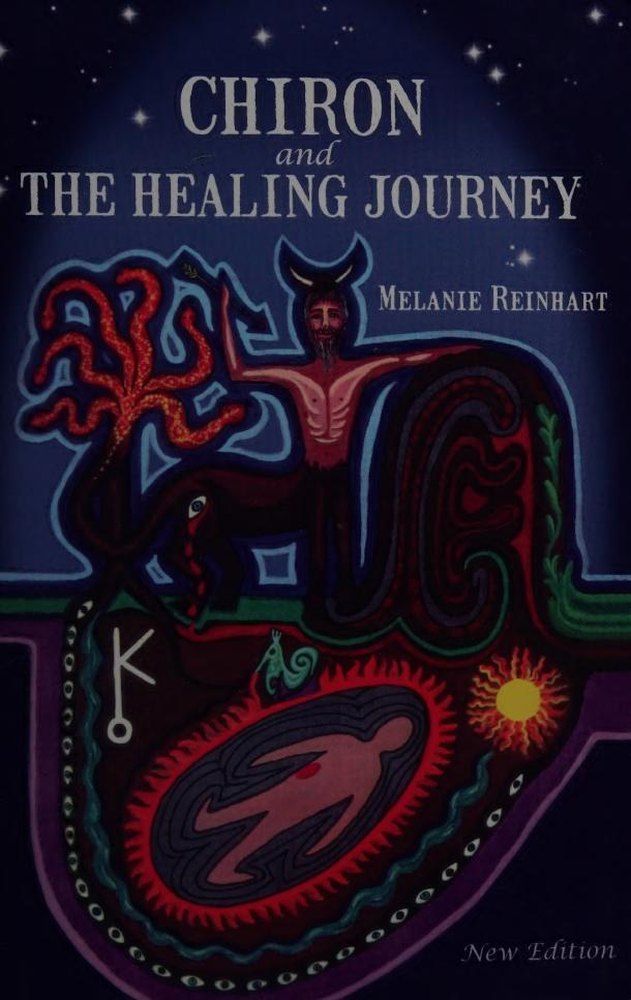
Chiron and the Healing JourneyAn Astrological and Psychological Perspective
Melanie Reinhart
A body discovered only in 1977, which speaks of the wounds we carry and what they teach us.
What We Can Do for Others
When a friend runs into trouble, you often know what to say and whom to go to, yet when something similar happens to you, you cannot sort it out at all. Melanie Reinhart, born in Zimbabwe and a professional astrologer since 1975, looks at this situation through a single heavenly body in Chiron and the Healing Journey, published in 1989. In the acknowledgements to the third edition she says that most of what is in the book she learned bit by bit over thirty-two years of listening to clients and students talk about their lives. In all those charts she saw that where Chiron falls is often the very thing a person can do for others but not for himself.
Often Chiron symbolizes things we can do for others, but which we may not be able to do for ourselves.
The myth offers a ready parallel. In Greek myth Chiron was half man and half horse, skilled in medicine, the teacher of heroes such as Jason and Achilles, and many people's wounds healed in his hands. He himself was struck in the leg by one of Hercules's arrows in a brawl. Being half divine, he could not die, and the wound never healed either; it stayed with him through a long life. Reinhart reads Chiron from this image: where in a person's chart the wound lies, how it keeps coming back, and how the person learns to live with it.
The book has four parts. The first is about astronomy: Chiron was discovered only in 1977, and its orbit at times crosses inside Saturn's and at times swings out near Uranus. The second is about myth, running from the shamans all the way to ancient Greece. The third, the longest, is about how to read Chiron in a person's chart, from its sign and house to its aspects with other planets to where it travels over a lifetime, and it ends by tying these together through several complete life stories. The fourth places Chiron within the events of eras and collectives.
One woman in the book has Chiron conjunct Mercury in Libra in the second house. At school, a classmate who had not done his homework asked her to write a story for him. She dashed one off and handed it over, and it got a higher mark than the one she had written for herself, which startled her. As an adult she always wanted to write, yet always felt she could not. Later she became an editor, and in that work her creativity and generosity came quite naturally; she was very good at understanding and supporting the authors she worked with. She would joke that what she needed was someone like herself in her own life. Mercury stands for writing and expression, and this was exactly what she could do well for others but not for herself.
A Newly Discovered Body
Dane Rudhyar once imagined a “Higher Moon” between Saturn and Uranus, and Charles Jayne predicted that a new planet would be found in 1975, with an orbital period of about 50 years. In 1977 the astronomer Charles T. Kowal found Chiron between Saturn and Uranus, only two years after the predicted date, with an orbital period of 50.5 years. It is larger than an asteroid and smaller than a planet, and its orbit is both elongated and tilted, so for a time astronomers did not know how to classify it. Astrologers were quick to connect it with the outsider and the loner; Reinhart calls it “the wanderer among wanderers”.
Howard Sasportas was the editor of the book's first edition. At the time hardly anyone in astrology knew much about Chiron, but he believed in this material and encouraged her all the way to a finished book. Reinhart says one sentence of Sasportas's sums up the book best:
Chiron is about the wounds that make us wise
That is, she looks not only at where the wound is but also at what a person learns from it. Sasportas also belongs to the lineage she describes. Reinhart sees the discovery of Chiron alongside the entry of depth psychology into astrology: an approach begun by Dane Rudhyar and carried forward by Liz Greene, Stephen Arroyo and Sasportas, and which she traces further back to the Centiloquy ascribed to Ptolemy and, later, to Marsilio Ficino. The “Wounded Healer” is the familiar image of Chiron; having checked it against real people, she adds another role, the Wounder. In myth Chiron was first rejected by his mother and later wounded by his own pupil Hercules, so in her view reading someone's Chiron means looking not only at where he was hurt and where he helps others, but also at where he may hurt others.
What she changed most was the way of reading. Chiron is not a planet, and she was unwilling to devise a fixed set of definitions for it. She preferred to watch how it unfolds, step by step, in a particular person, like a tracker in the wilderness who follows the trail quietly and waits for the animal to show itself. In her introduction she explains that the Chiron manifestations offered in Part III are not intended as a “cookbook” of “recipes” for interpreting Chiron; in her hands signs, houses and aspects are only a lens through which people can look at their own experience with care. She sets little store by diagnosing pain. What she cares about is how a person treats what he has been through, and what he makes of it. The third edition of 2009 was heavily revised, adding the new discoveries of the Kuiper Belt and a group of similar bodies, and giving more weight to the ancestral dimension. The basic meaning of Chiron, she says, has not changed much.
The Wound Was Not His Fault
In telling the myth of how Chiron was wounded, Reinhart makes a point of saying that the wound was not Chiron's fault. With her clients' wounds, too, she does not try to settle whose fault they were; she cares more about how the person has lived with them since. In her view, part of Chiron's gift for helping others came from his own pain:
Chiron suffered unceasingly from his wound, and his ability to help others was very likely increased by his continual search for relief.
She looks at her case studies in the same light. One mother in the book has Chiron in the first house, square a Saturn–Moon conjunction in the fourth. She had five children, the house was always in chaos, and she spent a great deal of energy being irritated and guilty about it, trying for years to get the household back in order. Only when she finally admitted she could not cope did it occur to her that she could pay someone to help. She had always had the money; it had simply never crossed her mind. Reinhart explains that Chiron in the first house gave her a stubborn independence that kept her from admitting she could not manage alone. Saturn and the Moon, in aspect to Chiron, carried the “shoulds” left by her family of origin, making her feel that keeping a whole family in perfect order single-handed was her duty, and that failing to do so was failure. Once she was willing to admit this “failure”, the simplest solution appeared of its own accord.
Nor does Reinhart conclude that the mother's efforts in the earlier years were wasted. She writes that whether a person's struggle is in vain is something an onlooker cannot really know, because we do not know what this person's Inner Teacher has in mind, or what the struggle is cultivating. So in her case studies the weight falls on helping the person see clearly what is happening now.
What Returns Is What Is Unfinished
Chiron's orbit passes in and out of Saturn's, and Reinhart uses this as a reminder that some things can be crossed in a single stride while others ripen only slowly, and repetition belongs to the second kind. Many people have one thing like this: they change jobs, they change the people around them, and it still comes back in much the same shape. Reinhart says that when people find a pattern recurring in their lives, and perhaps in earlier generations too, their first reaction is often anger and fear, followed either by hopelessness or by a resolve to fight it to the end, and neither reaction goes very deep. Her principle is simply put:
something returns or repeats only when it is ‘unfinished’.
Seen this way, repetition is something still waiting for you to finish it, and there is no need to keep wrestling with it. Sometimes a relationship or a career has in fact run its course, and a person is still holding on with all his strength. Reinhart says such a struggle is protecting something already dead; what is needed then is to mourn it properly and let it go. If a person cannot let go, other parts of life may lose their vitality along with it.
The Chiron Return is another thing one can prepare for in advance. Chiron takes about fifty years to circle the Sun, so the Chiron Return always falls in the year after one turns fifty. In the nine months or so before the return, past events often come back one by one, asking to be thought about and felt again. Reinhart says that this is when people begin to think seriously about the end of life:
The Chiron Return poses the question: ‘What am I going to do with the last part of my life?’
So she suggests leaving more time for solitude in this period, and time for mourning as well. Some wishes can no longer be fulfilled in their original form; only by setting them down can one's strength go into the stretch of life that lies ahead.

Chapter by Chapter
Chapter 1: Our Changing Solar System
Before Chiron was discovered in 1977, it could be traced back on old observatory plates to the 1890s. It had been there all along, but no one had noticed it; Reinhart suspects that collectively we were not yet ready. In the early 1990s the Kuiper Belt was discovered, along with a group of bodies that behave much like Chiron. They were named “Centaurs”, and Chiron was recognized after the fact as the first of them, their prototype. She writes that Chiron, once alone as a celestial anomaly, has now been rejoined by his tribe.
This chapter discusses the second Centaur, Pholus, discovered in 1992, with an orbit of about 90 years. In myth Pholus guarded a jar of wine belonging to the god of wine, a jar not to be opened for four generations, so Reinhart links it with what our ancestors left behind. Sometimes a concrete act is needed, such as forgiveness, or laying flowers on a forebear's grave; more often it is simply acknowledging in one's heart the suffering one's forebears went through.
Chapter 2: Shamanism
The second chapter looks for Chiron's roots in still earlier times. Chiron's lower half is a horse, and the horse appears in the shamanic rites of many cultures; like the shaman, it is a bridge between the visible and the invisible worlds. An unbridled horse symbolizes frenzy; bridled, it is instinct guided by consciousness. Reinhart describes how a person is called to become a shaman. The call usually comes with an illness of body or mind; the person must leave ordinary life and go through a long ordeal, and then must return to the community and work on its behalf, and only with the community's recognition is he truly a shaman. She also cautions that going through such an ordeal does not necessarily mean a person will go on to make helping others a profession; it is more like the beginning of that person's awakening.
Chapter 3: Classical Greek Mythology
Chiron was born half man and half horse. His mother was horrified at the sight of him and begged the gods to turn her into anything at all, so long as she need no longer be the mother of this monster, and the gods turned her into a linden tree. Chiron was abandoned, later found by shepherds and taken to Apollo, who raised him. Reinhart says that Chiron's individuality was established through rupture and exile.
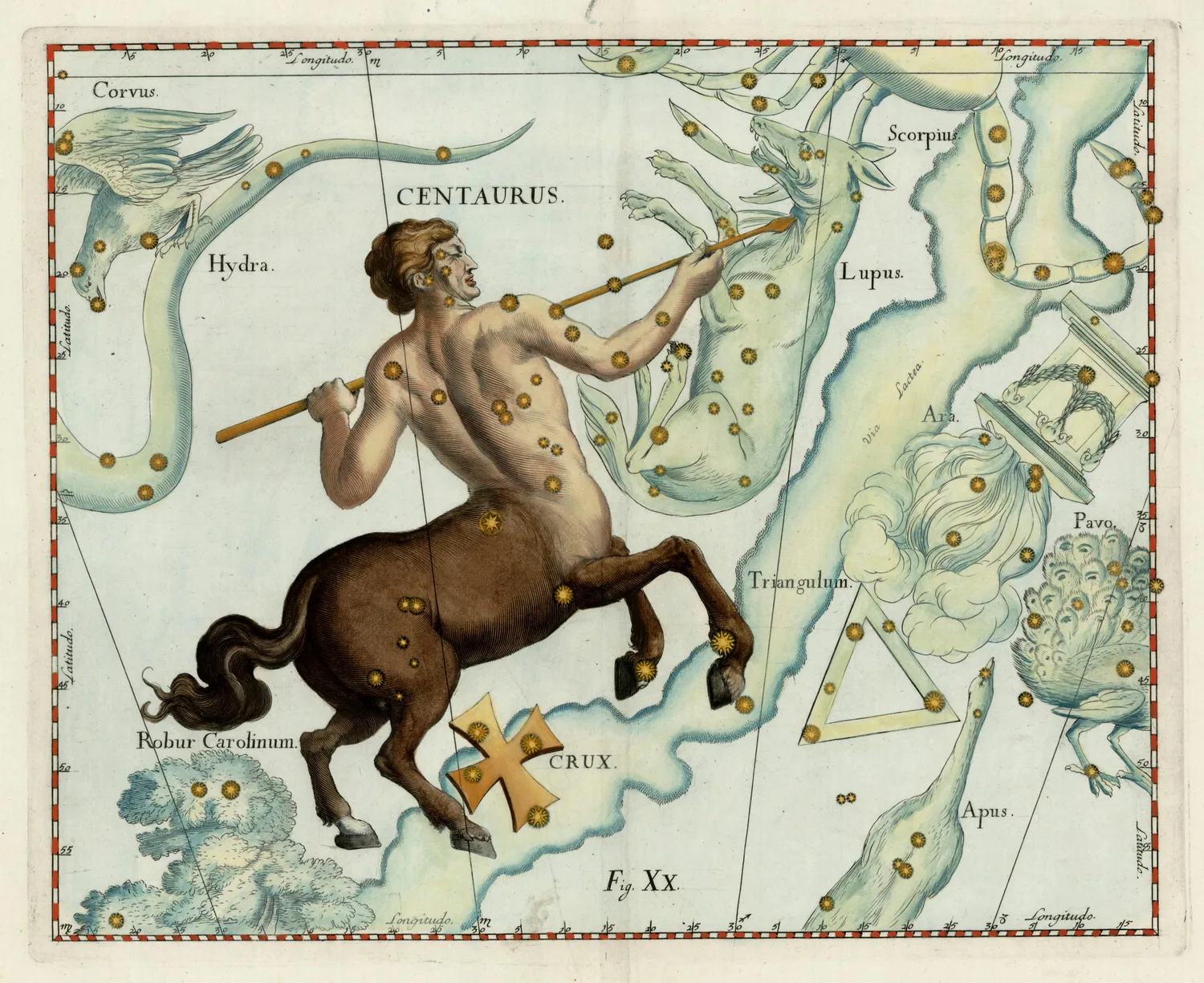
The heart of this chapter is how Chiron was released from his pain. Prometheus had been chained to a rock by Zeus for stealing fire, and Chiron agreed to take his place. He died, and nine days later Zeus raised him into the sky as the constellation Centaurus, just above the Southern Cross, often used to find one's bearings. The condition of Prometheus's release was that he wear a ring forever, to remind him of the time he was chained, and to remind us of the need for proper limits. Reinhart takes Hercules as the model of the hero and says that Chiron's path begins where the hero stops. In other words, however great one's abilities, some things cannot be achieved by effort; what a person can do is prepare the conditions for them.
Chapter 4: Chiron's Themes
From Chapter 4 on, the book turns to chart reading. Reinhart begins with a checklist for the “Chiron Configuration”: the sign and house Chiron falls in, where the ruler of that sign is placed, and then on through the ruler of the sign that planet occupies. Orbs for aspects can at first be set at those used for Saturn, starting with the most exact; the more exact, the clearer the theme. She calls this following the trail, and reminds us that at every step you must go back to look at the person's real life.
The chapter goes on to discuss several common Chironic themes, and the section on repetition has an example. A woman with Chiron in Virgo in the eleventh house was afraid of being in groups; from workshops to reading circles, and later even ordinary gatherings, groups frightened her more and more. In a group she either withdrew to the edge or became the one who always said “But what about …”, and in the end she felt she was not accepted. During a period of psychotherapy she saw that this was exactly how she had been at home: her family valued emotional control and “proper” standards, and the deepest part of her had never been seen. Once she got in touch with her anger at her family, and with the need to be accepted that lay beneath it, the repetition gradually stopped. When transiting Chiron reached the waning square to her natal Chiron, she began training to lead groups, teaching handicrafts to people recovering from surgery.
Chapter 5: The Question of Rulership
As to which sign Chiron rules, some hold that it is a maverick and cannot be pinned to any one sign, while others propose Virgo, Libra, Scorpio or Sagittarius. Reinhart does not settle the matter here; she explores its symbolism, and says Chiron is a helper in times of transition. The part of this chapter closest to chart reading is Chiron's orbit. Its closest point to the Sun is in mid-Libra and its farthest in early Aries, and while it moves from Leo to Sagittarius it is inside Saturn's orbit. Reinhart observes that people whose natal Chiron is inside Saturn's orbit are more defensive and reactive, apt to feel that hurts are aimed at them personally, even to identify with the role of victim, and must work harder to see the larger picture. Those with Chiron outside Saturn's orbit see the larger picture naturally; what they must learn is to remember to come back to their own personal feelings and thoughts.
Chapter 6: Chiron by Sign and House
Here the twelve signs and their corresponding houses are discussed together. Reinhart says this is a compromise forced by space, and that signs and houses are not therefore equivalent. She also explains that these descriptions do not prescribe how Chiron must, or “should”, show itself.
With Chiron in Libra or the seventh house, for instance, relationship is the most important thing, and in relationships a person meets Chiron's various faces again and again. Those with Chiron in the seventh tend unconsciously to play a role, the wounded one, say, or the helper, and then attract people who stand on the other side. Reinhart says that looking at what kind of people you are always drawn to, and what kind you always attract, will show you a good deal about yourself. If those around you are always people who need looking after, it may be that you have a failure of your own you have not yet admitted, or that you need them in order to feel strong.
With Chiron in Capricorn or the tenth house, a person may find it hard to settle on goals or find a place in society, and the vocation comes late, after several false starts. With Chiron in Capricorn, the wound may lie in the relationship with the father. Many people resolve as children, “I’ll never be like my father,” and only later discover that they have lived out, in another form, the very traits they most disliked in him. Reinhart also writes of what this placement gives: a success that comes from deep acceptance of oneself, and an authority that commands respect without relying on outward achievement.
Chapter 7: Chiron in Aspect
Reinhart starts from the word “aspect” itself, whose Latin root means to look, and also to be looked at. When Chiron makes aspects to the planets from the Sun to Saturn, it often points to a blind spot, much like the situation described at the start: what one can do for others, one cannot do for oneself. When Chiron aspects the Moon, for instance, the theme is often the mother. Some people became caretakers very early, even looking after their own mothers, and later get stuck in the role of “Super-Mother”, because stepping out of it means meeting the pain and anger underneath, and the care they never got enough of. With Chiron in aspect to Mars, a person may be busy all the time, unable to stop, yet not feel fulfilled. Reinhart suggests asking yourself: what am I really trying to achieve, and for whom am I doing it?
This chapter also gives astrologers a particular reminder. Between 1952 and 1989 Chiron and Uranus were in exact opposition about 41 times, so Reinhart regards it as a generational aspect shared by everyone born in those thirty-seven years, and most people who come to an astrologer carry it. She says this aspect can carry a person's thinking beyond either-or toward newer and more inclusive ways.
Chapter 8: Kairos: Transits of Chiron
The original title of this chapter uses the Greek word kairos, meaning the right moment, the point where eternity intersects with clock time, when people often have a sense of “so that's it”. Reinhart says that Chiron transits differ from a purely Uranian experience: they also ask a person to face inner obstacles, and only when those obstacles have been contained, understood or released can the experience truly become one's own.
A few months after her mother died, a client named Mandy was frightened by the intensity of her own grief, and in 2002 she came to ask whether astrology could shed any light on it. Mandy's natal Chiron was conjunct the Moon in Capricorn in the tenth house, opposite Uranus in Cancer. Reinhart laid out her transits after the Chiron Return and found that about three weeks after her mother's death, transiting Chiron was exactly opposing her natal Uranus. Then she realized that the same sequence had occurred soon after Mandy's birth: in 1952, when Mandy was about nine months old, transiting Chiron had likewise made an exact opposition to natal Uranus. Mandy said that was roughly when her younger sister was conceived. From then on her mother's attention moved away from her, and she began to push down her own feelings and needs so as not to be a burden to her mother. Fifty years later her mother died, and the ordinary mourning was mixed with the feeling of being abandoned at nine months old, which is why it was so intense. Once this layer was seen clearly, her present grief had a source.
Chapter 9: Chiron in Context, Chapter 10: Chiron and the Collective, and the Epilogue
Chapter 9 uses three complete life stories to show how to read natal Chiron together with a lifetime of transits. Here Reinhart values a cross-generational view: looking at where the Chiron of one's parents and grandparents falls often reveals the blessings and difficulties that will pass to the next generation. She writes that, with regard to our past, we are less bound by it than called to bear witness to it.
Chapter 10 reads Chiron within collective events and eras, and the author herself says this is only the tip of the iceberg. The Epilogue is short and comes back to each individual: just as Chiron crosses Saturn's orbit again and again, a person meets his own fears and rigidities again and again, and the turning point, Reinhart says, lies wherever one's attention is in the present moment.
How to Read This Book
At the start of Chapter 6 Reinhart offers a way of reading: first read the section on the house Chiron is in, then the section on its sign, with a journal at hand to write down whatever comes up as you read. If you are starting from your own chart, follow this and begin with Chapter 6. Then read Chapter 4 and see which themes are most evident in you; she herself says that not all the themes in the book will appear in any one person. If you want to know about timing, read Chapter 8 next, lay out your own past Chiron transits, and compare them with the turning points of your life. The astronomy of Part I she hopes readers will take in with a poet's eyes and ears, and the mythology of Part II she treats as a store of images and stories; readers eager to get to their charts can leave these until later.
The book has its difficult side. It is long, with a great many famous people and case studies. Reinhart's language is strongly coloured by meditation and shamanism and often turns to Buddhist practice, which some readers will find remote from their own lives. She deliberately avoids fixed definitions, and she discusses signs and houses together, so readers looking for a single definite answer will find it unsettling and will need to check it against their own lives. Chapter 10, on collectives and eras, contains much of the author's personal view and is further from reading your own chart, so it can be left until last.
What Reinhart did for Mandy, Your Chiron in Depth does with your own chart: it lays out the moments since your birth when Chiron reached its key angles, all the way up to the Chiron Return around fifty, with the dates calculated precisely by the program. You can set these years against the turning points of your own life, and also see which places in your chart transiting Chiron will pass over in the next five years. The report also reads the sign and house of your Chiron together, to see how the place where you were hurt has also become the place where you can help others, and where you always feel like an outsider, and it ends with how to live with this Chiron. It reads only this one place, Chiron, the part of your chart where you were wounded and where you can best understand others; the rest of the chart needs to be read separately. As Reinhart says in her introduction, to truly understand Chiron, each of us in the end has to make the journey with it ourselves.
 Your Chiron in DepthSee report · $19