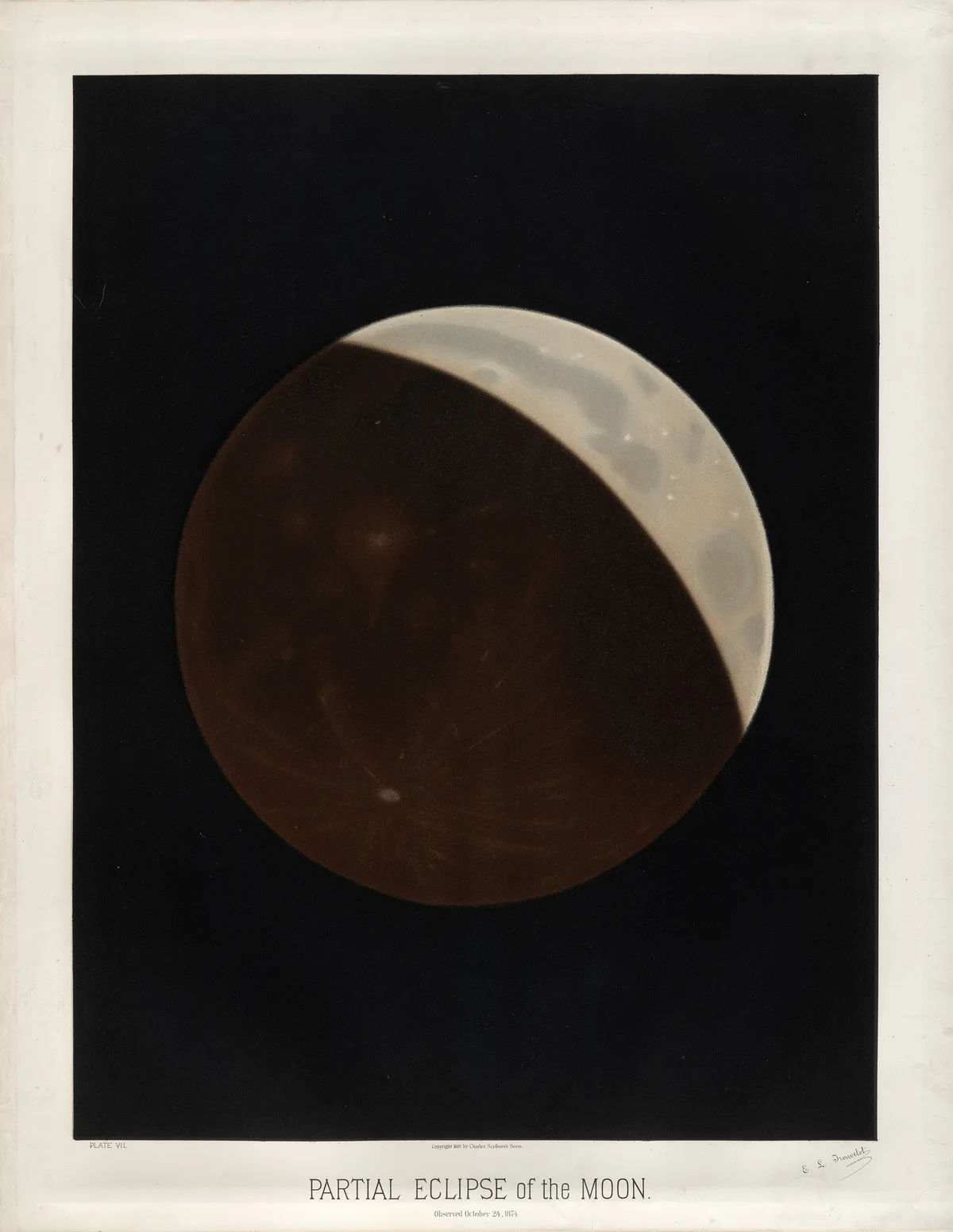
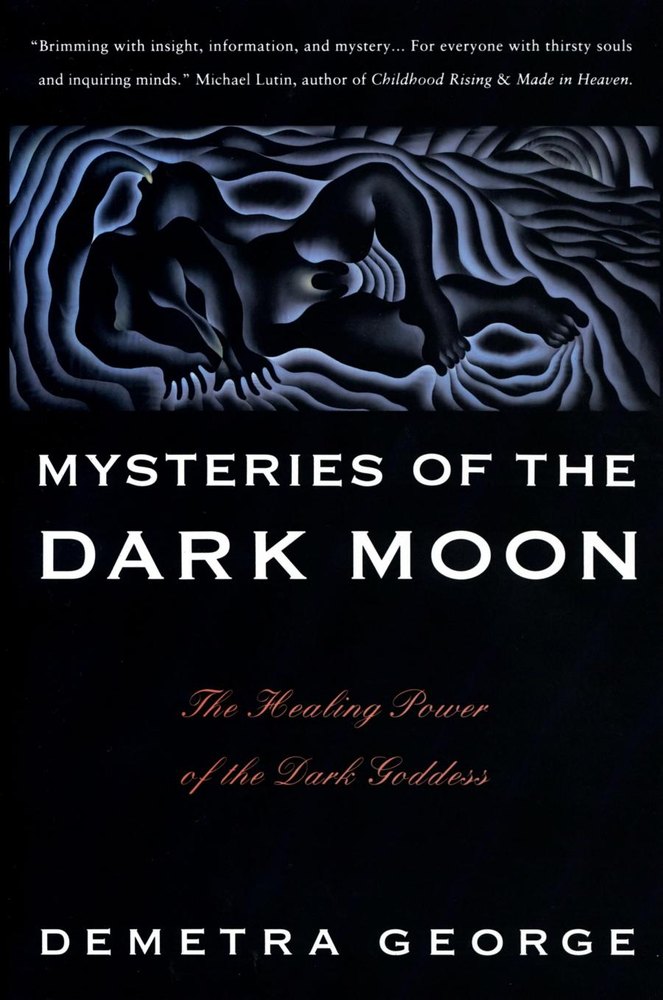
Mysteries of the Dark Moon
Demetra George
The three days before the new moon, when the Moon cannot be seen, come in a human life too.
The Three Days the Moon Cannot Be Seen
In the weeks before a birthday, many people quietly keep track of who remembers them this year and who forgets. When the day comes, however lively it is, it always falls a little short of what they were secretly hoping for, and the next day comes almost as a relief. Demetra George writes about this mood in Mysteries of the Dark Moon, published in 1992, calling the month before a birthday the dark moon phase of our yearly age cycle. After middle age, birthdays gradually stop being something to look forward to: one is a year older, and some wishes are still unfulfilled, so in this month people easily feel lonely and low. George goes on to explain that at this time there is naturally less energy for dealing with the outside world and meeting other people's expectations, because the purpose of the dark moon is to turn our attention back to our own bodies and minds.

The dark moon originally means the three days before the new moon. The Moon grows thinner day by day until it disappears entirely. George reminds her readers that the moonlight we usually see is sunlight reflected back from the Moon, and so she writes:
the dark moon is in a sense the moon's true face
The Moon is there all through those three days; we simply cannot see it. George applies this to everything that has a beginning and an end. Within a day, the dark moon is the darkest two hours before dawn; within a year, it is winter. In a human life, when a relationship, a job, a home or a belief comes to its end, the old is gone and the new has not yet appeared, and the person is walking in the dark moon. In her view the dark phase of any cycle is a passage between the ending of the old and the beginning of the new, a time to withdraw, rest and dream of what is to come. It may last only a few days, or several years.
On winter, her example is the month before the holidays at the end of the year. Its days are the shortest of the year, and by the rhythm of the seasons people ought to be drawing their energy inward, resting and reflecting. Yet in this month people rush to the shops every weekend, spend more than they can afford, wrap presents and go from one party to the next. George says that the dark side is painful often because people are moving against the rhythm of the cycle.
The whole book is built around such times, in three parts and nine chapters. The first three chapters deal with the dark moon itself, the dark moon goddesses of the ancients, and a long history of women and the Moon. The middle three take one figure each: Nyx, goddess of night, Medusa and Lilith. The last three return to human life: the lunar phases of a woman's life, the myth of a mother and daughter, and, in the final chapter, how a person recovers from the darkest stretch of the Moon and finds firm footing again. At the start of the first chapter George says that, with luck, what readers find in this book may help them let go of some of their fear of the dark.
The House That Makes Astrologers Frown
When astrologers see a planet in the twelfth house, they often frown first. George writes about this reaction in the second chapter, saying that the twelfth house is the dark moon of the circle of houses. The fear of the dark is old. Plutarch, in ancient Greece, already said that the waxing moon is of good intent, while the waning moon brings sickness and death. George believes the earliest peoples knew that the power of life lay hidden in the Moon's darkness; only after thousands of years, when this was forgotten, did people begin to fear it.
For the lunar phases she uses Dane Rudhyar's lunation cycle. Rudhyar recovered the ancient eightfold division of the Moon's phases and described the character and function of each phase through the growth of a plant from sprouting to seed; George also cites his The Lunation Cycle in her notes. For the side of ourselves we push away, she borrows what Jung called the “shadow”: the traits a person, shaped by culture, feels he should not have and must not show, which are driven into the unconscious and become the shadow. She also often cites Esther Harding, who says that although the waning crescent's path leads downward, it may also lead to a person's transformation.
What George changes is to widen the dark moon from three days a month into a set of positions in the chart and a set of times. In the fourteenth note to the first chapter she lists them: the balsamic phase in the natal and progressed charts, that is, the stretch when the Moon is within 45 degrees behind the Sun and about to catch it up, along with the void-of-course Moon, lunar eclipses and the twelfth house, all belong to the dark moon. Transits of Pluto to sensitive points in the chart, transits of planets through the twelfth house, and the last year of any planet's return cycle, such as the year before the Saturn return, also carry a dark moon quality. As the bodies that represent the dark moon she names Pluto, the several bodies called Lilith, and a few asteroids named after dark moon goddesses. In the same note she announces a companion book that would teach beginners to find their own dark moon periods in the birth chart; it was published in 1995 as Finding Our Way Through the Dark.
Another of her methods is to read myth and astrology side by side. At the start of Part II, George describes something she has seen again and again in her years as a mythologist and astrologer: when a particular body is prominent in the sky at a person's birth, the story of the god or goddess who shares its name becomes a theme of that person's life. Several bodies in the asteroid belt are named after dark moon goddesses, so Part II takes up these figures. She had earlier written Asteroid Goddesses, and when this book discusses the three Liliths, the notes point to that one.
When Nothing Seems to Be Happening
There are times when you feel yourself drawing entirely inward, and nothing will move forward. George does not treat such times as something gone wrong. Looking back, she says, these fallow periods are often the seed sprouting underground, and what follows is a burst of new creativity and growth. Darkness comes before light, she says, as sleep comes before waking; only after sleep do we have strength again. If you have been through a time when, asked how things were going, you could only say “still thinking it over”, while blaming yourself all along for standing still, these lines of hers are about exactly that kind of time.
She looks the same way at the unlovely side of a person. What we call the “demons” within us, George says, are not evil by nature; it is the pressure of the individual and the culture together that has twisted them into that shape.
The dark becomes frightening and destructive only when we deny and disown it.
The part of ourselves we push away does not disappear. It may burst out when we are most tired and under the greatest strain, or it may be projected onto other people. So the direction she offers is first to acknowledge it.
Chapter 5 has an example many people will recognize. Someone who fears being looked down on or bullied puts on a cold, hard face first, so that others will not dare come near. George calls this donning the Gorgon's mask. Beneath the mask the person is soft and sensitive, but others see only the face and grow less and less willing to approach her; she feels ignored and shut out, and her face sets harder still, often without her knowing how cold her gaze has become. Because this guard grows out of fear, the first step George offers is a small one: recognize the wrathful face you present to others.
What Goes in the Seed Capsule
When something has wound down and reached its end, George asks you to do something very practical: take stock. Describing the third step out of the dark moon in the last chapter, she says to prepare a “seed capsule” for the next cycle and put into it the essence of the one just ended. In concrete terms, this means looking back and asking yourself what you learned this time round, what more you know about yourself and others, where you are still deceiving yourself, which abilities, knowledge and strengths remain, and what you are willing to put your effort into from now on.
She also gives an exercise. First imagine what you would most like to do if limits such as money, qualifications and age did not exist, and let your imagination go as far as it will. Then look at which of these could actually be done, and find out: when the course starts, what it costs, what qualifications it needs, whether there is such work where you live, whether you would have to move. She is careful to add that this is not yet the time to act; for now, simply find out. If a job has just ended, for instance, you need not rush to send out your CV. First write down the abilities these years have given you, then ask when the course you have always wanted to take begins. That is preparing the seed capsule.
George also discusses the word “crisis”. The English crisis comes from the Greek krino, to decide, so a crisis means only that the time to make a decision has come. She goes on to say that every opportunity for change arrives in the form of a crisis, and if a person does not decide, old habits sink one layer deeper.
Chapter by Chapter
Chapter 1: The Dark Moon
The first chapter divides a cycle into three stages: the new moon is intention, the full moon is fulfilment, and the dark moon is release. George's example is a house. A couple form the idea of saving to build a house in which to raise children: that is the new moon. The house is built, the family moves in and makes it a home, and the children grow up there: that is the full moon. Later the children grow up and leave, and the old couple can no longer manage so large a house; neither money nor strength is enough. Now it is time to sell the old house and move somewhere simpler and more suitable. That is the dark moon.
Nothing went wrong with the house; it simply completed its purpose. When a form has been used up, George says, it must be taken apart, so that the energy within it is released and can be used to make something new. She also says in this chapter that the Moon itself does not change, only its light; the phases we see are really the changing relationship between the Moon and the Sun.
Chapter 2: The Dark Goddess
The ancients imagined the Moon's three phases as three goddesses: the new moon the maiden, the full moon the mother, and the dark moon the crone, which George says also correspond to the three ages of a woman's life. The old one originally ruled over death and renewal; later cultures feared her and painted her as something terrible. George writes this history at great length; the part of the chapter that really comes down to human life is the later section on the shadow.
She cites an idea from Edmond Whitmont: ask a person to describe the kind of person he finds hardest to get along with, and what he describes is often the traits he has pushed down in himself and refuses to admit. If you cannot stand a colleague who speaks bluntly without regard for anyone's feelings, for example, you might ask yourself whether you have always forbidden yourself to speak that way.
Chapter 3: A Lunar Her/Story of the Feminine
This chapter is George's own speculation; she says the idea came to her on walks along the Oregon coast, where she lives. Her question is whether the goddess's retreat from culture over the past five thousand years might be the goddess's own cycle reaching its dark phase, withdrawing to rest, and now reappearing in a new phase.
Following this idea, she does a calculation. Taking these five thousand years as the balsamic phase, which is one eighth of a cycle, the whole cycle comes to forty thousand years, reaching back to the beginning of the Upper Paleolithic. She then lays the great ages of precession over this, saying that we are now at the handover between the end of the Age of Pisces and the start of the Age of Aquarius. She is quite clear herself about these calculations:
I offer them to you not as irrefutable fact, but rather as insights to ponder in the attempt to revision the dark.
So read the forty thousand years and the precession in this chapter as one astrologer's associations. More useful to students of astrology is the chapter's table of the eight lunar phases: new, crescent, first quarter, gibbous, full, disseminating, last quarter and balsamic. The table gives how many degrees separate the Moon from the Sun in each phase, and what stage of a plant's growth it resembles.
Chapter 4: Nyx, Goddess of Night, and the Daughters of Night
Part II begins with Nyx, goddess of night. In the Orphic creation story of ancient Greece there was at first only a boundless void, and Nyx was the first deity to rise from it. George takes care to explain the word “chaos”: its original meaning is simply the boundless void, with no sense of disorder, and black stands for the state before form, from which all forms come. Her daughters, the Fates, the Furies and Nemesis, originally guarded the order of the cosmos.
The second half of the chapter is about Hekate. She stands where three roads meet, her three faces looking in three directions at once, so that she can see behind and ahead at the same time. George says she also stands for a time of sinking down: quiet, still, alone, as if nothing were happening. Western culture prizes action and output, and calls such times being stuck, spacing out, going numb. George compares it to the tide: between ebb and flood there is slack water, when the sea hardly moves, and such a pause usually comes just before trapped energy begins to flow again. In her view, this still pause is exactly Hekate's contribution to a person's slow growth.
Chapter 5: The Serpent-Haired Queen Medusa
In the usual story Medusa is a monster, and one look at her turns you to stone. George first returns her to an older tradition. In Libya, Athena, Metis and Medusa were the three aspects of one goddess: Athena the warrior maiden of the new moon, Metis the mother of the full moon, whose name means “wise counsel”, and Medusa the crone of the dark moon, keeper of women's wisdom. That frightening serpent-haired mask was originally meant to guard secrets and frighten outsiders away.
Readers who study astrology will notice one star in this chapter. Algol, in Perseus, is called the Demon Star; on star maps it is the eye in the head of Medusa that Perseus holds in his hand. It is two stars orbiting each other, and at intervals the dark one passes in front of the bright one, so that it seems to blink slowly. The ancients said it was the severed head still blinking.
Chapter 6: The Dark Maid Lilith
The Lilith chapter has the most concentrated astrology. George first says that in myth there are three Liliths: the young maiden, the one who became a mother, and the ancient crone, matching the new, full and dark phases of the Moon. Then she says that there are also three bodies in the night sky called Lilith. One is the asteroid Lilith. One is the disputed Dark Moon Lilith, which some say is a second satellite of the Earth. The third is the Black Moon Lilith, which she defines as the empty focal point in the Moon's orbit around the Earth; it is a point, not a body. George says that the positions of these Liliths in the birth chart point to the inner journey a person must make when Lilith becomes a prominent archetype in that person.
She divides that journey into three steps. In the first, the person stands up and will no longer be held down, demanding equality in relationships, at work and at home; George writes that she would rather have no relationship than a bad one. In the second, she is cast out, alone in the wilderness, disappointed and angry, the fire inside her finding no outlet. The third is in the darkest place, where the blade in Lilith's hand pares away, one by one, the layers covering the true self.
The black aspect of Lilith closes all the wrong doors that face us.
George goes on to say that Lilith leads a person toward the goal by removing everything that is not the goal. Several applications or several relationships fail one after another, for instance, and only looking back do you see that those directions were never right for you.
Chapter 7: The Dark Goddess as the Muse of Menstruation and Menopause
This chapter is about the lunar phases of a woman's life: the maiden is the new moon, motherhood the full moon, and gradually becoming the crone is the dark moon. George says that entering this last stage is not necessarily a matter of age. The last child leaving home, becoming a grandmother, retiring from work, the death of a parent or a partner: any of these may be the moment. Her measure is this: when a woman who has spent many years attending to children, family, partner or career can at last think about what she herself needs, she has entered this stage.
In earlier cultures such older women were respected, and people in trouble went to them for counsel. Later their image was recast as old and ugly, and in this chapter George wants to reclaim “old” from that picture. The dark moon goddess, she says, does only one thing: she destroys the old for the sake of renewal.
Chapter 8: The Initiation Mysteries of Demeter and Persephone
For two thousand years the ancient Greeks held mysteries around the story of this mother and daughter. Everyone who took part swore to secrecy, and to this day no one knows what was actually done there. What George values is the story itself. The daughter, Persephone, went to the underworld, and her mother, Demeter, searched for nine days and nine nights with a torch, without eating or washing.
She reads the story as the separation every mother and daughter go through. For the mother, a child's leaving seems to take part of herself away too, and the empty house is the beginning of her dark moon; she must move from the stage of mother to that of the crone. For the daughter, George's view is that Persephone found herself in the very moment she lost her mother. She also says that Persephone is the moment when the Moon turns from dark to new. If you are a daughter who left home years ago, or a mother whose child has just left, this chapter is about both sides of the parting.
Chapter 9: The Healing Power of the Lunar Darkness
The last chapter divides the way out of the dark moon into three steps and matches them to the three outer planets. In myth Uranus is the sky god, sometimes appearing as lightning; he corresponds to the sudden breaking of a form, when a relationship, a home, a job or a belief can suddenly no longer hold. What this step teaches is letting go, because the harder one clings to the old form and denies what is happening, the greater the force that breaks one apart.
Neptune is the god of the sea and corresponds to dissolving and washing clean. At this time a person feels that past identities and supports have all gone, and is lonely, exhausted and in a daze all day; what to do is withdraw, rest, cry it out and open the heart. George says this step leaves a person with compassion for others: once the heart has broken, it has also opened. Pluto is the god of the underworld and corresponds to growing back. A person goes into the part of himself he has pushed away and refused to own, and meets a great power, which can be used to hurt others or to change himself and build a new life. The seed capsule described earlier is prepared in this step.
In the book the three steps are called disintegration, purification and regeneration. George says she sets the steps out so that people can understand what is happening as they go through the dark, and have faith in the renewal that follows.
How to Read This Book
The astrology in this book is scattered in a few places: the fourteenth note to Chapter 1, the observation from her practice at the start of Part II, the Lilith chapter, and the three outer planets in the last chapter. Students of astrology can begin with Chapters 1 and 9, to get clear on what the dark moon is and what the steps out of it are, and then read the Lilith chapter. Each chapter ends with a few Journal Questions asking how you see darkness and how you face change and ageing; after a chapter, pick one or two and write your answers.
The harder reading is in the other chapters. Chapters 2 and 3, and 7 and 8, deal mostly with goddesses, the history of women and changes in religion. George's position is very clear-cut, and she is severely critical of patriarchal culture, of certain male scholars and of the medical establishment; these can be read as one author's views. The forty-thousand-year cycle and the precession in Chapter 3 are, by her own account, speculation. Nor does the book go sign by sign or house by house through Lilith or the twelfth house; the method for finding dark moon periods in the birth chart she left for the later companion book.
What that companion book sets out to teach is finding your own dark moon periods in the birth chart. The report Your Dark Moon in Depth does this in your chart. Following the positions and periods listed in that note to Chapter 1, it looks for them one by one, telling you which lunar phase you were born in and where your twelfth house and Black Moon Lilith fall. Among the periods, it begins with the progressed balsamic phase. Each day after birth corresponds to a year of life, and the progressed Moon circles the progressed Sun in about thirty years, spending a little over three of them in the balsamic phase. The report covers whichever of these stretches apply at your age. For those already past, it gives the ages from and to, and asks you to think back on yourself at that time. For one under way or still ahead, it gives the year and month it begins, and discusses where your energy is best placed in those years.
The three steps of Chapter 9 are also placed in specific years. If in these years Uranus, Neptune or Pluto touches a personal planet such as your Sun or Moon, or your Ascendant or Midheaven, the report says which point is touched, from what year and month, and whether this is a step of breaking apart, dissolving or growing back.
This report reads only the positions and periods in your chart that belong to the dark moon, explaining where a low point comes from and when it passes; for the full picture of character, career and love, you need a reading of the whole chart. The month before each birthday is calculated precisely by software, and the report gives the date the next one begins, so that when it comes you can leave those weeks a little looser.
 Your Dark Moon in DepthSee report · $19