
The Gods of ChangePain, Crisis and the Transits of Uranus, Neptune and Pluto
Howard Sasportas
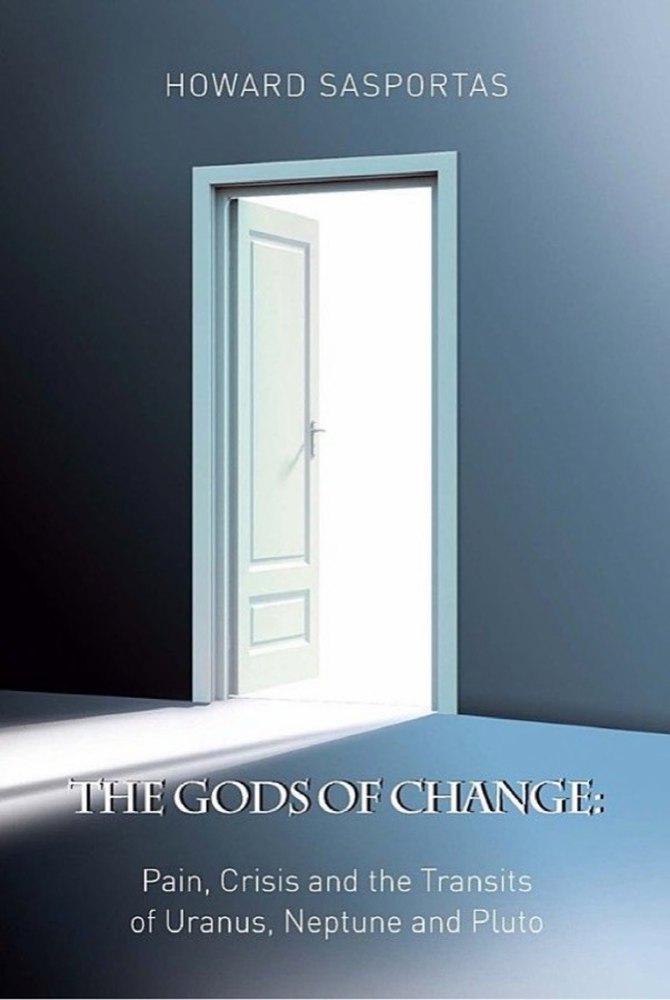
How a person can make it through the years when the three outer planets turn life upside down
When Life Slips Out of Control
Howard Sasportas was often asked what kind of people come to see an astrologer. Some come out of curiosity, he said, and some want to see whether the chart can help them make better use of their potential, but in his experience most people come because they are in the middle of some crisis. A relationship has gone wrong, there is trouble at work, they cannot get along with their children or their parents. Their usual ways of solving problems no longer work, they feel life has slipped out of their control, and so they pick up the phone and call an astrologer.
He found that such periods mostly corresponded to important transits or progressions of Saturn, Chiron and the three outer planets. The Gods of Change: Pain, Crisis and the Transits of Uranus, Neptune and Pluto, published in 1989, deals with Uranus, Neptune and Pluto among them. The three planets bring different kinds of trouble, but they have one thing in common: none of them lets a person stay as he was. In his introduction Sasportas puts the question another way. Faced with pain and crisis, people always ask first how to avoid them; what he wants to ask is how to understand these periods and how to use them creatively.
The book treats Uranus, Neptune and Pluto in turn and ends with three case histories. It can be used simply as a reference for reading outer-planet transits, but Sasportas hoped readers would come away understanding a little better how a crisis can become an opportunity.
The first of the case histories is Betty. She married in 1975, and two years later left her job in public relations to pursue what she had always wanted, to become an actress. She wanted to establish herself in the new profession first and put off having children for a few years, but her husband wanted children right away. From 1977 to 1979 she toured the world with several theatre companies, and her performances were warmly praised. In November 1979 her husband told her that while she was away on tour he had met someone else and was leaving her, and in January of the following year he moved out. Betty was in such pain that she pounded the walls and screamed. Yet by March she could already look back on what had happened and was beginning to see its value. She later put it this way:
The break-up of my marriage marked a clear dividing line in my life, a personal BC/AD.
Reading her chart for those years, Sasportas saw transiting Pluto moving through her fifth house, the house of children and creativity, in opposition to her Sun progressed into the eleventh. The progressed Sun in the eleventh was her determination to establish herself as a performer; transiting Pluto opposing it from the fifth corresponded exactly to her dilemma between career and children, and to the conflict this caused in the marriage.
The Astrologer as Counsellor and Guide
Among books on transits there is one kind written entry by entry: you look up which transiting planet is touching which natal planet and read the corresponding passage. Sasportas called these transit “cookbooks” and said they have built-in limits, because what a transit does can only be seen clearly within the whole chart; still, they remain useful for prompting ideas. The three chapters in his own book on the planets' contacts with natal planets and their passage through the twelve houses can also be looked up entry by entry. The difference lies in how he reads each entry.
Many textbooks attach a warning to a given transit. With transiting Neptune passing through the fourth house, for instance, they usually caution that buying a house at this time invites deception. Sasportas agrees that you should check things carefully before buying, but to say that no one can buy a house at such a time he thinks is too absolute, because for some people buying a home of their own then is exactly the fulfilment of a lifelong wish. When transiting Neptune makes a hard aspect to natal Jupiter, the textbooks usually warn that one is prone to being unrealistic and unclear, and here he agrees, adding that this is not the time for risky investments. He reads the rules of his predecessors by checking them against the people he has seen in consultation, keeping what holds up and pulling back what goes too far.
He has his own understanding of transits themselves, too. When writing about transits it is hard not to slip into saying that Uranus brings upheaval or that Pluto tears a person apart, and he often writes this way himself, so in the third chapter he makes his position clear first:
Transiting planets don’t cause events, but they do symbolize psychological energies and forces at work in us
In other words, what he reads in a transit is something changing inside a person, and what happens outside is how those changes show themselves at the same time. The astrologer's position shifts accordingly. He saw himself as a counsellor and guide, helping the people who came to him find meaning in what they were going through. He also warned his colleagues that an astrologer who treats crisis as nothing but bad, and hurries to make everything right and pull people out of it as fast as possible, takes away the strength they might otherwise have gained by facing it.
This way of reading has its sources. In his introduction and first chapter Sasportas quotes Dane Rudhyar and Robert Hand. Rudhyar wrote that people meet certain experiences because they need them in order to become more fully what they potentially are. Hand, too, said he did not believe the planets “cause” anything. In 1983 Sasportas and Liz Greene founded the Centre for Psychological Astrology together in London, and this book reads transits in the manner of psychological astrology, drawing throughout on Jung and a number of other psychologists.
One Transit, Two Ways Through
The same transit falling on two people can turn out very differently. In discussing transiting Neptune square the natal Sun, Sasportas sets two women side by side. Clara's husband was offered a job abroad; to go with him she would have to give up the freelance design work she was doing so well in London. She struggled for several weeks and in the end decided to go with him, while openly admitting that she resented him for the career she was giving up. Emma's husband wanted to move back to Scotland to be nearer his family. She loved living in London, yet decided at once that she ought to follow her husband, and quickly pushed down her reluctance without looking at it closely. Six months after the move she was physically worn out and badly depressed.
The two women did the same thing; the difference lay in whether they saw their own unwillingness. In his view, when transiting Neptune passes over the Sun, a person may have to give up what he wants for the sake of someone else or of a larger situation. Doing so may well be right at the time, but the part of you that does not want to let go needs to be recognized and dealt with. Clara spoke her resentment aloud, so her sacrifice was a conscious one. Emma pressed hers down, and six months later it found its way out through her body and her moods. Many people have made this kind of concession for their families, saying it doesn't matter while the unwillingness has nowhere to go. Sasportas does not say whether one should give way. He wants people first to see that unwillingness.
He asks the same of astrologers. When reading someone's transits, he suggests first asking yourself: what is trying to emerge in this difficulty? What quality is this person's inner self trying to bring out? What is his next step? All these questions rest on the person himself, so the transits he reads describe what this person is now trying to grow.
Knowing Where You Are in the Process
A Pluto transit often lasts two or three years, or even longer, because Pluto moves slowly and also retrogrades, so it often touches the same natal planet three times. Sasportas says that at the first contact the change that is needed begins to show; when the retrograde brings it back a second time, the person feels stuck; only at the third does it move toward resolution. He gives an example: the first time transiting Pluto squares your natal Moon, you realize you need to move house; the second time, however hard you try, the move will not happen; the third time you actually move. Someone who knows he is at the second contact need not treat those stuck months as failure.
Even after the three contacts, things do not fall into place at once. There is an aftermath that lasts until Pluto has moved two or three degrees past the exact aspect, and many people only understand how much they have been changed when they look back a year later. In his experience, the first half of a Pluto transit is mostly taking apart and the second half rebuilding. So in the taking-apart half, the feeling that everything is falling to pieces is simply the nature of the process.
The book also has plenty of advice for the matter at hand. When Uranus passes through the second house and people grow sick of their work, they are prone to quitting on the spot in a burst of impulse. Sasportas generally advises holding back a little: first look for fresh ways of doing the present job, leave only if that really fails, and preferably find the next job before leaving. When a client wanted to change careers while Uranus was passing through the tenth house, he did not argue, because Uranus is powerful and by then it was probably time for a change anyway. He simply looked with the client first at whether a new project could be added to the existing job, or more autonomy won, to make room for something new.
Chapter by Chapter
The book has ten chapters. The first three are general. Then Uranus, Neptune and Pluto each get two chapters, one on the crisis the planet brings and one of transits you can look up entry by entry. The last chapter is case histories.
Part One: The Collaboration with the Inevitable — Chapter 1: The Search for Meaning
Sasportas begins with what he himself believes. Within each person there is a deeper core self. Just as an apple seed knows it is to grow into an apple and not a pear, this core self knows what a person is to grow into. The birth chart shows what kind of seed this is; borrowing Greene's phrase, are we a lentil, an avocado or a Brussels sprout? Transits and progressions speak of the seed's timing, of whether something is ready to sprout now. He quotes Jung: with meaning, many things become bearable. Each time he discusses a transit later on, he comes back to this question: what does it want this person to grow?
Chapter 2: Breaking Down to Break Through
Saturn represents boundaries. It is the ego's defence system and wants to keep things as they are. Uranus, Neptune and Pluto are all at odds with Saturn in this sense: they take down the boundaries the ego has built, so that a person can be put back together in a new way. Sasportas points out in particular that good things such as marrying, falling in love, buying a house or being promoted disrupt the old order of life about as much as bad things do. He borrows the five stages described by Kübler-Ross, denial, anger, bargaining, depression and acceptance, to describe how people react when they meet a difficult outer-planet transit.
On denial, he gives the example of a married couple. In the morning he saw the husband's chart: a Libran with the Sun in the seventh house, and transiting Uranus passing over that Sun. Asked about his marriage, the husband said it could not be better. In the afternoon it was the wife's turn. The same transiting Uranus was squaring her Cancer Sun, and the first thing she said was, “You must know why I've come. I've had enough of this marriage.”
Chapter 3: Interpreting Transits: Some Practical Guidelines
This chapter is about technique. Sasportas allows wide orbs for outer-planet transits: conjunctions, squares and oppositions can be felt from about 5 degrees away, so he believes one can prepare for an outer-planet transit well before it is exact. Knowing a Uranus transit is coming, you can listen first to the part of you that wants to change and try letting the new in, without having to knock down everything you have. Without preparation, by the time the transit is exact either the wish for change suddenly runs out of control, or the change is forced on you through outside events.
Part Two: Uranus Transits — Chapter 4: Uranian Crises
Sasportas likens a Uranus transit to an alarm clock jolting a person awake. He uses the myth of Ouranus overthrown by Cronus to describe a quarrel everyone carries inside: Saturn wants to hold on to what is already there, Uranus wants to knock it down and start again. Where a person refuses to change what needs changing, the change comes through outside events; he calls this “choice or coercion”.
He once counselled a young man who wanted to be an actor. His mother wanted him to train as an accountant and brought him to the consultation hoping he could be talked round. In those years transiting Uranus crossed his Scorpio Ascendant into Sagittarius, squaring his natal Pisces Sun, and he only grew more determined. At home his mother, his aunt and his sister began handing him some task that had to be done immediately, about forty-five minutes before his appointments, so that he could not make them. In the end he went to drama school anyway.
Chapter 5: The Transits of Uranus to the Planets and Through the Houses
The general rule of this chapter is that Uranus awakens and amplifies whatever planet it touches. One man with natal Saturn in the eleventh house had spent his whole life afraid to speak up in groups; even when he had something to say, he simply sat there in silence. When transiting Uranus conjoined his natal Saturn, he finally found the courage to stand up in front of a group. From this Sasportas suggests that such transits can be used to try a new way of doing things: those who always say “no” can try saying “yes”, and those who always say “yes” can try saying “no”.
The longest section is transiting Uranus to natal Uranus, which he follows from around fourteen to the return at eighty-four. The opposition between thirty-eight and forty-five often arrives together with Saturn opposing natal Saturn, and this is what is usually called the mid-life crisis. He says that if the self-examination of this period is avoided, the problems only go into hiding until the next Uranus or Saturn transit brings them up again, and so:
It’s generally easier to have your mid-life crisis at 42 than at 56 or 60.
As he sees it, the earlier you face the conflicts of this period, the better your chances of a full second half of life.
Part Three: Neptune Transits — Chapter 6: Neptunian Crises
Neptune dissolves boundaries, blurring both the line between oneself and others and the line between the conscious and the unconscious. Learning to let go, Sasportas says, is the lesson Neptune asks of us. He tells of Joe, a Piscean actor, whose natal Sun was squared by transiting Neptune in Sagittarius; because Neptune moved forward, turned retrograde and moved forward again, the square came round several times. The first time, he had just left drama school and won several acting awards. When Neptune came back by retrograde, his career stopped for no apparent reason, and for months he could not get a good part. When Neptune moved forward again he landed an important television role and his photograph appeared on a magazine cover, but when Neptune retrograded once more he fell into another empty stretch.
As Sasportas sees it, Neptune was teaching him that he could not rely on outside things to give him an identity. In the empty stretch Joe turned inward and studied meditation with a guru, and the understanding of himself he finally found was something no one could take away.
Chapter 7: The Transits of Neptune to the Planets and Through the Houses
Mark, a freelance writer, had always been disciplined: up at seven, exercises, a healthy breakfast, and at his computer by nine sharp. When transiting Neptune in Capricorn squared his natal Mercury in Aries, he began to lose his drive. He did not want to get up in the morning, started eating fried eggs and chips at a café instead of his healthy breakfast, and counted himself lucky to be at his desk by noon. At first he tried to keep to his old routine, but the lethargy was too strong, and in the end he gave in to it, allowing himself to write nothing all morning and to write only when he felt like it. He would come to the computer in the afternoon and write until he no longer wanted to, and he turned out as much as before. Sasportas says that with a difficult Neptune transit, a person sometimes has to let himself be lost for a while before he can find himself again.
In discussing Neptune's passage through the fourth house, he compares it with Uranus. When Uranus passes through this house, a person may wake up one day suddenly sure of what he wants. Neptune is different:
Neptune doesn’t push and shove; it nudges.
So when Neptune passes through the fourth house the answers come slowly, and a person can only stay with himself and wait for his real wishes to become clear.
Part Four: Pluto Transits — Chapter 8: Plutonian Crises
People often rely on those around them, on a partner, a job, savings, children and beliefs, to confirm who they are, and a Pluto transit is often the collapse of these attachments. What Sasportas looks at is what is left after the collapse. This, he says, is Pluto's gift:
When what we thought supported us is taken away, we find out what really supports us.
In the collapse, the jealousy and anger pressed down inside also come up, and he uses the myth of Hercules and the Hydra to show how to deal with them. The Hydra hid in a cave at the edge of a swamp, and Hercules had to shoot flaming arrows to drive her out. Standing, he struck off her heads with his club, and for each one he cut off, three grew back. Then he remembered his teacher's words, knelt down in the mud of the swamp and lifted the Hydra up into the daylight, where she lost her strength. Sasportas reads the swamp as the unconscious. Cutting off the heads is cutting feelings out of awareness, and what is cut off only comes back more fiercely. What works is to lift it out into the light of consciousness, acknowledge it, and not simply act it out.
His example is jealousy. A partner does something that makes you jealous, but you insist aloud that you are not, and for the next few days you are cold and distant toward your partner, or remark in a huff how shallow they were at the party. What you have not become aware of comes out like this, from behind. Only by admitting the jealousy do you have a chance to see where it comes from, and to sort out how much of it was caused by what just happened and how much was brought in from the past.
Chapter 9: The Transits of Pluto to the Planets and Through the Houses
In discussing Pluto's contacts with the Sun, Sasportas sums up how Pluto works on any planet it touches. If a person has long been estranged from the part of life that planet represents, Pluto reconnects him with it. If he already puts effort into it, he must go deeper and do it better. If he identifies with that part too much, he has to develop in another direction.
Jim's example falls on Saturn. At 31, transiting Pluto conjoined his natal Saturn in the tenth house. The position he had long hoped for went to someone else, his usual “nice guy” manner suddenly collapsed, his anger and jealousy could not be hidden, and he sank into depression. His first thought was to move to another company and prove himself again, but he soon saw that this would only be going on proving himself somewhere else. He decided to stay and look back at how he had grown up. His father was hard-working and never recognized in his whole life, and his mother made no secret of her disappointment; his fierce drive to climb was really an attempt to win his mother's love. Only once he saw this cycle clearly did he begin to think, by his own judgment, about what he truly wanted.
Part Five: The Light at the End of the Tunnel — Chapter 10: Three Case Histories
The last chapter is three case histories under pseudonyms, each reading together several transits and progressions over the same period, because Sasportas holds that any transit can only be understood within the whole chart. Betty is the first. He had expected that when her marriage broke up, transiting Pluto would be making a hard aspect to her natal Venus; instead it was a trine, and in the same period transiting Neptune made only a sextile to her Venus. He says Betty's story taught him a lesson: even soft outer-planet aspects such as trines and sextiles can correspond to a painful ending and a new beginning. And because the aspects were soft, she came to accept it fairly quickly, finding meaning in what had happened within a few months.
In 1979 the three outer planets stood in adjacent signs, all touching her Venus in Aquarius at once, and she came to understand that the relationship she wanted was one founded on freedom. Love, she said, has to do with freedom, not with fencing someone in. In March, when transiting Jupiter conjoined her IC, she saw the garden beginning to grow again and felt that she, too, was growing anew.
How to Read This Book
The entries in Chapters 5, 7 and 9 can be dipped into, but Sasportas's method for reading transits is set out in the first three chapters, so read those first. Then see which outer planet is touching your chart at the moment, read that planet's crisis chapter, and look up the entries for the natal planet it is touching and the house it is moving through. The three crisis chapters are best read whole, because each planet's myth and Sasportas's overall view of it are there; the entries only bring that view down to a single planet or house.
The book has its limits. It was published in 1989, most of its examples are clients from the 1970s and 1980s, and some of what it says was addressed to the generations of that time; on transiting Neptune conjunct natal Uranus, for instance, he says that those meeting this transit in 1988 were in their eighties. The book draws heavily on psychology, and the Pluto chapter spends a good many pages on infantile needs, rage and envy, which makes for dense and rather heavy reading. Sasportas says himself that his experience with Chiron was not sufficient, so the book has no section on Chiron transits and touches on them only briefly in the final case histories. Nor is there an ephemeris; which years a given transit will reach you, you have to look up yourself.
The step the book does not calculate for you is worked out precisely by the program in Your Next Five Years of Uranus, Neptune and Pluto in Depth: which houses of your chart Uranus, Neptune and Pluto will pass through over the next five years, and in which stretches of their movement they will touch which of your planets, laid out as a timetable. With this timetable, Sasportas's way of reading can be brought to bear on you. If transiting Pluto squares your natal Sun in these years, for example, the report follows his way of reading Pluto to explain what this kind of turning point is like, which area of life it will stir in your chart, and how you can work with it.
The last part of the report is about how to live with the upheavals of these years, returning to the question he recast in his introduction: how to understand this period, and how to make good use of it. What it reads is the part this book is about, the places where the three outer planets will push you to change over the next five years.
Sasportas once said that an astrological consultation cannot stop something from happening, but it can help a person see clearly what is happening, and so make the experience of going through it more meaningful.
 Your Next Five Years of Uranus, Neptune and Pluto in DepthSee report · $19