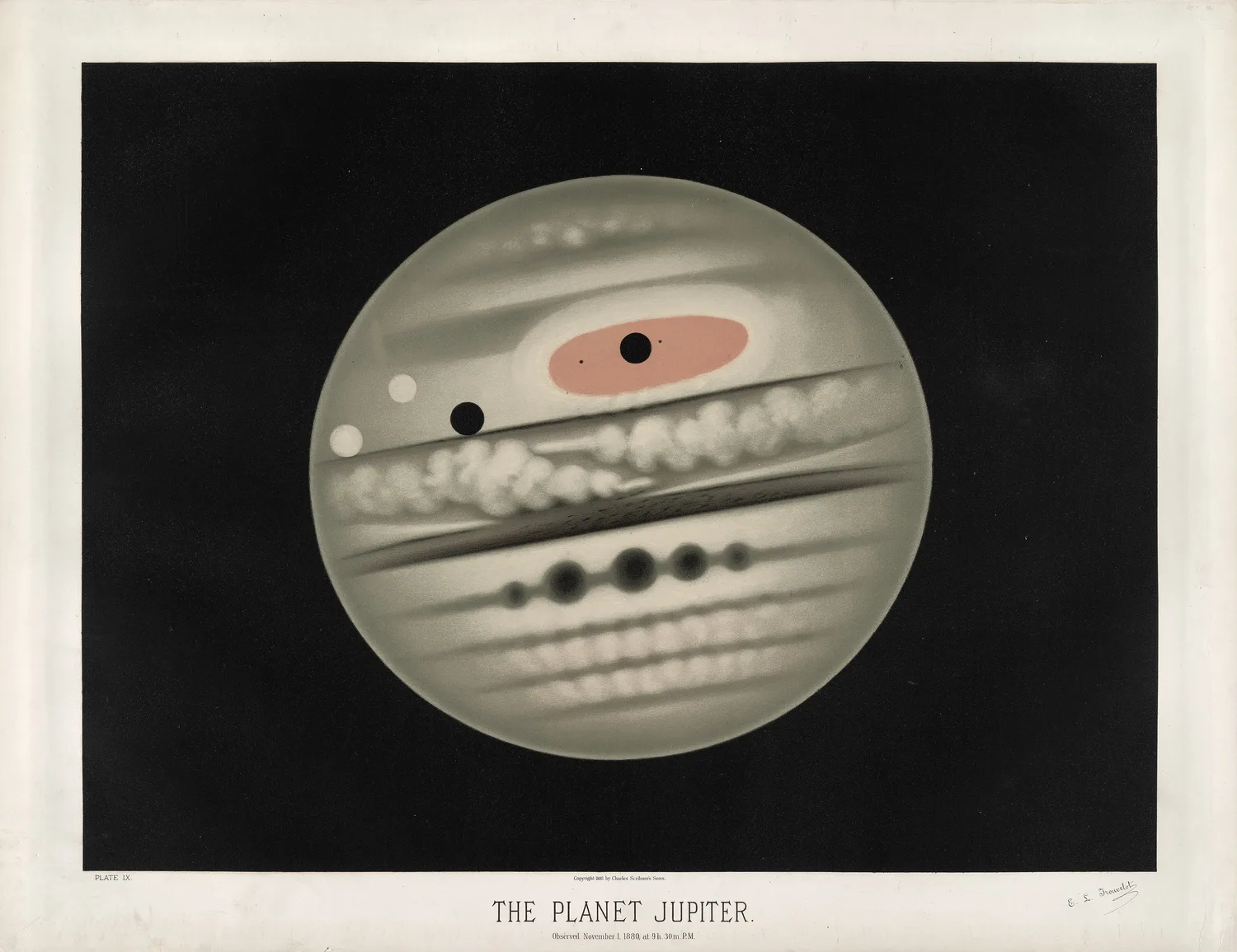
Exploring JupiterThe Astrological Key to Progress, Prosperity & Potential
Stephen Arroyo

The part of life where you most dare to let go and try is often found where Jupiter falls.
Jupiter Came By, So Where Is the Gift?
Every year, when Jupiter changes sign, articles appear telling certain signs that this will be a year of opportunity, with money and career going smoothly. Some people wait in earnest for a whole year; their job does not change, their income does not grow, and they conclude that Jupiter is not much after all. Stephen Arroyo writes about this disappointment in Exploring Jupiter: The Astrological Key to Progress, Prosperity & Potential, published in 1996. He admits that Jupiter often promises more than it delivers, then goes on to say that people are disappointed in Jupiter partly because they do not understand how it works, and their expectations were unrealistic to begin with:
we act like children throwing a tantrum when we do not get what we want from Santa Claus
What Arroyo means is that what Jupiter gives has to be taken up by the person, and given time. The stretch that transiting Jupiter passes through is often a time of sowing, and seeds take a while to sprout and bear fruit. So if you watch only for whether some benefit drops into your lap this year, you will easily be disappointed.
He feels Jupiter has always been read too narrowly. Some try to understand it through simple, Mercurian analysis; others treat it as the key to wealth and getting ahead. He does not deny that Jupiter has to do with worldly prosperity; his point is that reading this layer alone makes Jupiter's meaning small. In this book Jupiter stands for a person's urge to move forward and grow larger. It is not content with things as they are and always wants to climb the next mountain. It gives a person an ideal, a long-range goal, and because there is that goal in the heart, life has direction and feels meaningful. In the introduction he quotes something a doctor said in a lecture: if people do not make their lives fit their ideals, they will make their ideals fit their lives. He says this sentence captures what Jupiter does in each of us. The book begins with the nature of the planet itself, moves through Jupiter in the twelve signs, the twelve houses and the various aspects, and ends with a chapter on transits. Arroyo calls the book an exploration, with no intention of giving the final word on Jupiter.
How the book came about is itself an example of Jupiter. A friend reminded Arroyo that Pluto was about to enter Sagittarius, and he was suddenly seized with the wish to write a book devoted to Jupiter, though this would interrupt another book he was already writing. He tried to put the idea aside but could not stop himself making a few notes every day. When he finally looked at his own chart, he found that he was in his Jupiter return that year, the time, about once every twelve years, when transiting Jupiter comes back to the position of natal Jupiter, and that transiting Jupiter would also conjoin his chart ruler three times that year, while his progressed Sun and Moon were both about to enter Sagittarius. He joked that he must have enough Jupiter in him to miss what was plainly in front of his eyes. What he says of strongly Jupiterian people in the introduction is the same thing: such people cannot bear trivia, and often fail to see details that are right in front of them and obvious to everyone else at a glance.
Jupiter, Dismissed in a Few Lines
In his previous book, Chart Interpretation Handbook, Arroyo wrote a long footnote saying that both interpretation and tradition underrate Jupiter's weight in the birth chart. In it he says that Jupiter is too simple for a complicated age, and too philosophical for a relativistic, materialistic one. Traditionally Jupiter is regarded as the planet that brings the most benefits, yet astrology books often dispose of it in a few lines and keep it very simple. Students of astrology take Jupiter for granted, much as many people take for granted the gifts their own Jupiter points to.
The first thing he changes is to treat Jupiter as a way of learning. Mercury's way is to see details clearly one by one and take things apart to analyse them; Jupiter's way is to look first at the broad direction and explore with faith. Arroyo considers the two equally valid. The modern mind and school training both lean toward Mercury, so Jupiter's way of learning is often overlooked.
The second thing he changes is to stop judging Jupiter good or bad by whether its aspects are easy or tense. Jupiter magnifies everything it touches. In itself it only shows potential and direction; whether the outcome is good depends on the whole chart, and on the person's experience and how he uses it. Tradition says Jupiter in Virgo is in its detriment, but in his experience it is more common to see Jupiter magnify Virgo's analytical and verbal abilities; cases of Virgo holding Jupiter down are rarer. The old idea that retrograde planets are weak he says outright should be thrown on the astrological scrap-heap. The houses are the same. The traditional reading treats the twelve houses as twelve departments of life and applies rules to them one by one, and many people finish reading their charts feeling that their fate cannot be changed, and sink into low spirits. Arroyo wants readers to treat the houses as starting points for exploration, to use them for reflection and inquiry, and then to find what that area of life means for themselves.
The book often quotes Charles Carter. The preface quotes him as saying that “Jupiter rules the future and movement towards progressive change.” Arroyo reads “progressive” here literally: improvement, increase, going beyond present limits. He also knows Dane Rudhyar's books well; when the preface discusses the progressed New Moon, it uses Rudhyar's view. Arroyo himself holds a master's degree in psychology and worked as a counsellor for many years. In the introduction he also talks about how astrologers speak to those who come to them: he hopes every chart reading and every consultation leaves some weight for Jupiter, because this planet's optimism can offset much of the fear, anxiety and fixation on the past that many people carry away after seeing an astrologer.
What Was Left Undone
On Jupiter's faults, Arroyo borrows a saying often applied to Sagittarius:
the sins of Jupiter are sins of omission, not commission.
He goes on to explain that when a person feels his abilities and influence expanding and his goals growing larger, he pays less and less attention to small matters close at hand and to the feelings of those around him, and sometimes does not notice them at all. He is rarely doing it on purpose; he simply feels he stands above these things. But the people around him can feel it, so the bigger the Jupiter side feels, the smaller others feel. If you have ever enthusiastically laid out a big plan and only then remembered the worry someone told you about the day before, which you never once asked about, that is the omission Arroyo means.
Arroyo does not use these faults to pass judgment on people. He says these are distorted forms of what is, at root, one of Jupiter's finest gifts: to be a teacher who leads people toward greater wisdom. He also cautions astrologers not to stare only at the chart. In the introduction he quotes a remark of Isabel Hickey's as someone else recorded it: an astrologer who keeps his head down over the chart and never looks up into the client's eyes is probably not a good astrologer. At the start of Chapter 2 he says again that astrological statements are only working hypotheses, and that parents and upbringing can magnify Jupiter or hold it down. If a child is criticized every time he thinks far ahead, this urge to grow outward may be suppressed, or may come out in a more hidden form. Of people with Jupiter in Virgo, he observes that they often underestimate themselves, so he takes care to urge them not to sell themselves short.
Listing Book Titles Before Writing a Book
Drawing up a list of book titles before having written a single book is Arroyo's example of Jupiter overdone. Another kind of person, with no money to invest, spends hundreds of hours studying investments instead of finding a way to earn a little more. Jupiter always wants to leap past what is in front of it and spend its energy on things that will only be useful much later. Knowing you have this tendency, the next time you are eagerly drawing up plans, you can first check whether the step right in front of you has been taken.
Arroyo suggests first treating the house Jupiter falls in as the area of life you tend to idealize and often think about in terms of the future. In this area a person most readily feels confidence, trust and abundance straight away. Take Jupiter in the second house: most introductory books describe it as a hunger for a great deal of money, but Arroyo quotes Margaret Hone, who says this placement often means contentment with one's possessions, an inner trust that one will always be provided for. He also says plainly that about half the people with this placement use that trust as a reason not to save for the future, and pay little attention to their possessions. So the same sense of security calls for a little more thought when it comes to spending.
Balancing Jupiter and Saturn is something Arroyo returns to again and again. Many people with tense aspects between Jupiter and Saturn, he says, lack self-confidence, as though the security and expansiveness Jupiter gives had to be earned bit by bit. They often build that confidence slowly by taking on a risky job or responsibility that might fail, while learning to be a little less pessimistic and self-doubting. If you have always felt that the ease other people seem to have naturally comes to you only after you have accomplished several hard things, this passage will help you see some of the reasons.

Chapter by Chapter
Chapter 1: A Framework for Understanding Jupiter
This chapter looks at Jupiter and Mercury together, because each planet stands for a way of learning. The four mutable signs, Gemini, Virgo, Sagittarius and Pisces, all have to do with learning; Mercury rules the first two, Jupiter the last two. Arroyo quotes Carter as saying that Mercury cares about how things are now and looks at the local map, while Jupiter wants the map of the whole continent. Carter also wrote:
The vision of Gemini is normal, that of Virgo microscopic; but Jupiter is telescopic, scanning distant horizons.
The chapter also cites a record kept by the teacher David Hamblin. Students born in the same year mostly have Jupiter in the same sign, so Hamblin looked at how each class behaved according to its Jupiter sign. The Jupiter in Gemini class held discussions that were free and lively; the Jupiter in Cancer class preferred teaching in which the teacher decided things, keeping a low profile and staying protected. The Jupiter in Sagittarius class kept going off topic and missed the most lessons, yet its group presentations were full of laughter and, except for the Jupiter in Leo class, better than any other class's. Arroyo uses this record to show that Jupiter's sign is the way a person learns.
Chapter 2: Jupiter in the Birth Chart: Key Concepts & Interpretive Guidelines
The heart of this chapter is that Jupiter needs Saturn. Saturn, Arroyo says, is heaviness: it grounds a person and focuses attention on present reality. Jupiter is lightness: it lifts a person up to see things from the height of an ideal or of humour. He quotes Carter: Jupiter without Saturn's cooperation is clever and dazzling but unreliable, here today and gone tomorrow. He also cautions against reducing this to the aspects between Jupiter and Saturn alone. Many people with Jupiter conjunct Saturn are very successful in business, yet among people equally successful the combinations in their charts vary endlessly, so one has to look at how much a person responds to Jupiter and to Saturn each. The chapter ends with thirteen guidelines for interpreting Jupiter, which you can check against your own chart. For example, where Jupiter falls is where you should take risks, and also where pressure can ease and you can find your confidence again.
Chapter 3: Exploring the Jupiterian Personality
Arroyo gives the Jupiterian person one key word: aspiration. Such a person usually holds a distant goal in mind, and that is what gives meaning to the matters at hand; sometimes there are too many goals and the energy gets scattered. A friend of his with Sagittarius rising said they shoot a great many arrows in every direction, and one of them is bound to hit the target. At the end of the chapter he divides Jupiter into four levels. The material level is wealth, success and fame. The social level is commitment to a cause or a large group, or to education, law and foreign affairs. Then there is the level of spiritual seeking and faith, and the level of morality and self-improvement. Jupiter usually works on two or more levels at once, he says, and without talking to the person it is hard to know which level it lands on in that particular life.
Chapters 4 to 7: Jupiter in the Fire Signs; Jupiter in the Earth Signs; Jupiter in the Air Signs; Jupiter in the Water Signs
These four chapters take Jupiter through the twelve signs by element: fire, earth, air and water. Each sign opens with a few lines of interpretive guidelines, covering what people with this placement grow through, how they build faith in life, what happens when it is overdone, where opportunity comes from and what they understand by nature; then come short comments from several astrologers and a set of famous people's charts. Here Arroyo often departs from traditional views; Jupiter in Virgo, mentioned earlier, is one example. The piece on Amelia Earhart in the book also uses this placement. Her Jupiter was in Virgo, closely conjunct Mars. In 1928 she flew across the Atlantic as a passenger, saying before she left that she wanted to gamble on something big, and if she won, all would be well. Four years later she became the first woman to fly the Atlantic solo. Virgo's eye for detail did not narrow her horizons; her flying linked places far apart.
Chapter 8: Jupiter in the Houses
This chapter makes a point right at the start: to determine reliably what Jupiter means in a particular house is almost impossible. Arroyo's reasons are all practical. Most people's birth times are not completely accurate, and there are many house systems. Many experienced astrologers find that a house starts to operate about 6 degrees before its cusp. A planet's sign and aspects carry more weight, and the house alone is unreliable. So you can speak with confidence only after talking with the person and learning what he values and what he intends to do.
The chapter closes by comparing two people. The anthropologist Margaret Mead and the poet Emily Dickinson both had several planets gathered in Sagittarius, and both had Jupiter in Capricorn. Mead's Sagittarius planets were in the eleventh house, and all her life she went outward, to Samoa, New Guinea and Bali, to study how people lived in different places. Dickinson's Sagittarius planets were in the fourth house; for her last twenty years she hardly left her parents' house, and put all her longing to travel far into her poems. Mead said she was sixteen before she learned that a Sagittarian is someone who goes as far as anyone else and shoots a little farther. The same sign in different houses: one woman travelled the world, the other stayed at home and wrote poems.
Chapter 9: Ruled by Jupiter: Sagittarius & Pisces Rising
For people with Sagittarius or Pisces rising, Jupiter is the chart ruler, and Arroyo wants them to understand the sign and house of their Jupiter especially well, because putting effort in the direction of this planet makes them feel more alive and more confident. The two signs look very different, so he looks specifically for what they share: both want to make life a little better for those around them, love learning and love passing on what they have learned, are easily too trusting, and cannot bear a present that never changes. He has known many friends with Sagittarius rising, and noticed early on that their handwriting tends to be large, with each line slanting upward, as though their optimism could not be contained. People with Pisces rising often stay in the background and let their work speak for them. Arroyo says astrology books rarely mention how much inner strength they have; they seem easygoing, but in fact have very strong personalities.
Chapter 10: Jupiter's Aspects in the Birth Chart
Arroyo does not divide aspects into harmonious and tense, because the judgment of good and bad is too rigid. He borrows the old saying that a tree is known by its fruit. Jupiter is the largest planet; whatever planet it touches, it draws into its own field and magnifies, and only Saturn can hold it down a little. So although the orbs he normally uses are tight, he widens them for Jupiter.
The piece on Albert Schweitzer in the book can be read in the light of this saying. His Jupiter opposes Neptune and the Moon, a tense aspect. As a child he could not understand why he should be able to live so happily when so many people around him were suffering. At twenty-one he made a pact with himself: until thirty he would live for scholarship and art, and after thirty he would serve people directly. Later he gave up the fame he had already won and went to Africa. In September 1915, with transiting Neptune exactly square his natal Jupiter, he travelled for three days by boat up an African river, and at sunset, passing through a herd of hippopotamuses, the words “Reverence for Life” suddenly came into his mind. Arroyo says the famous people in this chapter are proof that even tense aspects can be creative.
Chapter 11: Transits Involving Jupiter
The last chapter deals with transits in two parts: transiting Jupiter touching the points of the birth chart, and other planets touching natal Jupiter. In the book there is a young woman who had to break off her university studies for lack of money. When transiting Jupiter was trine her Ascendant and sextile her natal Jupiter, the administrator of a private trust fund heard about her situation and gave her a scholarship covering all her costs, though she had never even applied. Arroyo also makes the limits clear: transits show how energy is released, not what specific thing will happen, and trying hard to guess the specific event is wrong more often than right. What he gives weight to are stations. When a transiting planet stations and turns near natal Jupiter, or transiting Jupiter stations near a natal planet, it usually marks a period of profound change.
Saturn and the outer planets (Uranus, Neptune and Pluto) move slowly, and when they touch natal Jupiter, Arroyo says, it is like opening a storehouse of energy: a person's beliefs about the future, aspirations and plans all change. He also cautions that the deeper understanding Jupiter brings comes late, only after one has dealt with the world, taken risks and made the effort:
Jupiter favors active risk-takers, but life favors those who also have patience, persistence, and moderation.
So if a transit of Jupiter has passed and things did not succeed straight away, that does not mean Jupiter came by for nothing.
How to Read This Book
At the end of Chapter 3 Arroyo explains how to read the chapters that follow: only by reading the four levels of Jupiter together with the lines of interpretive guidelines at the start of each sign can you understand a person's Jupiter in some depth. Following this approach, first find the sign your Jupiter is in and read that section in Chapters 4 to 7, then read your house in Chapter 8, and go back to check it against the thirteen guidelines at the end of Chapter 2. If you want to understand how you learn, read Chapter 1. If an important transit is coming up, read Chapter 11.
The book also has its difficult side. Most of its examples are Western celebrities, Americans especially: athletes, actors, writers and politicians. Many of the short biographies were researched and written by the editor Barbara McEnerney, and Arroyo loves to quote others, often citing two or three astrologers in a row within one passage, so as you read you need to keep track of whose view each sentence is. There are also many passages on religion and faith, which may feel remote to many readers today. Arroyo himself says the descriptions of each sign are mainly meant to prompt further thought, with no guarantee that every point will fit every person.
Without talking to the person, it is hard to know which level Jupiter lands on in that life, and this is also the restraint we kept in writing Your Jupiter in Depth. On your Jupiter sign, the report does not decide for you which level it lands on; it gives a sentence or two on roughly what each of the four levels looks like in this sign, and asks you to compare for yourself. On Jupiter and Saturn, it follows the view of Chapter 2 and looks at what supports each side in your chart: whether there is an aspect between Jupiter and Saturn, whether Saturn touches your Moon, Mars, Ascendant and Midheaven, and whether any planet falls in a sign that can rein in extravagance. It gives no scores and does not say which side is stronger by how much.
As for timing, Jupiter returns to its place about every twelve years. The report sets out the returns of your whole life in a table, describes the next return, and also the points in your chart that transiting Jupiter will touch over the next two years, with the dates calculated precisely by software. If in these years any of transiting Saturn, Uranus, Neptune or Pluto is touching your Jupiter, the report has a separate section that follows the view of Chapter 11 to describe this longer, deeper change. From start to finish it looks only at Jupiter and the planets Jupiter draws in; the rest of the chart is not part of it. What Jupiter gives often takes a few years to show, so the next time Jupiter returns to the place of your natal Jupiter, you can take out the report and compare again.
 Your Jupiter in DepthSee report · $15