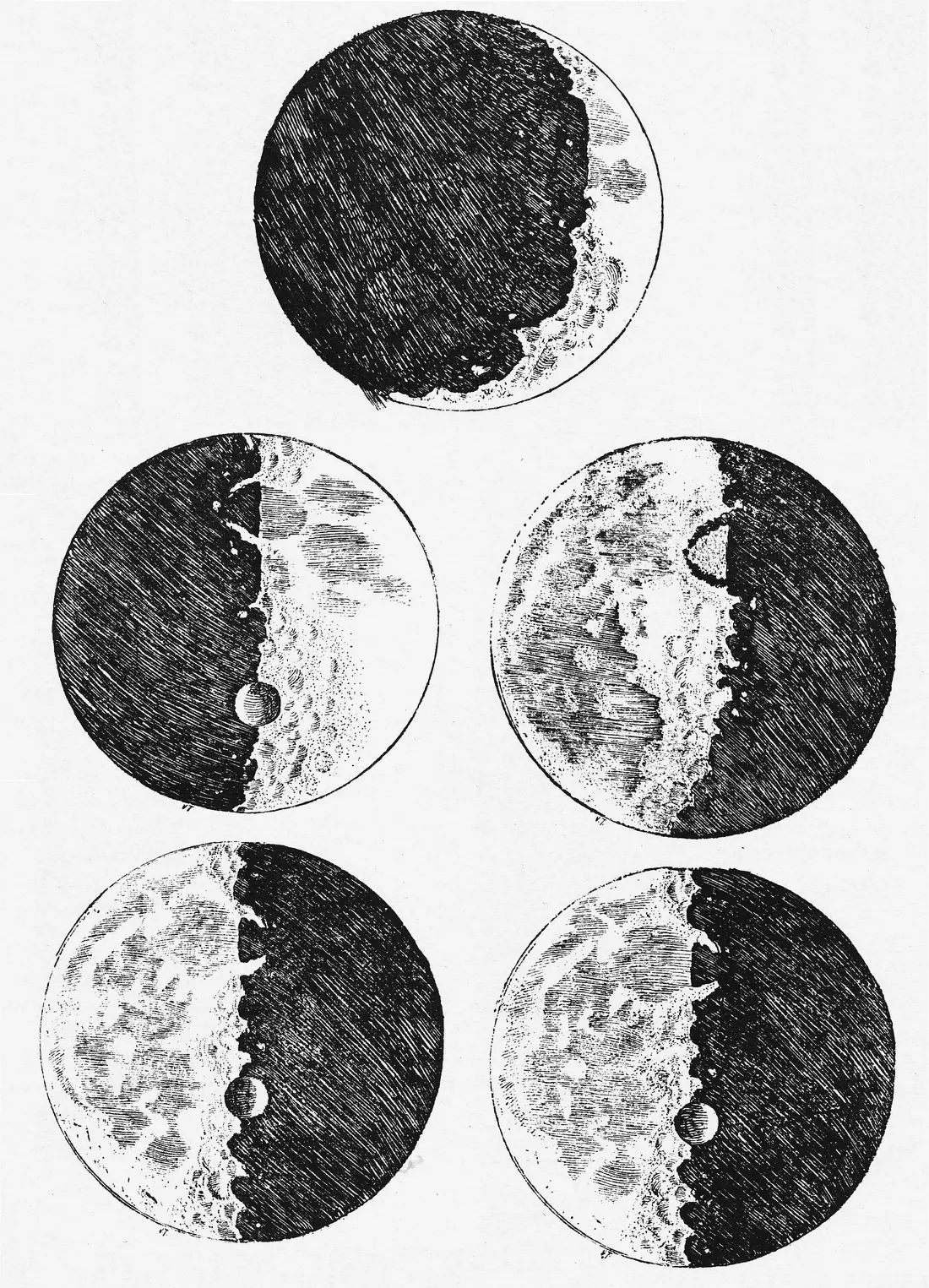
The Lunation Cycle
Dane Rudhyar
You know your Sun sign. But what did the Moon look like on the night you were born?
The Moon on the Day You Were Born
You know your Sun sign and probably your Moon sign as well, but whether the Moon was waxing or waning on the night you were born is something most likely no one has ever told you. Dane Rudhyar (1895–1985) thought it mattered a great deal. The Sun's position tells you what you have come here for; the phase of the Moon at birth tells you how you meet the relationships in your life, and how, step by step, you turn what you want to do into reality.
In the winter of 1944 to 1945 he wrote a book devoted to this, and called it The Lunation Birthday. When the book was about to go to press, the editor found the title too poetic. Rudhyar was away travelling and could not be reached, the publisher's catalogue was waiting to be printed, and so the editor changed it for him to The Moon: The Cycles and Fortunes of Life. Rudhyar later wrote quite bluntly in his foreword that the title misled readers, because this book, of all books, is not about the Moon. It is about the relationship between the Moon and the Sun.
This may sound like hair-splitting, but the whole book grows out of it. Looking up at the Moon as it waxes and wanes from night to night, it is easy to think the Moon itself is changing. It is always the same Moon.
But the moon does not change. Her light does
What changes is the angle between the Sun and the Moon, that is, how far along a relationship has come. So at the moment a person is born, this relationship has reached a particular point, and that point can tell us something about the person. If you were born a day or two after the New Moon, when the Moon has only just left the Sun, you probably act on impulse, and when you look at other people you mostly see the picture in your own mind. If you were born on the day of the Full Moon or a few days after, when the Sun and Moon face each other across the whole sky, your relationships with others become the great business of your life.
The book sold a thousand copies within a few months, and just as a second printing was in sight, the publisher decided to stop publishing astrology books altogether. In the years that followed Rudhyar kept thinking it through. He added the eight lunation personality types and two further kinds of chart, revised the old text closely, and gave it the name it has today, The Lunation Cycle. The copyright page gives the year as 1967. What we read now is the 1986 Aurora Press edition, which adds a long essay by Leyla Rael Rudhyar at the end.
It Put Time Back into the Chart
In astrology at the time, most people used only the Sun sign to answer the question “Who am I?” Astrologers who knew more would spread out the chart and count off its features one by one, a conjunction here, a square there, analysing it as a snapshot. Rudhyar felt that this lost the most important thing of all, which was time, because a person is alive, and to be alive is to change.
By thus arresting the flow of time the astrologer analyzes death and lets life escape
So he defined astrology as a technique for studying the cycles of life. Signs and houses deal with position, where a planet has got to. Aspects deal with relationship, the distance between two planets opening out from the conjunction to the opposition and then closing again. The lunation is the simplest of all the relationships, and anyone can see it.
Traditional astrology missed something here. At both the first and the last quarter the Sun and Moon are ninety degrees apart, and both are called a square. But one happens as the Moon is growing brighter and the other as it is growing darker. Failing to tell them apart is like knowing the tide has reached a certain height without knowing whether it is coming in or going out.
it is more important to know whether the tide is advancing or receding
Applied to a person, this is easy to grasp. Two people both change jobs at thirty. The one in the waxing half is probably building something new; the one in the waning half is probably bringing something to a close. These two situations call for different preparations. Take the idea one step further and you have the progressed lunation cycle: the cycle of phases laid out across a whole life, turning once in about twenty-nine and a half years.
Why Readers Like It
You cannot look up and see where the Sun is, but the Moon's phase is different. The phase you were born under comes back to the night sky every month, and you can recognize it at a glance. Rudhyar called this your lunation birthday.
Nor does it rank people as good or bad. The same phase can produce a politician who devotes himself to his cause, or a primary school teacher in a remote village who spends a lifetime raising the schooling of the village children. What Rudhyar cares about is how a person enters into relationship and what he brings to those around him. Each of the eight phases has its difficulties, but none of them is bad, so when you read about your own, there is no need to worry.
The eight phases later spread widely. Demetra George teaches a course on the lunation phases today that covers the eight, and its description credits Rudhyar with originating the system.
What You Can Take Away
If you were born a few days before the Full Moon, and where others are content once a thing is done you still want to know what it means, this book will tell you that this is a common trait of the Gibbous type.
If at work you are always wanting to set up rules and frameworks for the team, while your colleague is happiest explaining what he has learned to the newcomers, you are close to the First Quarter type and he is close to the Disseminating type. You want different things, and once you know that, you need not get on each other's nerves.
The house of the Part of Fortune shows the circumstances in which things come most easily to you. People with Fortune in the sixth house are most at ease when they are perfecting the work in their hands. Those with it in the seventh feel best when an important relationship has been opened up and talked through.
If you are nearing thirty or have just passed it, and feel that everything is coming loose, the progressed lunation can help you see whether you are in the middle of changing gear.
Some people often feel that they are not quite the same inside as outside. Rudhyar looks at whether the New Moon before birth and the Sun at birth are in the same sign; if not, the person often carries two keynotes. Jung is his example: the New Moon before his birth was in Cancer, and his Sun in Leo.
Chapter by Chapter
The first two chapters are the toughest; from the third on, it reads easily.
Chapter I: Astrology, Time and Cycles
This chapter defines astrology as a technique for studying the cycles of life, then distinguishes two kinds of time. One is the time of clocks and calendars, the same for everything. The other is the rhythm a person lives out, different for each. So when the same five years pass, one person feels they went quickly and another feels a great deal has changed, because each has a rhythm of their own.
Then comes timbre. The same note sounds different on different instruments, because timbre comes from the relationships among the overtones. The character of a chart is the same: it comes from the relationships among its factors, and cannot be reached by adding them up one by one. So when you look at your own chart, don't look only at where one planet is; look at how the planets work together.
Chapter II: The Lunation Cycle, as a Dynamic Pattern of Relationship
The Sun stays constant; the Moon's light grows and shrinks with the angle between them. From New Moon to New Moon takes 29 days, 12 hours and 44 minutes, the cycle of relationship. The Moon's circuit of the zodiac takes 27 days, 7 hours and 43 minutes, the cycle of position. This book is about the first.
The most important points in the cycle are the two right angles.
The first quarter represents a crisis in action; the last quarter, a crisis in consciousness.
At the first quarter you have to break with the old in what you do; at the last quarter you have to turn in a new direction in what you think. On a larger scale, the waxing half leans toward instinct and building, the waning half toward consciousness and spreading. Every chapter that follows uses this division.
Chapter III: The Eight Lunation Types of Personality
- New0–45°
- Crescent45–90°
- First Quarter90–135°
- Gibbous135–180°
- Full180–225°
- Disseminating225–270°
- Last Quarter270–315°
- Balsamic315–360°
Rudhyar first sets a rule: the name of a phase covers the stretch of time after that aspect, so someone born a few days after the first quarter counts as a First Quarter type. He divides the cycle into eight parts of 45 degrees each.
People born from the day of the New Moon to about three and a half days after are the New Moon type, with the Moon less than 45 degrees ahead of the Sun. Because the cycle has only just begun, such people are subjective and impulsive. When they meet someone, what they mostly see is a picture from their own minds, and the other person becomes a symbol. So they often fall in love with someone and only then discover they do not know the person. Rudhyar's typical example is Freud.
When the Moon is 45 to 90 degrees ahead of the Sun, this is the Crescent type. The new impulse now runs into the forces of the old, and the person grows confident and willing to break through obstacles; this is how Liszt changed the social standing of musicians. The difficulty of this type is feeling weighed down by the past.
Next comes the First Quarter type, 90 to 135 degrees. This is the phase of the manager, fond of building frameworks, strong-willed, and at times cold and hard in getting things done. When the company is about to be reorganized and everyone else is worried, he is already sketching the new structure on paper. Rudhyar counts the poet Baudelaire as a negative example of this type, while saying that he was a superb manager of words.
People born a few days before the Full Moon are the Gibbous type, with the Moon 135 to 180 degrees ahead of the Sun. Such people are always asking why, because they care about their own growth and want to add some meaning to society or culture, and for this they can give themselves to a person or a cause. Newton, Pasteur and Gershwin were all of this kind.
After the Full Moon the second half of the cycle begins, and the angle is now measured by how far the Moon falls behind the Sun. The Full Moon type runs for three and a half days from the day of the Full Moon. What was once felt is now seen. For this type, relationship is everything: either fulfilment or separation, even separation from reality. Goethe and Joan of Arc share this type.
When the Moon falls 135 to 90 degrees behind the Sun, Rudhyar gives the phase the name Disseminating, a word with the sense of sowing. Wanting to pass on whatever you learn, never able to resist sending a good book to a friend: this is the mark of the disseminator and the popularizer. Jung, Dante and Wagner all belong to this type. When it goes astray, the person loses himself in a cause and becomes fanatical, or simply follows the crowd.
Another 45 degrees on is the Last Quarter type. Now a person needs to turn convictions into a system of thought or an institution, and for the sake of principle will stand firm to the end, with little flexibility, often feeling that his work must wait for later generations to understand it. Einstein and Victor Hugo are examples. If someone of this type has a sense of humour, he can use it in the service of his ideas; Rudhyar's example is Bernard Shaw.
Last comes the Balsamic type, with the Moon less than 45 degrees behind the Sun, about three days before the New Moon: the thin crescent seen before sunrise. These three days are the seed period. Such people feel carried along by something larger than themselves and readily accept sacrifice; Kant and Lincoln are here. When it goes astray, this too becomes fanaticism.
These famous people were all chosen after the fact, without statistics, and people of the same type differ widely. Rudhyar himself admits that the eight types are not enough for a full analysis of a person, which is why there is a next chapter.
Chapter IV: The Part of Fortune
Of all the Arabian Parts, only the Part of Fortune has been widely used, and it has always been misunderstood. Wealth is not its primary meaning. Rudhyar sees it as a moving indicator of the Sun–Moon relationship. It is calculated as Ascendant + Moon − Sun, that is, the distance between the Sun and Moon measured out from the Ascendant. At the New Moon, Fortune is conjunct the Ascendant; at the first quarter it is near the cusp of the fourth house; at the Full Moon it is conjunct the Descendant; at the last quarter it is near the cusp of the tenth.
To continue the comparison with timbre: the Sun is the fundamental, the Moon produces the overtones, and the Part of Fortune marks the position of the whole wave form. So Fortune speaks of the particular charm a person gives off, and of how he becomes happy. Rudhyar's definition of happiness is simple: when the life force flows freely, a person is happy.
Happiness comes in two kinds, the comfort of body and mind and the joy that comes from creating. Fortune governs only the first; for the second you look to the point opposite it, which Rudhyar calls the Point of Illumination.
The second half of the chapter reads Fortune house by house and sign by sign, in short passages, so you can turn straight to your own. People with Fortune in the second house feel secure only when they gather money, possessions and inheritance around them; the example is Montessori. In the third is Liszt, who spent his life giving concerts across many countries. People with Fortune in the fifth overflow with creativity and have a gambling streak; Gershwin is here. The passages on signs require an exact birth time. People with Fortune in Taurus, for instance, are happy only when they can see solid results; Rudhyar says such people want to be the “mother” of tomorrow. So when the work in their hands is slow to show results, they lose interest sooner than others, and it helps to break the work into small pieces, each with a result they can see.
Chapter V: The Part of Fortune and the Part of Spirit
A very short chapter. Swap the Sun and Moon in the formula and you get the Part of Spirit. Fortune moves forward through the houses and Spirit moves backward; at the New and Full Moons the two coincide, and at the two quarters they oppose each other. Rudhyar believes Fortune represents a person making his potential real, and Spirit the pull of past tradition upon him. In other words, one draws you forward and the other draws you back.
Rudhyar gives the example of a newly married couple. The husband is a soldier; they have only a few hours together before he is called away, not to return for a month. Once they are apart, one keeps going back over the hours they shared and the other counts the days until the next meeting. Memory and expectation are the two ends of how we feel time.
Chapter VI: The Planets in Relation to the Lunation Cycle
This chapter teaches you to mark the arc from the Sun to the Moon and see which planets fall inside it. If you were born in the waxing half, the planets inside the arc are abilities you were born with and that work naturally, while those outside are abilities this life asks you to develop. Liszt's arc held Venus, Uranus and Neptune, with Saturn outside, so Rudhyar believes he was born lacking restraint, and that this lack finally led him into the Church. If you were born in the waning half, the reading is different: planets in the stretch of zodiac the Moon has swept through concern public life, and planets between the Moon and the Sun point to the future.
Chapter VII: The Progressed Lunation Cycle
This chapter puts everything that came before into time. In secondary progressions, one day after birth corresponds to one year of life, and by this measure the lunation cycle turns once in about twenty-nine and a half years.
The progressed New Moon is a time of reorientation. People are often hazy then, full of longing but unable to say what they want, so Rudhyar suggests looking at the sign and house in which this New Moon falls. At the progressed first quarter, a person meets a deadlock in instinct and feeling. At the progressed Full Moon, things have reached a high point, and next comes the question “And then what?” At the progressed last quarter, it is one's ideas that must change.
The book uses Liszt as its demonstration. He reached his progressed Full Moon at about 10; a few months earlier his career had just begun, at the princely court where his father was employed. At about 17 came the progressed last quarter, and a breakdown after his first love. At 25 came the progressed New Moon, and from then on his career opened out fully. Rudhyar also points out a difference: for those born in the waxing half, the first progressed Full Moon arrives before 15, and what is fulfilled then is mostly what family and tradition have given. For those born in the waning half, it comes later. Seen this way, what a person achieves in youth is sometimes the gift of family and tradition, and not yet truly his own.
Rudhyar puts it plainly.
Progressions do not refer to objective events; they deal only with subjective conditions.
So this chapter will not tell you in which year you will be promoted. It tells you what conditions you are living in during these years. People around the progressed New Moon are often in a fog; that is simply the nature of this stretch, so the direction can be settled a little later.
Epilogue: A Lunation Birthday for Modern Man
Rudhyar enlarges the lunation cycle to the great precessional cycle of about 25,868 years and uses it to discuss the stages of human history. This chapter is heavily marked by its time and can be set aside on a first reading.
The Lunation Process in Astrological Guidance, by Leyla Rael Rudhyar
This essay, The Lunation Process in Astrological Guidance, first ran as a series in the magazine Astrology '78/'79. Rudhyar gives the principles; she shows how to use them. Her most important reminder is that no kind of event belongs permanently to any one phase. What you look at are the turning points and the stages.
She tells of a student named John. Between four and seven he reached his progressed first quarter, just as his father joined the army, and he was left to be “the man of the family”. At thirty-three he reached the progressed first quarter again, and left his job and ended his marriage. John could not at first see what the two periods had in common; put side by side, both were declarations of independence. Because a phase never repeats exactly but climbs, cycle by cycle, when you look back over your own life you can set side by side two stretches some thirty years apart and compare them. The failure of Wagner's first opera also came around a progressed Full Moon, and she uses it to make the point that the meaning we give a failure matters more than the failure itself.
The last part takes Rudhyar's own life as its case. His three progressed New Moons fell in the summer of 1898, the spring of 1928 and the autumn of 1957. As his first progressed Full Moon drew near, at 17, his father died suddenly, and it was then that the purpose of his life took shape: to break free of the old culture of Europe.
How to Read This Book
It is not an easy read. Rudhyar's prose leans toward the abstract, the first two chapters are heavily philosophical, and the sentences are long, so on a first reading it is easy to stall there.
On a first reading it is best to start with Chapter III and find your own phase, then read the passage in Chapter IV on the house and sign of your Part of Fortune, then skip to Chapter VII and read Leyla's essay straight after. Leave the first two chapters for last, and go back to those long sentences once you have come to like the book. Chapters II and III give different degrees for the Crescent: Chapter II gives the astronomical 18 to 36 degrees, while the personality types in Chapter III use 45 to 90 degrees. To find your own type, go by Chapter III.
These ideas of Rudhyar's still have to be put together on a single chart. Say a Gibbous type has the Part of Fortune in the sixth house and is now passing through the progressed last quarter: how these passages should be read together, the book does not say. The dates also have to be worked out yourself, counting day by day through the ephemeris to find when each phase of your life begins and ends, and that is no small job.
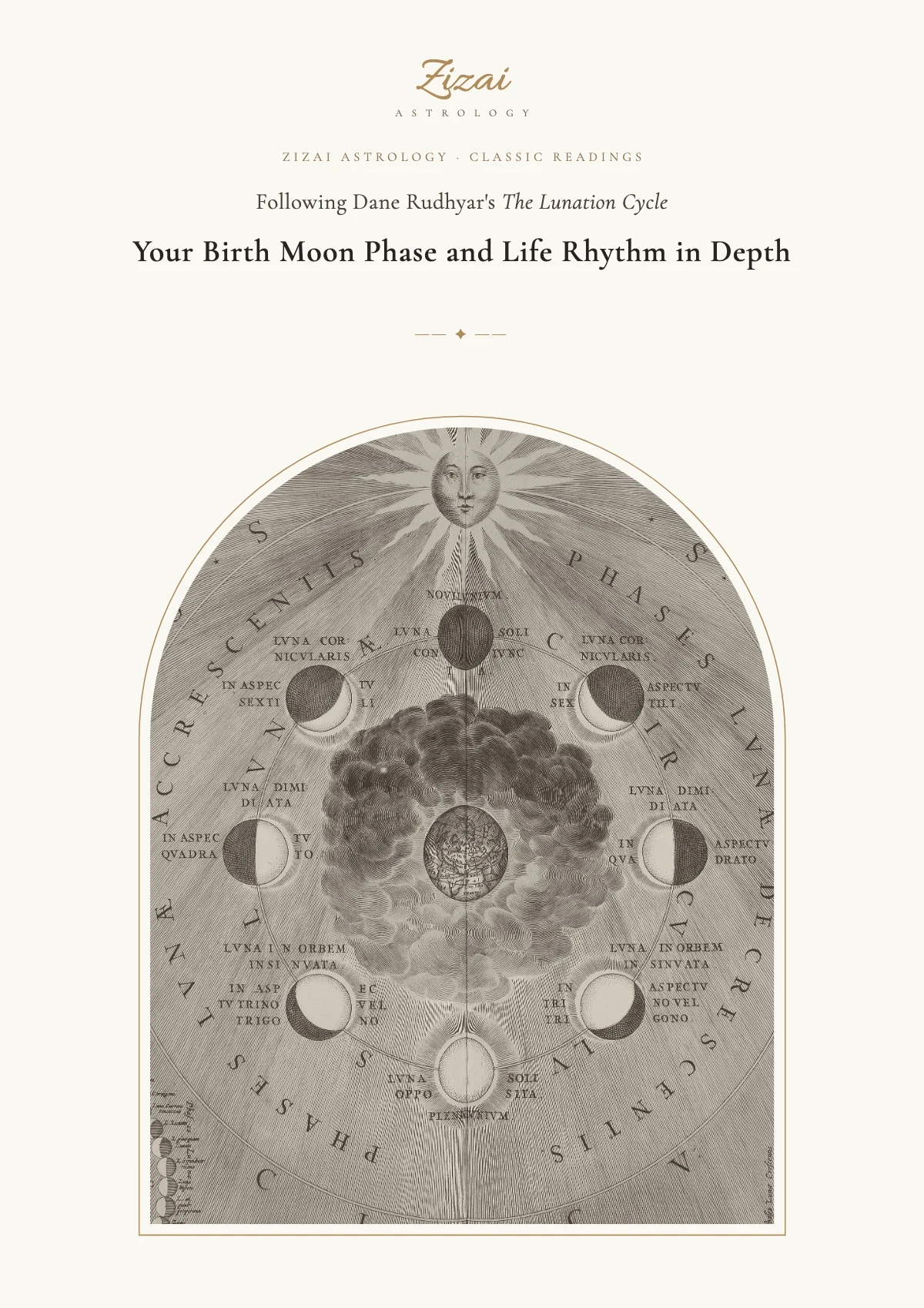
We have taken this step for you in a report called Your Birth Moon Phase and Life Rhythm in Depth, written following this book of Rudhyar's.
It begins with how Rudhyar saw the waxing and waning of the Moon, then calculates the phase you were born under, the New Moon before your birth, and the sign and house of your Part of Fortune.
Here the progressed lunation cycle becomes a timetable for your life, turning once in about thirty years. The start and end of each phase are worked out to the year and month, so you can see which phase you are in now, when the next one comes, and where the progressed New Moon and Full Moon of each cycle fall.
Finally it reads the phase, the Part of Fortune and the timetable together. The dates are calculated precisely by the program and independently checked against the Swiss Ephemeris.
While you read this book, look up at the Moon once a month and note which phase it has reached tonight. The abstract passages will come a little easier.
 Your Birth Moon Phase and Life Rhythm in DepthSee report · $15