Vocations
Noel Tyl
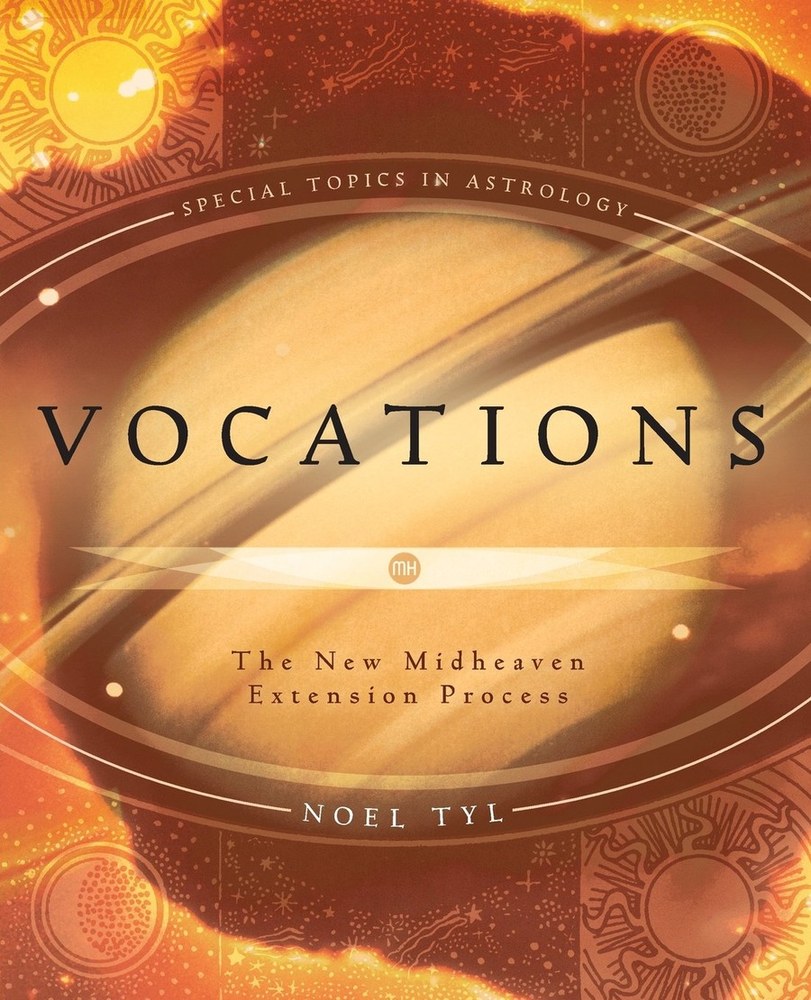
Reading what work suits a person, starting from the Midheaven
What the Midheaven Extension Process Is
When people first meet, one of the first questions is often "What do you do?" The answer says a good deal: what a person spends the day on and cares about, and how other people see them. In Vocations: The New Midheaven Extension Process, Noel Tyl opens the main text with a very short sentence:
We are what we do.
Then he does the arithmetic. Work takes up more of our time than sleep, and a person's standing in society depends mostly on their work and their place in it, so the answer to that one question says most of what there is to say about someone. The book came out in 2005. In the preface Tyl explains that he spent twenty to twenty-five years researching this way of profiling a vocation, and that the results are highly reliable but, like everything else in astrology, not foolproof. The question he sets out to answer is a single one: what work am I suited for?
His answer is the Midheaven Extension Process. The Midheaven is the highest point of the chart and has long been tied to career and social position, so Tyl makes it the focus for looking at vocation. He starts from the sign on the Midheaven and finds the planet that rules that sign, the Midheaven ruler. Then he looks at whose sign that ruler is in and which planets it contacts, and each planet passes the meaning on to the next until the chain reaches a "target," the best use this person can make of themselves in work. Along the way he pays little attention to the other signs and doesn't sort aspects by type, because what he wants is a direction, not detail. With practice, he says, the direction often shows within twenty seconds and usually within two minutes. He estimates he has tested the method on three to four thousand cases, and it seems to hold in about 80 percent of them, or more.
Tyl believes every chart holds a need that has to come out through work. Some people find it in their twenties, and some take decades to get there. His job is to recognize it in the chart and say it to the person in a few words, so that it "rings a bell."
The Book's Contents
- Background and the Modern Premise
- Sociological Framework
- A Modern View: The Midheaven Extension Process
- Observations: The Analytical Considerations
- The Midheaven Extension Process in Practice
- Practicing and Gaining Confidence
- The Communicating Channel
- The Performing Channel
- The Creative (Aesthetics) Channel
- The Helping/Healing Channel
How Tyl Reworked the Old Methods
Tyl had little patience with the old methods. The great theorists of the past grouped careers by which planet was strong. A strong Saturn could make a theologian, a sculptor or a mining engineer. A strong Moon made a queen, a princess, a hunter or a "commoner," and solar types ran all the way from ambassador to pope. He says this was fitting reality to the theory of the day, and it divided careers far too simply. In the past people mostly worked to make a living. After what he calls "the psychological century," people work to become the person they see themselves as and want to be. So astrology can't stop at a career label. It also has to say how a person needs to express themselves at work, and what kind of work has room for that and puts it to use.
The first thing he changed was to take things away. The career rules handed down over generations had added layer after layer of detail to patch the holes in each method. Tyl calls them "band-aid details" and says they made vocational analysis very cumbersome. In the preface he puts his own direction this way:
I have worked to cut away much heavy baggage from traditional astrological technique.
So what is left? The planets themselves. Tyl says Jupiter is Jupiter and Saturn is Saturn. Whether a planet is in Taurus or some other sign need not concern this method, because the planet carries the meaning of the Midheaven sign, and adding a layer of sign character only slows the extension down. Aspects are the same. Which kind of aspect the ruler makes with another planet mostly doesn't matter. In his words, "contact is contact," and retrograde motion plays no part here either. But one rule he holds to strictly: the house a planet rules almost always matters more than the house it is in.
He explains the premise himself. The Sun's light reaches the whole solar system and every planet receives it, which is the whole. Each planet receives it to a different degree and from a different place, which is the individual. He carries this over to the Midheaven and lets its meaning reach as many planets in the chart as possible. Following the ruler one planet at a time is, in his comparison, like a piano student telling you his lineage: my teacher studied with so-and-so, who studied with someone else, all the way back to Liszt. In the same way several planets are linked into one chain. Tyl took his degree at Harvard in Social Relations, which combined psychology, sociology and anthropology. That background shows in the book's first section, "Sociological Framework": in earlier times most men took up their father's trade, which is why the 10th house stands for both career and the father.
What Decides How Far Someone Gets
The same clear career routing, carried by different people, can reach very different heights. This is what Tyl means by Level, a word he comes back to again and again:
There is a difference of Level
He gives an example. Take the handyman who helps keep your house in shape. He likes fixing things and putting them in order, setting the stones in the yard so they look right, trimming the big shrubs, laying brick and building walls. He loves the work and is doing exactly what he needs to do, but he isn't a landscape designer or an architect, and yet his chart can carry exactly the same symbols as theirs. Tyl says Level is set by five things together: the example at home, vision, education, opportunity and reward. When people go for years without getting anywhere and stay a long time in work that doesn't suit them, the cause often lies here, not in something missing from the chart.
He also warns astrologers how easy it is to project their own likes and dislikes onto a client, to feel that one set of talents is dull and another isn't worth developing. That is only human, he says, but it has no place in work done for a client. The astrologer has to respect the client's real situation and take all of it into account, security, family and values included.
When the Job and the Wish Differ
The work a person does now and the work they really want can both be in the chart at the same time.
The book also has advice for people who can no longer change careers. A corporate executive whose chart says "teaching" doesn't have to quit and become a teacher. He can ask his company to put him in charge of training new employees. For someone in their early fifties a complete change of career is hardly realistic, with income and pension at stake. Then, Tyl says, astrology should look at the other troubles in that person's life, so the job isn't left carrying the blame for them. He also says the right channel has often already found an outlet in a hobby or in study on the side. The hardest vocational analysis, he says, is for young people who haven't yet entered the working world, and what he most hopes is that this kind of analysis becomes part of planning for every high school and college student.
Chapter by Chapter
The book has three main parts, Background and the Modern Premise, the Midheaven Extension Process in Practice, and the Art in Judgment, followed by data appendices and an index of vocations. More than sixty formal case studies and some fifty support charts are spread through the chapters.
The Preface and the Sociological Framework
The preface is short and explains how the book is put together. It begins with celebrity charts, since everyone knows what those people did for a living, and then moves on to the formal cases. Tyl also devised a shorthand for the method, to write the most with the fewest marks. "Sociological Framework" traces a few words to their roots. "Job" first meant a "lump," a gathering of concerns to tend to. "Vocation" comes from the Latin for a "calling," "profession" first meant avowing, taking a vow, and "career" is a road. Tyl goes on to say that many people end up in the wrong work because no one guided them, as they grew up, to put their needs and talents to the best use. Some stay there all their lives. Others finally turn in the right direction around thirty, at the transiting Saturn return.
A Modern View: The Midheaven Extension Process
This section finishes setting out the premise and lists nine ways of extending the Midheaven through the whole chart. Last on the list, and "perhaps most important" in his words, are the sign and house of the Moon. The list is long, and Tyl adds at once that not every chart needs all of them. The skill lies in choosing and in framing things to fit the person's actual life, and what matters is understanding the premise, not memorizing it.
Observations: The Analytical Considerations
This is the longest chapter in the book, and every measurement the extension uses is explained in it. The Midheaven sign strikes the first spark. Virgo, for instance, suggests discrimination, organizing, libraries, diet and pets. Cancer suggests caring, cooking, the home and real estate. Capricorn is management and administration, and Aquarius is invention, humanitarian work and technology. The Midheaven ruler is the "spokesman" for the career, and Tyl wants readers to ask one question from the start: where is this ruler going?
One technique in this chapter is about the Moon alone. Tyl says the Moon is the chief need of a person's life, and it often gathers the other measurements into a single house. The way to read it is simple: put the words "needs to" into the description of the Moon in its sign. The Moon in Aries needs to be number one, the Moon in Capricorn needs to make things happen, and the Moon in Sagittarius needs to have its opinions respected. With those two words, a description of how a person is now becomes a forecast of how they will act. He then goes through the Moon in each of the twelve houses: in the 1st it needs to do its own thing, in the 10th it needs to be in charge, in the 12th it works behind the scenes. Level and the five channels are also first set out in this chapter.
Practicing and Gaining Confidence
For about twenty-five years, Tyl wrote down a vocational guess of four or five words for almost every client before asking, "What do you do?" and then compared it with the answer. About 80 percent, he says, were right, and about another 10 percent were people in the wrong work. When that happened he would say politely, "Perhaps this has not been the right profession for you?" What usually followed was a long conversation about detours, broken-off studies and sacrifices made for a marriage.
The biggest fault in learning the method, he says, is measuring too much, which comes from the insecurity of a learner. What he wants is a range that rings a bell for the client, with the details left for the client to fill in. "Transportation" is enough, for instance, because the astrologer has no way of telling whether it means bicycle repair or flight attendant. He compares the chart to a long train puffing down the track: count the cars until you reach the most important one, and note where it is.
The Communicating and Performing Channels
From here on the book arranges its cases by the five channels. Tyl first says the channels aren't fixed rules but a way of sorting that helps identify the target of an extension. Someone who wanted to be a doctor can be happy as a first aid instructor or a dental assistant, and someone who wants to understand why people live as they do may become a successful astrologer, or even a talkative bartender. The Communicating channel opens with publishers, because the publishing pattern comes up again and again, built on Jupiter, Mercury and the axis of the 3rd and 9th houses. The chapter then moves on to writing, software, sales and transportation, still centered on the 3rd house, with different combinations of planets.
The Performing channel puts a person on a stage, any kind of stage, from the boardroom, the courtroom, the basketball court and the classroom to Broadway and Hollywood. Fire signs are common in these charts, and the work has to bring personal recognition and achievement. Tyl says a chart can have one clearly stated channel with a secondary one alongside.
The Creative, Helping and Administrative Channels
The Creative channel still centers on the 5th house, but the planets shift from fiery display to a strong Neptune and Venus, often with quintiles.
The Helping/Healing channel covers medicine and its supporting trades, research, social services, philanthropy and estate management, as well as editing, reorganizing and handling money. The 8th, 12th and 6th houses are common in these charts. The Administrative channel is mostly earthy and needs to preside, manage, organize and invest. Tyl notes that today nearly everyone is in business, and work is so finely divided that few people say "I'm a businessman." They say "I'm in construction" or "I'm in advertising," and even business school graduates soon introduce themselves by the field they do business in.
The Art in Judgment and Deeper Technical Understanding
"The Art in Judgment" is short. It says astrology long ran on the idea that this stands for that, and wanted very much to become a science. Once the twentieth century added the human dimension, the symbols needed finer shading, and astrologers had to use lean modern techniques to make empathetic deductions. "Deeper Technical Understanding" then takes up what to do when the routing goes nowhere. When the chain of rulers is trapped in a circle by two planets in mutual reception, one can switch to the ruler of a sign intercepted in the 10th house, to a planet right next to the Midheaven, or to the final dispositor of the whole chart, or follow a new aspect.
The last part covers the timing of a job search. When a transit or a Solar Arc sets the Midheaven and its ruler in motion, work comes to the fore. Jupiter promises reward, Saturn calls for a change of strategy, Uranus is change, and Neptune mostly brings confusion, except to artists, for whom it is inspiration. The main text ends with this sentence:
Doing what we need to do is a joy; it is our fit into time.
How to Read This Book
The easiest way in is to read the preface and the short "A Modern View" section to get the premise clear, then go straight to "Practicing and Gaining Confidence." Tyl's twenty-five-year habit of writing down a guess before asking the client what they do is there, and once you have read it you know what kind of answer he is after. "The Analytical Considerations" is long and works best as a reference chapter, to go back to for whatever you need. Read the cases in the five channels with a pen in hand: cover his conclusion, follow the ruler down yourself, then check your answer. Tyl asks for this himself. He wants readers to step away from the page and walk a chart's routing three or four times, and to feel their confidence and speed grow.
This isn't a beginner's book. Chains of rulers, mutual reception, the 165° aspect, the Aries Point and midpoints each get a few paragraphs in "The Analytical Considerations," but tightly, and he assumes you already have the basics of signs, planets, houses and aspects. The shorthand he devised for the method looks like code at first and takes a while to get used to. Many of the cases are twentieth-century American celebrities, actors, talk show hosts, athletes and business people, and a reader who doesn't know their lives loses one point of comparison. The 80 percent figure is his own count from years of practice, not a figure from controlled experiments. The part on the timing of a job search is short. It tells you what each transiting planet stands for, but it doesn't grow into a full method for timing.
Before meeting almost every client, Tyl wrote four or five words on paper, the result of a few minutes with the chart. Your Vocation in Depth slows those few minutes down and spreads them out over your own chart. It starts from the sign on your Midheaven and the Midheaven ruler, follows the ruler's chain of dispositors one planet at a time, and looks at which planets contact the ruler and what each adds to your vocation. Tyl also values a handful of other measurements: planets tied directly to the Midheaven, the oriental planet, quintiles, peregrine planets, the Aries Point and the Sun/Moon midpoint. The report reads whichever of these your chart has. The sign and house of your Moon get a section of their own, since that is what you most need work to give you. Then it looks at which houses the extension leads you to, and in which of the five channels the signs in your chart turn up. It also reads the signals tied to Level, such as the example at home, education and the Saturn return. Then it works out, to the month, when transits over the next three years set your Midheaven and its ruler in motion. Finally it presses the results into a sentence or two and brings them down to a few things you can do in the next two or three years. It reads your vocation alone, does not stand in for a reading of the whole chart, and names a range. Just as Tyl stops at "transportation" and doesn't say whether it means bicycle repair or flight attendant, the details are left for your own experience to fill in.
 Your Vocation in DepthSee report · $29
From the chart to a written reading
The reports below are written readings, sent as a PDF by email.