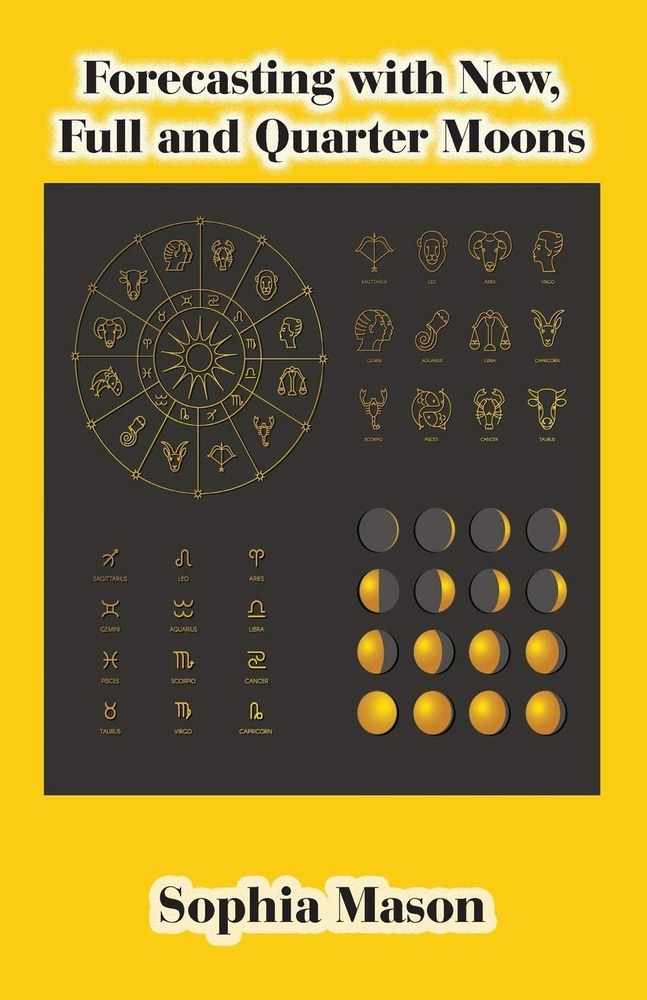
Forecasting with New, Full and Quarter Moons
Sophia Mason
A New Moon for a month, a Full Moon for two weeks, read by where each falls in your chart
Where the New Moon Falls in Your Chart
Sophia Mason's Forecasting with New, Full and Quarter Moons is about how each month's New Moon and Full Moon fall in an individual birth chart. Calendars print the dates of the New and Full Moons, and people often say one day is good for starting something and another for letting go. But there is only one New Moon in the sky, and in each person's birth chart it falls in a different house and meets different planets. So the question Mason sets out to answer is which house of your chart this month's New Moon falls in, which planet it aspects, which part of your life it will touch this month, and how to handle it.
It is a slim volume, seventy-six pages in the original. A short introduction lays down the rules first: a New Moon works for a month, a Full Moon for two weeks, a solar eclipse for a year and a lunar eclipse for six months, and the orb from a New or Full Moon is five degrees to a natal planet and ten degrees to a planet transiting on that day. Twelve chapters follow in house order, from "First House New Moon" to "Twelfth House New Moon," and every one is built the same way. Each opens with the conditions that put the emphasis on that area of life, then covers the New Moon falling there, a planet the New Moon conjoins there, and the New Moon's aspects to planets in other houses. It closes with the Full Moon and the quarter Moons falling there.
Here is one entry from the chapter on the second house. When the New Moon falls in the 2nd house and squares a planet in the 11th, Mason advises against mixing money with friends this month. The 2nd house is your own income and possessions, the 11th is friends and groups, and in Mason's writing a square stands for an obstacle, so once money gets mixed up with friends, trouble comes easily.
The title talks about forecasting, but in her introduction Mason says this up front:
Lunations are not so much for forecasting as they are for guidance about using wise and well-directed actions
The Book's Contents
- Introduction
- First House New Moon
- Second House New Moon
- Third House New Moon
- Fourth House New Moon
- Fifth House New Moon
- Sixth House New Moon
- Seventh House New Moon
The Rules She Sets
Mason explains in the introduction that the position and date of each New and Full Moon appear on the monthly pages of an ephemeris, and astrology software can work them out too. For eclipses she points to how two ephemerides mark them. The Rosicrucian ephemeris lists all the year's eclipses at the front, and the Raphael ephemeris marks them in its column of lunar phases, a solid black circle for a solar eclipse and two for a lunar eclipse. So the dates are easy to find. What she sets out to teach is how to read one New Moon in a particular birth chart.

She sets the rules down one by one. For the orbs she gives a reason. New Moons, Full Moons and eclipses come back to the same degree of the same sign every nineteen years, so every nineteen years a natal planet receives exactly the same aspect, and the orb to natal planets is held to five degrees. Transiting planets keep moving to new positions, so the orb to them can widen to ten. On the day of a New Moon, a transiting planet other than the Sun and Moon that is within one degree of a natal planet has a more marked effect. Quarter Moons are usually only small everyday irritations and count only within one degree of a natal planet. A conjunction or square to a natal planet often sets off a "mini-crisis," when plans and direction have to change, and the house and sign of the natal planet that is touched show whom or what it involves. She uses a progressed chart the same way as the natal chart, again with five degrees for progressed planets.
The book doesn't say whose tradition she follows. There is no preface and no afterword, and it simply ends when the chapter on the twelfth house ends. The front of the book does list her other titles, among them Lunations and Predictions, The Art of Forecasting and Delineation of Progressions. She wrote separate books on lunations and on progressions, and this one covers only the New Moon, the Full Moon, the quarter Moons and eclipses, placing them house by house in the birth chart.
Where She Looks for a Way Out
Most of the trouble the book describes is small and close to home. When a First or Last Quarter Moon in the 6th house squares a Sun in the 3rd, Mason writes that you have too much on your plate and your energy is scattered, and you may start doubting your abilities for no reason.
If a Full Moon or Quarter Moon makes a sextile or trine to a natal or transiting planet, that planet shows where the problem can be solved, and she writes this at the end of almost every chapter. In the first chapter, a New Moon square Mars would mean watching out for bumps and mishaps, but if it also sextiles a planet in the 3rd house, the sextile is good protection.
When to Watch Which Part of Life
A New Moon covers a month, a Full Moon two weeks, a quarter one week and a solar eclipse a year. With those spans in mind, you can tell which area of life to watch at which point in the year. Say a solar eclipse falls in the 10th house. Mason writes that whatever aspects it makes, you should be ready for changes in your career, take a careful look at your goals in life, and not overextend your credit.
A Full Moon covers two weeks. If it falls in the 1st house opposite a Sun in the 7th, those two weeks are no time for any serious negotiation. Your ideas are likely to clash with the other side's, a partner or associate may not cooperate just then, and her advice is to learn to compromise and go along with the other person for a while. If a Full Moon falls in the 2nd house opposite a Sun in the 8th, an unexpected bill may arrive, or a debt you had forgotten, and before buying anything beyond what you need, make sure you have enough cash on hand.
Another thing she does often is count a house from another house and read it again. The 5th house is the 2nd counted from the 4th, so a Full Moon in the 5th may mean a parent has a decision to make about their own money. The 12th is the 6th counted from the 7th, so when a New Moon in the 7th is inconjunct a planet in the 12th, she suggests keeping an eye on a partner's health and work.
Chapter by Chapter
The book is an introduction and twelve chapters. All twelve chapters share one framework, with the first as the model, and when the later chapters come to the conjunction they often point back to the first house or say "as with the other houses." So below, the framework is laid out under Chapter 1, and for each of the other chapters one entry is picked out.
Introduction
The introduction runs only a few pages, and all the rules are in it. The periods of effect, the orbs and the one degree for quarters were covered above. It also gives her working method. Each month take two copies of the birth chart, write the New Moon and all the transiting planets of that day around the outside of one, and do the same with the Full Moon on the other. Write an eclipse degree on the chart for the next six months after a lunar eclipse, or twelve after a solar one, and watch especially for the first New or Full Moon that squares the eclipse point, roughly three months later. Major planets aspecting the eclipse point can also set off an event. For other New Moons, follow the transiting Sun and Moon as they move on from the New Moon's position. With a New Moon in Gemini, watch for the Sun and Moon to aspect natal or transiting Mercury, and for the day the transiting Moon enters the natal 3rd house. With a New Moon in Pisces, it is Neptune and the 12th house instead. After all this, she writes:
Experience in watching lunations and maintaining accurate records is by far the best teacher.
Chapter 1: First House New Moon
The first chapter is the model for the whole book. It opens with four rules for when the emphasis falls on the person themselves: a New Moon or solar eclipse in the 1st house or within five degrees of the Ascendant, a New Moon aspecting a natal or transiting planet in the 1st house, a New Moon aspecting the ruler of the Ascendant, or a New Moon in Aries, whatever house it falls in. The later chapters apply the same four, changing only the house and the sign. Next comes the conjunction, which she puts ahead of all the other aspects. The planet the New Moon conjoins is the focus of the month (for an eclipse, of the year), and you look at what kind of planet it is, what sign it is in and which house it rules in the birth chart. Then come the New Moon's sextiles, squares, trines, inconjuncts and oppositions to planets in other houses, nine groups in all, a paragraph each. Last are the Full Moon and the quarter Moons in the 1st house. At the end of the chapter she adds two points. See where Mars, the natural ruler of the 1st house, is transiting, and when a New Moon is in Aries but not in the 1st house, ask which house the ruler of the Ascendant has now reached.
Of the nine groups, take the square to the 10th. With a New Moon in the 1st house square a planet in the 10th, she warns against quitting or changing jobs and says to watch for someone damaging your reputation.
Chapter 2: Second House New Moon
This chapter is about your own money, but it often reads as though it is about other people, because this is where Mason counts houses from other houses the most. The 2nd house, for instance, is the 8th from the 7th, so with a New Moon in the 2nd, a partner may have a big decision to make about money.
Chapter 3: Third House New Moon
A New Moon in the 3rd house makes for a busy month, with plenty of news and paperwork and a lot of short travel back and forth. A solar eclipse here carries a different weight. It changes your outlook, your surroundings, or the circumstances of your siblings and close relatives.
Chapter 4: Fourth House New Moon
A New Moon in the 4th house is about family, home life, parents and older relatives, and repairs, remodeling and moving all belong here. She also notes that over the course of a year, old matters often wrap up at this point, and new beginnings get planned.
Chapter 5: Fifth House New Moon
When a solar eclipse falls in the 5th house, relationships with children may change. One child leaves home to study, another who had left home moves back.
Chapter 6: Sixth House New Moon
When a Full Moon in the 6th house opposes a Sun in the 12th, which in her writing stands for hidden matters and people working behind the scenes, she warns that someone at work may be quietly working against you, and that personal matters are best kept to yourself.
Chapter 7: Seventh House New Moon
When a New Moon falls in the 7th house and is inconjunct a planet in the 12th, someone charming and new may come along, with something hidden underneath. Mason's advice is:
Enjoy the relationship while it lasts, but try not to become emotionally involved.
Chapter 8: Eighth House New Moon
When a solar eclipse falls in the 8th house, joint financial arrangements may change a great deal, and taxes, insurance and debt all need watching. Mason advises against big purchases that need a loan that year.
Chapter 9: Ninth House New Moon
The 9th house covers long-range plans, people and business at a distance, travel and learning, as well as legal documents. With a Full Moon in the 9th opposite a Sun in the 3rd, papers or news from far away may push you to a decision. Mason advises being conservative in speech and not making promises you can't keep.
Chapter 10: Tenth House New Moon
With a Full Moon in the 10th house opposite a Sun in the 4th, career and home may pull against each other. Mason warns against carelessness during these two weeks and suggests finishing the details of the work in hand one by one.
Chapter 11: Eleventh House New Moon
With a solar eclipse in the 11th house, some of the new friends made that year will be helpful and some unreliable, and Mason goes on:
Old friends will leave, making way for new ones.
Chapter 12: Twelfth House New Moon
The 12th house covers confidential matters and investigations, institutions of every kind, solitude and personal limitations. For a solar eclipse here, Mason advises against looking for a new job that year and recommends keeping to the daily routine. It is a good time for research, for writing a book or poetry, or for taking up dance or music.
How to Read This Book
Start with the introduction. It is only a few pages, and the periods of effect, the orbs and the two-chart method are all there, so reading it twice takes little effort. Then read Chapter 1 all the way through, since the later chapters are written on its framework. After that there is no need to read in order. Find which house of your chart this month's New Moon falls in and turn to that chapter. See whether the New Moon conjoins a planet there, which houses hold the planets it aspects, and where the Full Moon falls. Read one chapter a month, and by the end of a year you will have opened most of them.
The book has its limits. It is written about American lives, with retirement accounts, country clubs and a few old ephemerides, and some scenes need carrying over into your own situation. Each chapter gives only the general influence of a house. Mason herself says at the end of the introduction that to understand a particular chart you have to work it out from the signs of the natal and transiting planets together with the houses and signs of the New and Full Moons, and she doesn't teach this step in detail, so it comes down to your own practice. All twelve chapters share one framework, so reading them straight through gets repetitive. Some of the eclipse passages put the consequences at their worst, so keep in mind that most of what she writes is "could" and "may." The periods also disagree in one place: the introduction gives a lunar eclipse six months, while the chapter openings say three to six months.
Mason has readers write the New Moon and the Full Moon around the outside of their own chart every month, for a whole year. Your Year of New and Full Moons in Depth lays that year out for you in advance. For one year from the report date, every New Moon, Full Moon, quarter Moon and eclipse is dated exactly, and the house of your birth chart each one falls in and the natal planets it touches all go into one timetable. Eclipses from before the report date that are still in effect are taken up in that same section, if there are any. Then each lunar month gets a section of its own. Following Mason's chapter for each house, it says where the emphasis lies that month in the area of life the New Moon falls in. If the New Moon conjoins a planet, that planet is the focus of the month. It looks at where the ruler of that house is now transiting, which area of life the Full Moon's two weeks face, and, if the Full Moon sextiles or trines a planet, where that planet points the way to a solution. Quarter Moons come in only when they are within one degree of a natal planet, and the first New or Full Moon to square an eclipse point is read in the month it falls in. Last, the whole year is put together to see which houses are touched again and again. It reads only this one layer, the New and Full Moons on your birth chart, and leaves out progressions and a reading of the whole chart.
 Your Year of New and Full Moons in DepthSee report · $19
From the chart to a written reading
The reports below are written readings, sent as a PDF by email.