The Book of PlutoFinding Wisdom in Darkness with Astrology
Steven Forrest
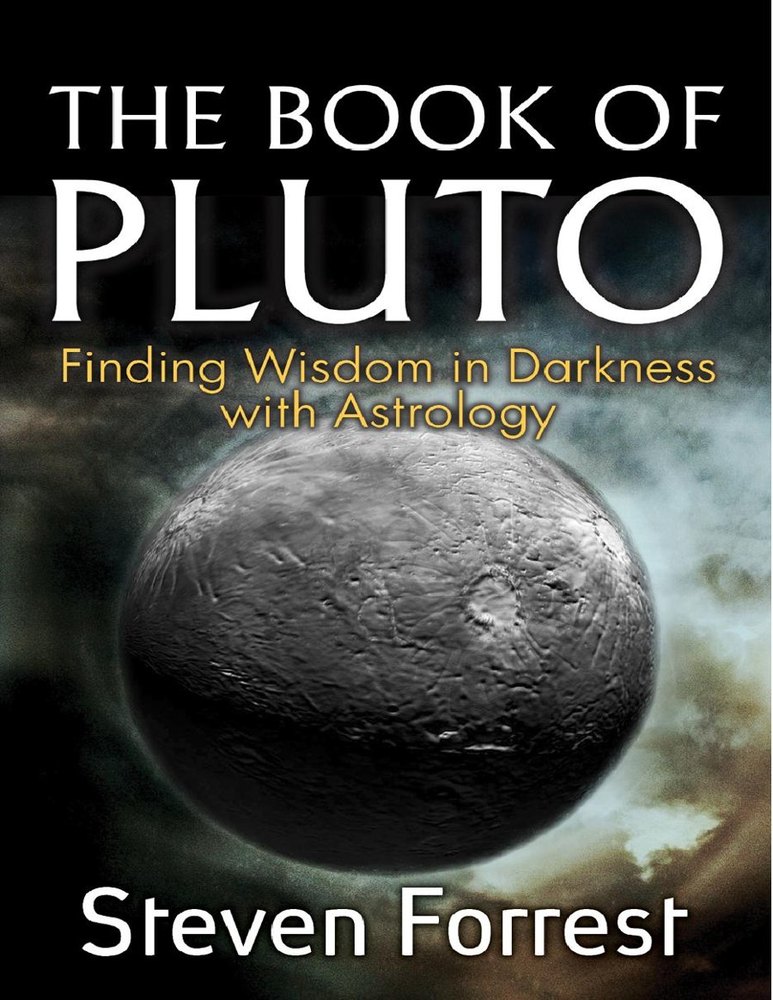
The old wound hides where Pluto falls, and so does the strength.
A Beer Can by the Compass
There are things you say you dealt with long ago, and you can speak of them quite calmly, yet at a certain turning point the same scene appears in your life again, and you react much as you did back then. This is what the American astrologer Steven Forrest, one of the leading figures of evolutionary astrology, writes about in The Book of Pluto: Finding Wisdom in Darkness with Astrology. Published in 1994, the whole book is about this one planet. Forrest addresses the reader directly as “you”, describing what is stored where Pluto falls in your chart and when it will be stirred up.
He tells it through a parable. A husband and wife set sail from the California coast for an island offshore. The husband opens a can of beer and, while watching the seabirds, idly tucks it into a gap beside the compass, then forgets about it. The can is steel, and it pulls the compass needle a few degrees off. The wife takes the helm and follows the course she has carefully worked out, a course that should have taken them two miles wide of a reef. After dark, the boat runs onto the rocks. Forrest points out that the error was small, and that is what made it more dangerous; had it been larger, they would have noticed.
Everyone, he says, is born with an inner compass, and only by being true to it does a person feel that life has meaning; the birth chart is a symbol of that compass. The old wounds that have been pushed down and never thought through are the beer can beside it. They quietly turn a person a few degrees off course in the choices that truly shape a life, in love and in work, while he believes he has been following his course all along. As for where the wound is stored, Forrest gives an astrological answer:
Pluto represents our hurt places — and where we pay the storage fee, at least until we clean up the mess.
The storage fee is no idle phrase. Keeping pain out of awareness takes a great deal of energy, so the most common sign is simply tiredness, a person who can take an interest in nothing.
He also describes two middle-aged women who came to him for consultations, both of whom had been told over and over as girls what “a woman's place” was. One complied and accomplished almost nothing. The other worked in real estate and earned several hundred thousand dollars a year, but she was a workaholic who could not stop, and her marriage was fragile. The same wound was stored, for the first, in her confidence in herself, and for the second, in her intimate life. Psychologically it is hard to predict which part of life a person will store a wound in; astrologically, Forrest says, it is easier: look at the house of natal Pluto, then at its major aspects to other planets.
The book begins with the dark places in the human heart, then goes through Pluto house by house, sign by sign and aspect by aspect, teaches you to recognize your own Plutonian times, and ends with how to live with the dark. Much of it is about wounds, but Forrest believes just as firmly that once a person has truly done Pluto's work, it becomes a symbol of passion and purpose.
The Pluto He Found in the Woods
When he comes to the twelfth house, Forrest first sets out the traditional view: this is the “House of Troubles”, and any planet here is seen as a source of misfortune, doubly so for a planet already counted “malefic”, as Pluto is. Pluto in the eighth house falls, by tradition, into the “House of Death”, which ancient astrologers used to time a person's passing. He reports these old teachings as they are, and says that he himself has observed no link between Pluto in the twelfth house and a life full of disasters.
Forrest's view of Pluto turned in 1973. He was working at a dispiriting job, and one day he skipped work, went deep into a forest, and there on a rock suddenly recognized Pluto in himself. The astrology books he was reading painted Pluto darkly, tying it to the blackest and most tragic feelings a person can bear. He grants that this is not wrong, and the opening chapters of his book are about exactly those dark places. But that day he felt that Pluto also stands for what makes a life meaningful, for the urge to do something beyond eating and earning a living. It was then, too, that he understood Pluto's sterner meaning: life has no ready-made meaning in itself, and meaning has to be created, actively and consciously.
His other change was to bring psychology to Pluto while staying wary of it. He borrows Jung's “shadow” in its broader sense, covering everything that has been repressed, including positive and creative parts. He cites a talk by Robert Bly on the witches of fairy tales, and Stanislav Grof's research on the process of birth. Yet he also warns that the framework of psychology has seeped so deeply into modern astrology that it is easy to develop a reflex of blaming every present difficulty on childhood harm, which is like going back to the Middle Ages, with poor Mom and Dad standing in for the devil. Between religion and psychology, he leaves a place for the counseling astrologer. In Plutonian times, he says, pure religion and pure psychology both fail, and the roles of priest and psychotherapist often overlap; a competent counseling astrologer works the same way.
He is clear in the book about the limits of prediction: when Pluto will be triggered can be forecast simply from transits and progressions, but how a person will respond cannot. Nor does Pluto passing over a sensitive point in the chart necessarily bring something terrible; it may only mean that the time has come to clear out old business.
A Mother's Backward Glance
In the second chapter, on the lives parents did not get to live, Forrest gives an example with no villain in it. A young woman with a fine voice was on her way to a career in opera when she fell in love and became pregnant by accident. The two of them decided to marry and have the child. She became a full-time mother and from then on would not let herself think about that dream. When her daughter was six, mother and daughter met a single painter friend in the street and exchanged a few words. After the painter had walked off, the mother glanced back after her and told her daughter that this was the luckiest woman she knew, because she could paint all the time.
It was a single sentence, but the daughter took it to heart: creative freedom was the thing most worth having in the world. When she grew up she went into a music program that embarrassed her at every turn, aiming to become a violinist. Forrest imagines that she had in fact come into the world for the rich experience of marriage and family life, a path less dazzling than the artist's but, in his eyes, just as sacred. So the life her mother had not lived came to rest on the child. That is why, in Plutonian times, he often asks clients: if your parents' lives had been a little freer, a little more conscious, or simply a little luckier, what might they have become?
He never treats these wounds as character flaws a person cannot change. To him they are knots in the heart; untie them, and the energy they have been holding can go to more interesting things. He speaks just as plainly about himself. On transiting Pluto square natal Jupiter, he describes his own years: each day, after his wife at the time had left for work, he put on a heavy coat and a scarf, turned the heat down to 45 degrees Fahrenheit, and wrote his first astrology book. He had turned down a job in Washington as a political speechwriter, preferring to draw unemployment, and he adds that he is not proud of it. The book, once finished, was rejected everywhere and was never published. He says that period was not easy, but it was not bitter either; his confidence in himself as an astrologer and a writer was forged then.
Why the Same Play Keeps Running
A woman whose father left her as a child grows up to fall in love with a man who will leave her in the end. Or, the other way round, she leaves a good man who truly loves her, feeling he is “not the one”, and this time she is the one who breaks a heart, as hers was once broken. Two different routes, the same play. In the third chapter Forrest puts this pattern into a single sentence:
that which we do not think out, we will live out...again.
So meeting the same kind of person or the same kind of situation again and again is often more than bad luck; it is an old matter, never thought through, looking for a way out. Only by recognizing this does a person have a chance to pause before the play begins.
The book also gives a sense of timing. Forrest says a Plutonian time usually takes a year or two to unfold. A fast planet crossing natal Pluto's position is over in a few days, while a progressed planet lingering in aspect to natal Pluto may drag on for ten years. Knowing that you are in such a stretch of time, you will not expect it to end tomorrow, nor will you take every rise and fall of these years as a sign that something is wrong with you.
What to do at such times he measures simply. Whether you go into therapy, see an astrologer, join a church, which book you read — all of these matter, but they all give way to one question: how deeply are you willing to feel? Conversely, getting drunk, staring at the television until your eyes glaze, working furiously, exercising furiously, even reading self-help books until everything becomes a concept in your head, are all ways of dodging that question.
The other half of Pluto is meaning. Every time Forrest opens his mailbox there is a pile of fundraising letters. Most end up in the wastebasket, and only a few make him sit down and write a check. Which cause moves which person often cannot be explained, but the small warmth he feels after writing the check is, he says, entirely Plutonian, because it is the heart's response to having done something that makes life meaningful.
Chapter by Chapter
The book has seventeen chapters and an afterword. Chapters 7 through 11 can be used as a reference alongside your own chart.
Chapter 1: The Dark
The first chapter opens with two little girls. One comes home from school to find her mother crying: her father has fallen in love with someone else and will not be coming back. Across the street, the other girl comes home to find her mother crying too: her father was killed in a car accident an hour ago. Psychologically, Forrest says, the second girl has been left behind just as the first has. With these two scenes he divides Pluto's world in two. One half is catastrophe, with no one to blame. The other is a person, in freedom and with no moral necessity, choosing to make others suffer, and for this he chooses a word he himself calls dangerous: evil. Wherever Pluto falls in the chart is where a person must face these hard questions, and how one faces them is, he says, the purest measure of a person's spirituality.
Chapter 2: The Parable of the Beer Can
After the beer can story, the chapter distinguishes several forms of repression. The most complete is total amnesia for the event. A common one is remembering the event clearly but not the feelings of the time, often with the claim that it was dealt with long ago. The hardest to detect is remembering the event, having cried over it even, yet not having understood what it left behind in one's fears and caution. Take a boy whose father, a military man, meant to spur him on by always saying he would never amount to anything. Perhaps he really does not amount to much; perhaps he strives desperately to prove his father wrong. Either way he has strayed from the path he was meant to walk, which Forrest imagines was becoming a veterinarian.
Chapter 3: Think It Out or Live It Out
The point of this chapter is that in a Plutonian time a person can take only one of two routes: face the matter inwardly, or let it surface once more in circumstances. Forrest tells it through Sam. Sam grew up amid his father's rage and learned to be a victim, and also to be a tyrant, because someone touched by darkness takes in not only his own role but the role of the one who hurt him. At thirty-two, on the day his new boss blamed him for a mistake in front of the board, he came home to find that his son had broken a window with a baseball. He very nearly struck the boy, but stopped, saw himself of twenty-five years before in his son's eyes, and quietly said he was sorry. Forrest says Sam knew nothing of astrology, but he was in the midst of a Pluto transit or progression, and this time he did not play the old scene through again.
Chapter 4: Hope, Purpose, and Possibility
The fourth chapter is about what a Plutonian time can bring once you have come through it. Forrest cites Robert Bly's talk on the witches of fairy tales: the witch guards a higher level of consciousness and uses every means to stop the hero, but once the hero gets past her, she drops her mask, as it were, pats him on the shoulder and hands him a cup of cool water. The only people she means to keep out are those without courage. Forrest calls this a thoroughly Plutonian view: to reach glory, you must first be humbled.
Ashes lie on the road to the throne.
Looking back at Sam, the new boss's lie to shift the blame and the broken window can both be seen as tests the witch set up. He barely held on to his awareness and did not let his rage become action, so that force had only one place left to go: upward, into consciousness.
Chapter 5: Fire
The one word that best sums up Plutonian consciousness, Forrest says, is intensity. Around people he considers saints he feels warmth and a little unease; around people who are mad there is the same intensity, but only the unease. The second half of the chapter is about Pluto at the edge of the solar system, symbolizing a very high and refined need, the hunger for meaning. He also points out that meaning is not found only in causes such as saving the whales; a violinist with a passion for Vivaldi is walking Pluto's path just the same.
Chapter 6: Astrology Grammar School; Chapter 7: Pluto in the Houses
Chapter 6 is an introduction for beginners, and those who know the basics can go straight to Chapter 7. Chapter 7 is the backbone of the book: a section for Pluto in each of the twelve houses. Each first describes the house's strengths and pitfalls and how tradition sees it, then how the wound is left there and where it turns a person off course, and also what can be done. On the fourth house, he says that people with Pluto here wanted a safe nest as children and did not get one, and as adults they tend to retreat into self-sufficiency; some have a houseful of children and are dutiful and generous, yet emotionally invisible. One client, borrowing the phrase “near-death experience”, said that life before therapy had been a “near-life experience”; the two of them laughed, and then fell quiet together.
Chapter 8: Pluto through the Signs
Pluto stays in a sign for anywhere from a dozen or so years to about thirty, so Forrest defines “a generation” as people born with Pluto in the same sign. A common scene in the eighties: Baby Boomers with Pluto in Leo, fresh from counseling, come home wanting to talk with their Pluto-in-Cancer parents about what went wrong in the family; the parents feel attacked and the children feel rejected. He calls it the Lion roaring at the Crab's shell. He also explains that on the personal level Pluto's house matters far more than its sign, which is why the sign sections are short. Only when Pluto is prominent in the chart, for instance in a close aspect to the Sun or Moon, conjunct one of the four angles, or in the first house, does its sign matter more for that person.
Chapter 9: Recognizing Plutonian Passages; Chapter 10: The Plutonian Triggers
Chapter 9 first lays down a principle: transits and progressions act upon the birth chart, so read the birth chart first and the transits and progressions after. Faced with the same chance at a sure ten thousand dollars that is not quite honorable, one person takes it and walks away, another takes it and gives it all to a family in hardship; without first knowing who the person is, you cannot say what the event means. Chapter 10 is about which planets trigger Pluto. The first simplifying principle is that slow beats fast: the longer a Plutonian time, the deeper its meaning. Transits of fast planets have to be seen against the larger backdrop of the slow ones. During the stretch when transiting Pluto is sitting on the natal Sun, for example, a single transit of Venus square natal Pluto deserves to be taken seriously. Forrest says it is like a cigarette butt tossed at a gas station, which matters far more than one tossed into a fishpond.
Chapter 11: Pluto and the Planets
This is the longest chapter in the book. It begins with the Sun, the Moon and the four angles and runs all the way to Neptune, ending with Pluto and itself. For each planet he treats both natal aspects and the aspects reached by transit and progression. On Mars, he asks readers to think of bombs and rockets. The two are the same in essence, something flammable packed into a metal shell, and once fire touches it, what follows cannot be stopped. A rocket releases the energy slowly and uses it to fly somewhere; a bomb releases it all at once, without direction, destroying itself along with everything else. When transits or progressions bring Mars and Pluto into a hard aspect, this is the choice a person faces, so the energy needs a direction then, toward pursuing what one truly wants.
Chapter 12: Living with the Dark; Chapter 13: The Proverbs of Hades Under Plutonian Stimulus
Chapter 12 is about the other side of goodness. Out of kindness, for instance, parents may keep a timid child at home too long and let him stay dependent; a husband may forgive his wife too quickly, so that she never grasps how deeply she hurt him. Forrest says goodness nearly always feels good, but goodness without wisdom makes people weaker; compassion is kindness tempered and deepened by wisdom. He gathers the theme of the whole book into a single phrase:
truthfulness beats goodness
His explanation is that someone who has come to a conscious peace with his own desires, selfishness, ambition and bad temper will, in the long run, be wiser than a “saint”, and most likely kinder too. Chapter 13 consists of thirteen “Proverbs of Hades”, each in the form “if you do this, you will attract that”: gullibility attracts liars, for example, and generosity attracts parasites. Each, he says, has two sides, victim and perpetrator, and these proverbs come true in life only when there is an unfaced wound in the heart and a hard Pluto aspect at the same time.
Chapter 14: Jerry Brown; Chapter 15: Joan of Arc; Chapter 16: Mestre Gabriel; Chapter 17: Eric Clapton
The last four chapters look at the charts of four real people: Jerry Brown, Joan of Arc, Mestre Gabriel of Brazil, and the guitarist Eric Clapton. Forrest notes first that these chapters also look only at Pluto, so they inevitably see the trees rather than the forest; real charts are used to bring the earlier principles to life.
Afterword: The New Solar System
In 2006 the International Astronomical Union demoted Pluto to a dwarf planet. In the introduction Forrest calls this good astronomy, but says “planet” was always more of a cultural word; astrologers have long called the Sun and Moon planets too, so he goes on calling Pluto a planet. He is, he says, an astrologer to begin with, not an astronomer. The afterword was originally an article published in 2006. In it he proposes trying to drop the word “planet” altogether, and suggests seeing what lies beyond Neptune as a doorway into the unconscious, with Pluto as its gatekeeper, moving between the two worlds like a shaman.
How to Read This Book
The stories of the beer can, Sam and the witch are all in the first five chapters. Read from the introduction through Chapter 5 first, and the technical chapters that follow will have something to rest on. Then find the house of your Pluto in Chapter 7, find the sign Pluto was in during the years of your birth in Chapter 8, and look up in Chapter 11 which planets in your chart it aspects. The real charts in the last four chapters are best read after all the rest.
The book has its difficult side. It was written in 1990s America, and many of its jokes, ads, television shows and churches were familiar mainly to American readers of the time. Its examples are also written very directly, including violence in the home and the loss of loved ones, so take them at whatever pace suits you. In going through Pluto position by position, Forrest admits that he breaks a basic rule of astrology, that nothing can be read out of context, so he leaves the work of synthesis to the reader. Technically, he uses Placidus houses and treats a planet less than a degree and a half from the next cusp as already in the next house. Since a four-minute difference in birth time shifts the cusps by about a degree, he suggests that anyone whose Pluto is only a degree or two from a cusp read the passages for both houses and see which sounds more like them.
What Forrest can forecast is when Pluto will be triggered; what he cannot forecast is how a person will respond when it is. Your Pluto in Depth works out the half that can be calculated for you: the times Pluto is triggered for you over the next five years are calculated precisely by the program, along with how to recognize that you have entered such a time. In reading your own Pluto, the weight falls on its house, because on the personal level house matters far more than sign; the sign you share with your generation, and Pluto's aspects to planets in your chart, are read together on the foundation of the house. The half that cannot be calculated, the report addresses in terms of whether you come to understand on your own or are forced to by life, and how to live with the dark places within. It reads Pluto alone; the rest of your chart is not in this report.
After reading the report, turn back to the pages for your house in Chapter 7 of the book, and what Forrest wrote for that position will read more clearly.
 Your Pluto in DepthSee report · $15