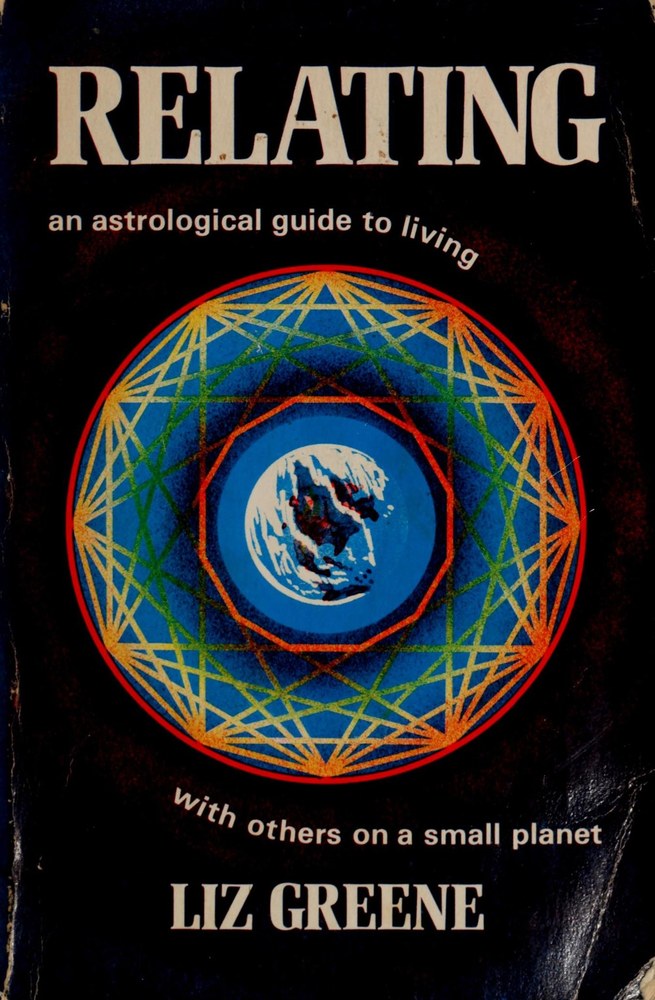
Relating
Liz Greene
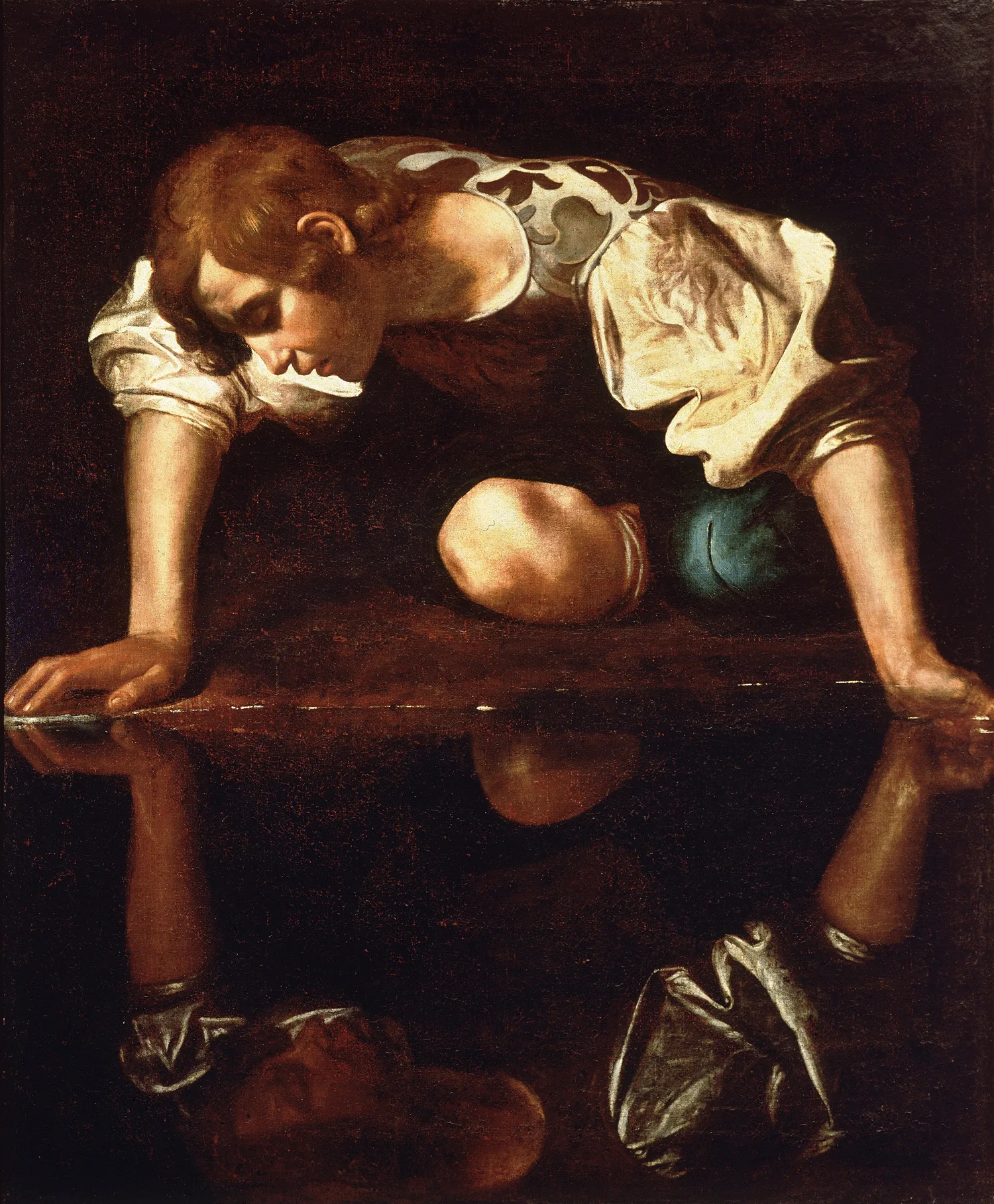
For Greene, relating is a way of recognizing yourself in other people.
Greene's View of Relationship
Once a relationship is past its first few months, most people have either said it or heard it: “You've changed.” In Relating: An Astrological Guide to Living with Others on a Small Planet, Liz Greene's answer is that the other person has usually not changed much at all. What has changed is the image you placed on them. The book came out in 1978. It is about how a person lives with other people, and what astrology can do to help.
Greene starts with fairy tales. The prince and the princess live happily ever after, with no divorce courts and no alimony. As adults we all know it doesn't happen, so we learn to say that relationships take work, responsibility and commitment, words used so often that their meaning ought to be plain by now. Yet once we are actually living inside a relationship, the words grow vaguer, because the person in front of us, whether husband, wife, child, lover, teacher, business partner or even enemy, is in the end still a stranger.
Her starting point is that relationship is more than a way for two people to meet each other's needs. A person needs it in order to grow in consciousness and come to know himself. We only learn what we look like by looking in a mirror. The psyche is the same: it has to see itself reflected in someone else. So the whole book turns on one key, projection: taking something in yourself that you haven't recognized for something in the other person, and then loving and hating them for it. As for what astrology offers here, she says the study of the human soul belonged to astrology long before anything else, and its real value lies in exploring the psyche, not in predicting the future. Joined with depth psychology, it has something to say about how people relate to one another, because relating is itself a path to knowing oneself.
The book gives an example. A man is convinced that women devour, manipulate and destroy men. He says he likes women all the same, and every woman he goes out with does end up trying to devour him, manipulate him and destroy him. He believes he has seen women for what they are. Greene's view is that these qualities may have been seeds in those women that would never have sprouted, and that he watered them and gave them sun, over and over, with his projection until they came up. The same woman in another relationship might be someone else entirely. Since half of it is his own doing, that half can be changed from his side.
The Book's Contents
- Introduction
- The Language of the Unconscious
- The Planetary Map of Individual Potential
- Air, Water, Earth, Fire - The Psychological Types
- Beauty and the Beast
- The Inner Partner
- The Sex Life of the Psyche
- Honour Thy Father and Mother - with Reservations
Old Readings She Revised
The first thing Greene takes apart is the Sun-sign column in newspapers and magazines. These columns turn each sign into a ready-made list of traits, Aries impulsive and combative, Taurus steady and fond of comfort, and she says they have done astrology a good deal of unintended harm. Even serious students fall into the same trap. She sees the Sun as what a person is working to become, a road walked for a whole lifetime, and a person often begins to ask who he really is only after thirty, after the Saturn return around twenty-nine.
Traditional astrology calls the Descendant the cusp of the house of marriage and says it shows the qualities a person looks for in a partner. Greene reads it another way. The Descendant sign is the side of you opposite the Ascendant, unconscious but needing to be taken in, and because it is unconscious it is usually projected outward, so what it really describes is the partner within. Tradition treats Saturn as a bringer of misfortune. She prefers the alchemists' reading, in which Saturn is the raw material that gold is made from, and what matters is what all that hard grinding is good for.
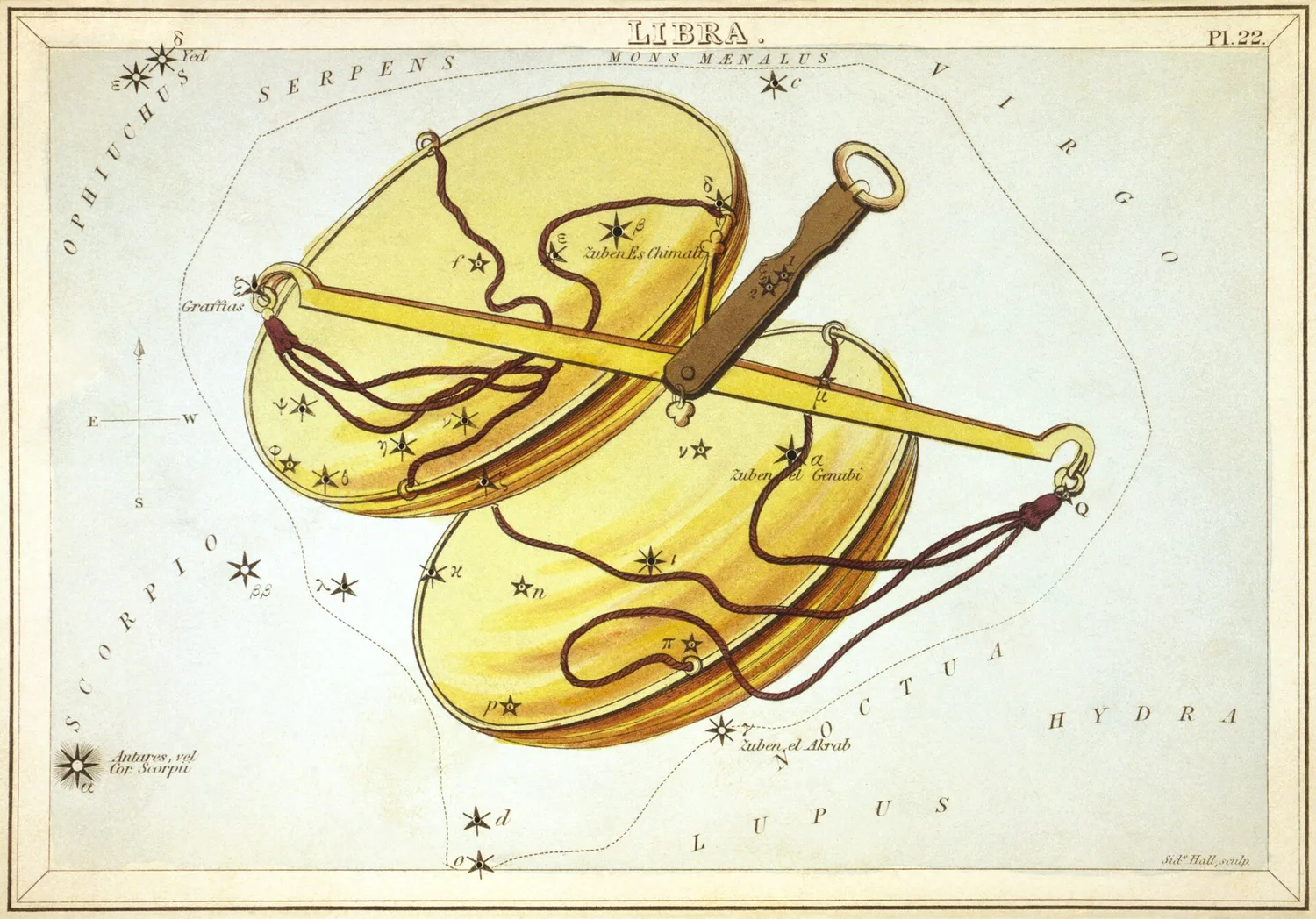
Synastry gets the same treatment. Traditional synastry takes a harmonious link between one person's Sun and the other's Moon as a good sign for a long and happy marriage, and when Jung analyzed the charts of a group of married couples, the aspect he found most often between one partner's Sun and the other's Moon was the sextile. Greene still doesn't treat synastry as a verdict. She calls its traditional techniques a useful lens, and says that used too literally they are worse than useless, because they mislead. No one should ever decide to begin or end a relationship on chart comparison alone.
There is no such thing as a pair of divinely suited birth charts.
She follows Jung. She says his four psychological functions fit astrology's four elements exactly, two ways of describing the same thing, with neither one explaining the other. Jung, as a doctor and researcher, had the courage to study astrology, and she thinks people today should have the courage to use this new tool. The book often quotes other Jungian writers, Edward Whitmont, June Singer and Esther Harding, and sets Assagioli's model of the psyche beside the birth chart, with the reminder that a model is only ever a model.
Choosing the Same Kind of Partner
Some people fall in love with the same kind of person again and again. The name changes and the job changes, and it is still the same kind of person. What Greene sees in her cases is that the qualities that fascinate us in the other person are often the very things our own chart holds and we have barely lived, and we have put them onto someone else. That person may never have pretended to be anything. It is the fantasy placed on them that keeps us from seeing them as they are.
Only as someone slowly finds these qualities in themselves can that weight be put down. Greene says earthy signs grow slowly and don't flower until the second half of life, and that a person who keeps coming up empty in outer unions can turn around and learn to build an inner one. In every case she tells the person's story first and only then turns to the chart.
Recognizing Your Own Projections
When two people quarrel, someone standing by is often startled to find that what each accuses the other of is exactly what both are doing. Greene says every marriage counselor has seen it. To an outsider it is comic and sad, and the two people inside it can't see it at all. So by her account, when something provokes an unusually strong reaction in you, it is worth a second look.
She borrows an observation from Whitmont. Ask someone to describe the kind of person he can least stand, and what he describes is often the side of himself he has pushed down, and he describes it with unusual vividness. He is the last to see this, while the people around him see it clearly.
Families work the same way. Many people in their thirties and forties are still settling accounts with their parents in their heads. Greene accepts that the stage of resentment has to be gone through. She only moves the reckoning one step further back. A child is not an empty container. He comes to his parents with expectations of his own, and what hurts is often the gap between those expectations and what the parents actually managed. Only when a person feels compassion for his own darkness can he feel it for his parents' darkness, and then the parents appear as people with light and dark in them, and no longer as monsters.
Chapter by Chapter
After the introduction the book has nine chapters and then a conclusion. The first three lay the groundwork, on the unconscious, the planets and the four elements. The middle four are about relationship itself: the shadow, the inner partner, intimacy and the parents. The last two are about time, and the book ends on the age we live in as a whole.
Chapter 1: The Language of the Unconscious
Greene compares projection to watching a film. We keep our eyes on the images on the screen and never turn round to look at the reel running through the projector. Projection works the same way. We think we are seeing the other person, when what is showing is our own film, and the work of a lifetime is to take back, bit by bit, what we have projected. How do you know you are projecting? She gives one sign:
The hallmark of projection is not the viewpoint, but the intensity and high charge of the reaction.
So if one person hates a certain view with a passion and another hates the opposite view just as fiercely, both may be projecting. Unlike Freud, she doesn't treat the unconscious as a rubbish bin. She compares it to a gardener's compost heap, without which no good garden grows. To deal with the unconscious you first have to learn its language, just as an Englishman in Germany can't get by speaking only English. That language is symbol, and astrology's symbols are one form of it.
Chapter 2: The Planetary Map of Individual Potential
This chapter goes through the birth chart and the ten planets, and the Sun and Moon are read side by side. The Sun, drawn on the chart as a dot in a circle, stands for the urge to become oneself, the person one is working to become. The Moon is the urge to go back, to the past, to the mother, to sink into feeling, and it stands for instinctive needs. So Leo reads differently on the Sun and on the Moon. Someone with the Sun in Leo pursues creativity and recognition consciously, as the direction he has to go. Someone with the Moon in Leo needs a stage and applause without knowing it, and only feels safe when he has them. Venus and Mars are paired the same way: Mars is wanting, and Venus is wanting to be wanted.
Chapter 3: Air, Water, Earth, Fire: The Psychological Types
Air is thinking, water is feeling, earth is sensation and fire is intuition. A person usually develops one dominant function first, and the weakest stays in the unconscious, where it is often projected onto other people. Greene tells this through a fairy tale. A king has three sons. The two elder ones are clever and strong, yet it is the youngest, the simpleton everyone laughs at, who saves the kingdom, and this least regarded son is the inferior function within us. Among her examples for air, a wife complains that in forty years of marriage she has never been given flowers, and her Aquarian husband answers, “But I told you I loved you when we married. Isn't that enough?” The greatest use of typology is in learning the hardest lesson there is, that not everyone is like me. But she won't let anyone use the types to label people. Typology is a road map that shows where you are starting from, and it was never meant as a set of boxes.
Chapter 4: Beauty and the Beast
This chapter is about the shadow, Jung's term, which astrology ties to Saturn. Saturn's sign and house are where a person is most blocked, most awkward and most likely to overcompensate. With Saturn in Aries, for example, the great fear is falling behind or losing, so the person either turns passive and sneers in private, or turns into the bully. The side that has been pushed down keeps surfacing. Greene says this could be a springboard for growth, if a person is willing to own their dark side. The shadow becomes an enemy because we treat it as one.
Chapter 5: The Inner Partner
This is the longest chapter in the book. A man carries within him an image of a woman, which Jung called the anima, and a woman carries an image of a man, the animus. When we fall in love, this image is projected onto a suitable “hook,” and when someone says “you've changed” after the honeymoon, what has changed is the projection. Here Greene takes up a view many writers have put forward:
there are not merely two people; there are four.
These are the two conscious selves and the partner each of them carries inside. She also says that one bad relationship can be put down to chance, but two make a pattern, and that is the inner partner pushing. On the chart, the Moon and Venus in a man's chart and the Sun and Mars in a woman's say the most about this image, and the inner partner often carries the color of the element opposite one's own dominant element. The woman inside a thinking man, for example, is often watery and motherly.
Chapter 6: The Sex Life of the Psyche
This chapter is about intimacy. Greene objects to labeling people “normal” or “abnormal,” and calls it the most ambiguous idea in the modern myth of relationships, one that shifts with the person and the era. Nor does she agree with drawing up an intimacy checklist by Sun sign. A chart can only point to the nature of a person's feelings, their capacity to form relationships, and the leaning of their inner image of the other sex. In this chapter she says the planets don't turn us into anything. They are symbols of certain kinds of psychic energy. So in her hands Venus with Saturn and Mars with Saturn speak of fear and self-protection, and nobody has been handed a sentence.
Chapter 7: Honour Thy Father and Mother, with Reservations
The chart doesn't describe the parents objectively. It shows how this person experiences them and how much weight they give them. From experience Greene reads the father from the IC and the fourth house and the mother from the Midheaven and the tenth, and she says herself that this is not theory and may not apply to everyone. The side of themselves that parents haven't lived is often pressed onto the child, who is left to live it for them, even when it is something the parents themselves look down on. As an adult, the child has to recognize that the drive pushing them along isn't their own. The chapter ends on a short line:
By freeing ourselves, we free our parents.
Chapter 8: The Infallible Inner Clock
This chapter covers progressions and transits, and Greene states her position through one example, the progressed Sun reaching Venus. Tradition says it signifies marriage, but a three-year-old doesn't marry. When the same progression falls on a small child, he may make a close friend, or learn about love from a pet he adores, or his parents may separate. At twenty-one it may mean falling in love or marrying, or ending a marriage, or having a child. Which one it will be, nobody can say. Only one thing is certain: the archetype in the psyche that has to do with relationship has been stirred, and it will find expression through whatever chances are there at the time. So the progression itself makes nothing happen. Astrologers are often asked when someone will marry or whether a couple will split up, and she says this can't be calculated. The Saturn return around twenty-nine and the Uranus opposition around forty-two, which everyone of the same age goes through together, she also treats as turning points in inner growth.
Chapter 9: Relating in the Aquarian Age
Greene places the Age of Aquarius inside each person, and says it isn't something happening out in the world. She starts from Hipparchus discovering the precession of the equinoxes around 150 BC and describes how the sign of each age seeps into that age's values. In the Piscean Age the values of the opposite sign, Virgo, were pushed down, the feminine was devalued, and people's capacity to relate to one another was nearly destroyed. This can't be won back through legislation or movements, only in individual people, men and women alike. The chapter ends by tying back to the title. The gatekeeper on the way to one's own center is the inner partner, and the only way to know it is to understand the outer partners who share this planet with us. We find ourselves only in the mirror.
Conclusion
When someone asks “Should I leave my husband?”, Greene says the question can't be answered with yes or no. It can only be answered with more questions: what does marriage mean to you, and how much of the problem is yours? Astrologers and psychologists who answer yes or no strike her as both presumptuous and dangerous. She brings in Parzival, who did not need heroic deeds to redeem the kingdom, only the right question. Whether two signs are compatible can't be used to dodge responsibility either, since half of any relationship is our own making. At the very end she comes to projection:
It is not wrong to project.
What is wrong is refusing to recognize it.
How to Read This Book
Read the introduction and the first chapter first. They set the tone for the whole book, and that is where projection is explained. After that you can go straight to Chapter 5 on the inner partner, where the relationship you can't let go of right now will probably show up, and then go back to the shadow in Chapter 4 and the parents in Chapter 7. Chapters 2 and 3, on the planets and the four elements, work more like a reference to keep at hand, and you can turn to them when a particular planet or element comes up.
Parts of the book are hard going. It was written in 1978 and is thick with Jungian terms, anima, animus and the inferior function one after another, and readers new to analytical psychology will need time to get used to them. The inner partner is treated strictly as men on one side and women on the other, and the book's picture of male and female roles carries the marks of its time. The intimacy material in Chapter 6 and the Aquarian Age in Chapter 9 feel the most dated today, and a few passages draw on esoteric teaching, which you can take loosely. Greene says herself that she is not trying to prove astrology or teach chart construction. Every case in the book comes with its chart, and you really need an accurate birth chart of your own at hand, or much of the time you can only follow her through other people's charts.
That last point is what Your Relationship Patterns in Depth is for. It reads your birth chart alone. It is not a synastry reading and doesn't look at anyone else's chart. What it reads is the pattern you bring into every relationship, using the judgments Greene makes in this book. One full section is given to the partner you carry inside. If your order includes whether you are a man or a woman, it looks at the planets the book points to for that chart, and then it reads your Ascendant and Descendant as a pair, to see which unlived half of yourself you are looking for in a partner. The sign and house of your Saturn show where in life you guard yourself most and are quickest to put on a hard face. For timing, transiting Saturn comes back into a significant relation with your natal Saturn roughly every seven years and returns to its place around twenty-nine, and in your early forties, when transiting Uranus opposes your natal Uranus, comes the turning point of mid-life. The report dates each of these to the month. The parents, Venus and Mars are read on your chart the way the book reads them. If your chart has Saturn in aspect to Venus or Mars, or an outer planet in aspect to the Sun, Moon, Venus or Mars, those links are read as well. Finally it puts all of this together to see whether it points to one pattern in your relationships.
It reads this one part of you, your relationship patterns, and is not a reading of the whole chart.
 Your Relationship Patterns in DepthSee report · $19
From the chart to a written reading
The reports below are written readings, sent as a PDF by email.