Your Secret Self
Tracy Marks
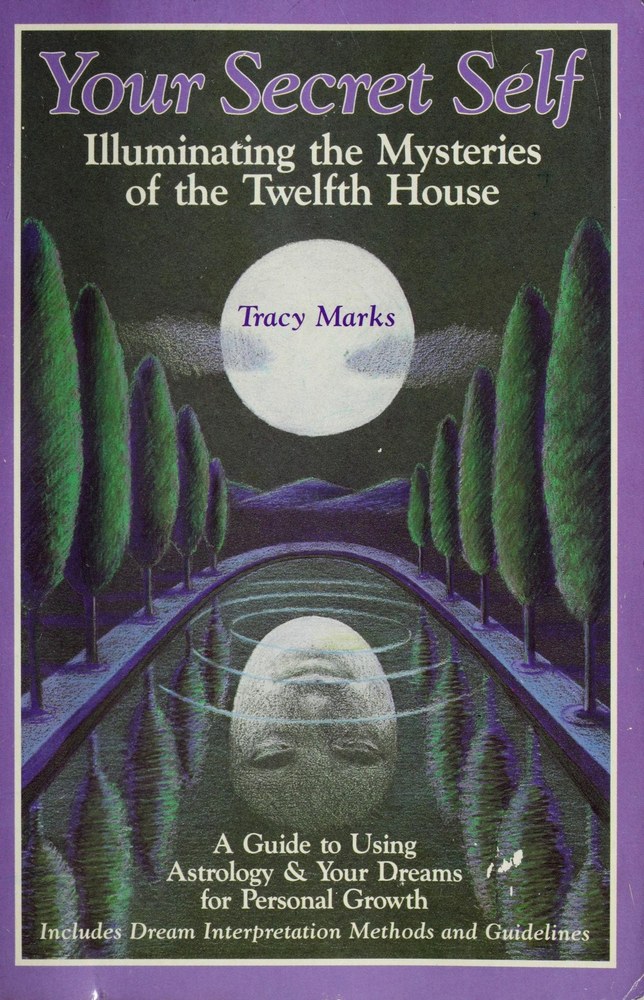
An astrologer who works as a psychotherapist reads the twelfth house as a storehouse
What the Book Covers
Tracy Marks's Your Secret Self: Illuminating the Mysteries of the Twelfth House came out in 1989. Marks is an astrologer who works as a psychotherapist, and many of the people who came to her were studying astrology themselves. She wrote the book to help people recognize the unconscious sides of themselves that quietly work against them. Once these sides are seen and brought back into life, they start to help instead, and most of them are pointed to by the planets and signs in the twelfth house and by the planets that rule it.
She starts from the Sun's daily path. The Sun rises every day, and the first house it passes through is the twelfth. As it crosses the horizon, Marks says, it calls on you to move first downward and backward, into the past. Marks calls the twelfth house the reservoir of the past. Feelings, thoughts and images from childhood settle there, hidden most of the time, and rise when a person is alone, frightening and enriching at once. She also compares it to a storehouse that keeps both what we fear most in ourselves and what is best in us. The better share is creative inspiration and the longing to love and to serve, but to reach it you first have to go down and face past failures and embarrassments, the sides of yourself you dislike, and also the sides you actually admire but have been slow to admit.
The “secret self” of the title is this part of a person: unseen by others, often unseen by oneself, and at work all the time. The book has four parts. The first covers the twelfth house itself and how to find it in your own chart. The second and longest covers the ten planets in the twelfth house or ruling a sign there. The third describes how these conflicts form in the family and how a person gradually brings them back together. The last is about dreams, which Marks sees as one of the best doors into the twelfth house.
One of her examples is a man with Mars in the twelfth house. A friend slights him once without meaning to, and he flies into a rage far out of proportion, as every small annoyance he brushed aside over the past months, because it seemed trivial or because he didn't want to disturb the peace, comes back to him one by one. Marks says people often don't know how much they are holding down until the brakes wear out from overuse and the unacknowledged thoughts and feelings flood in.
The Book's Contents
- Introduction
- The Twelfth House: Your Hidden Wisdom
- Twelfth House Planets & Signs
- The Psychodynamics of Twelfth House Conflicts & the Process of Integration
- Self-Transformation through Dreamwork
- The Dream Experience: Twelfth House Case Studies
- A Twelfth House Dream Journey
A Psychological Reading of the Twelfth House
The twelfth house has long carried a few unflattering names in astrology. It is the house of solitude and of confinement, and it is tied to “secret enemies.” Marks takes these old labels one by one and looks at them as things happening inside a person. Why is it the house of solitude? Because what lies in the twelfth house comes up only when a person is alone. Someone with the Sun there feels a warmth inside at those times, while someone with Saturn there meets a deeply hidden loneliness and guilt. And who are the secret enemies? She says twelfth house energy you aren't aware of has a kind of magnetism and draws to you people who will live it out for you, so the secret enemy is partly yourself and partly the people in your life who act out the negative side of your twelfth house in front of you. People with the Moon in the twelfth find childish, clingy people especially hard to bear, and people with Mars there are quick to label others “aggressive.” Either way, they are running into, in someone else, the part of themselves they won't own.
Here Marks builds on Jung's idea of the “shadow.” She points out that the seventh and twelfth houses are both houses of projection. The Sun casts its longest shadow as it passes through the twelfth house after sunrise and the seventh before sunset, and in Jungian psychology the shadow is the side of a person most deeply hidden and least seen by consciousness. She draws on Howard Sasportas's view that the twelfth house is tied to a person's earliest experiences, and when she discusses integration she borrows his point that a new belief doesn't have to overturn the old one: it takes the old one in and goes beyond it. For myth she recommends Liz Greene's The Astrology of Fate. She draws on psychology more widely, and Bugental, Firestone and Assagioli's psychosynthesis all appear in the book. As for theories that divide the psyche into several “subpersonalities,” she says she has already translated them into astrological terms in The Astrology of Self-Discovery and other books.
The first part is titled “The Twelfth House: Your Hidden Wisdom,” and it has a section devoted to hidden strengths. She says these strengths stay hidden because people often find them only under pressure, when they are forced to draw on their deepest resources. Twelfth house Mars holds the ability to start over again and again, and Saturn the ability to bear solitude and carry responsibility. She also says every planet has two sides. Saturn in the twelfth can be repression and fear, or it can help a person give themselves fully to inner growth and to working quietly alone, but the most constructive use is found only after facing the negative side.
Part of the book is older material. The chapter on the nodes, several passages in the first part and the long poem in the book come from her 1978 booklet The Twelfth House, and most of the rest was written later. The poem is about an astrologer who has spent her time calculating other people's joys and sorrows, while she herself has come to a halt and turned retrograde, sinking every day into her own chart. At the end of the poem she is about to begin rising over the horizon.
Facing the Parts We Dislike
Marks doesn't believe human nature is bad at bottom. She says instincts are neutral. When they are loved and disciplined with a sense of measure, they grow in a good direction, and only long frustration and deprivation make them grow crooked. People with Mars, Pluto or Saturn in the twelfth may carry a fierce, hard drive inside, but it was suffering that twisted them that way. This view shapes how she treats the ugliest part of a client.
When a pushed-away side first shows itself, it is often ugly and childish. Marks is in no hurry to change it, and first listens to what it wants. What she asks of people is to become more whole, not to become better.
We need to be committed to our own wholeness, more so than to our own goodness.
Marks adds right after this that people who identify too closely with virtue may unknowingly act out the very side they guard against most.
How the Book Can Help
The book can help you find where your moments of “overreacting” come from. Marks says twelfth house energy often runs all or nothing: for a while you feel you can't reach it, and then for a while it floods over you completely.
The less an energy is acknowledged and integrated, the more powerful it will express itself
She also wrote out a set of inner sentences for twelfth house planets under squares and oppositions. With the Moon in the twelfth, the thought that keeps running through the mind is “If I start crying now, I'll never stop,” and with Mars it is “If I really let out my anger, I'll drive everyone away.” Writing on anxiety, Marks says anxiety is fear that hasn't been named, and once you give it a name, you gain strength.
She also explains where it comes from when people spoil things themselves just as they are about to take a step forward. She says a child would rather believe “I'm bad and my parents are good” than face the fact that the parents can't be relied on, so the child takes the parents' badness on itself. In adulthood, the moment the person tries to change, the child inside is afraid of being abandoned, and the person undermines themselves. On the surface the fights are about money, love or work, and these fights mostly fall in the houses ruled by the twelfth house planets, but what is really pulling against each other is fear and guilt inside.
Chapter by Chapter
The book has four parts, followed by the cases of six members of a dream group and a dream journey of Marks's own. They are covered below in that order.
The Twelfth House: Your Hidden Wisdom
Part I opens with a “twelfth house profile,” and Marks asks you to take out your chart on the spot: what sign is on the cusp, which planets are in the house, and where its ruler falls. She says that if you have three or more planets in the twelfth, or two with one of them the Sun, Moon or Neptune, a large part of your consciousness is already in the twelfth house, digging through its garbage and its gold mines. Then come the aspects. People whose twelfth house planets are conjunct each other but make few contacts with the rest of the chart may be split in two, inside and out. People with many squares have to wrestle with this force again and again and are pushed to change. People with many oppositions come to know themselves through projection, in the mirror of relationships. People with many trines and sextiles find outlets easily, and their problem is rather a lack of drive, being at peace with themselves too easily.
The sections that follow work through solitude, childhood, relationships, sensitivity, and hidden weaknesses and strengths. In the last section, “Becoming Whole,” Marks says plainly that she doesn't favor forceful methods that pour out held-down emotion in one go, and advises people not to push themselves to see more at once than they can take in.
Twelfth House Planets and Signs
This is the longest part of the book. Instead of short separate entries for the twelve signs, Marks writes a long essay on each of the ten planets, and each one covers both that planet in the twelfth house and the sign it rules in the twelfth. With Leo on the twelfth, for example, you read the Sun chapter. If you have no planets in the twelfth, she sends you to the ruler: a ruler that isn't in the twelfth shows itself mainly in the house it occupies, but strongly colored by the twelfth. Each chapter first covers the planet as it is inwardly and in solitude, then its roots in childhood and the family, its patterns and negative expressions in relationships, and finally the direction of growth. Each ends with a string of images, a list of famous people and a few quotations.
The chapter on twelfth house Mars says these people are unsure of their bodies, and this carries over into trouble with machines and cars: when they feel deflated their tires go flat, when they need to let off steam the exhaust breaks down, and a noisy muffler expresses their anger for them. In the Sun chapter she writes:
As king or queen of your inner castle, you reign supreme.
But right after it she says that outer affairs are much harder for such people to manage. Descriptions like these invite readers to find themselves in every line, so Marks makes clear first that she is describing problems more likely with many squares and oppositions, far less common for people whose aspects are mainly trines and sextiles, and that not everyone will meet all of them. The last chapter of this part covers the lunar nodes in the twelfth house. The South Node is the path of least effort. Use it, she says, and don't let it use you. People with the South Node in the twelfth tend to withdraw inward and get lost in fantasy, and the North Node in the sixth asks them to put their inner ideals into practice. Marks puts the question bluntly: what does that longing of yours amount to if you won't do even the most menial and dirtiest work?
The Psychodynamics of Twelfth House Conflicts
This part covers how the twelfth house forms in the family. Parents with their own defenses push away certain sides of their child with the same force they use to push those things away in themselves, and the child grows a “false self” that pleases the adults. Marks gives a very concrete example. A child rips up his little brother's teddy bear, and on Christmas morning his father gives all of his presents to the brother. Twenty years later he has his own retail store, is wholly taken up by the business, and is still making up for a Christmas morning he barely remembers.
After that come defenses, repression, shame and guilt. She separates two kinds of guilt. Hold back and you meet the guilt of not living out who you are; move forward and you meet the guilt of breaking the family's old rules, so whichever way you move it hurts. She also says people can grow used to suffering, as if a thermostat inside them had been set in childhood: after a long run of warm days, the inner child creates a deep freeze to bring the temperature back down to the old setting.
The Process of Integration: Twelfth House Liberation
The second half of Part III turns to how these sides can be taken back. The first step is really wanting to change, and giving up the benefits of being the victim. Change begins with the light of awareness, but at first that light shows darkness, and the shadow seems to grow larger. She suggests treating a twelfth house planet as a “subpersonality” inside you, talking with it and asking who it is and what it wants. Planets are like gods inside us: neglected, they make trouble, like the fairy in Sleeping Beauty who wasn't invited.
In this chapter she tells the story of Athena, who gave the Furies a new name, the Eumenides, the Compassionate Ones, and built them a temple. Marks's point is that what has to soften first is the inner judging voice, not the shadow itself. She says the aim is more self and less self-image.
Self-Transformation through Dreamwork
Marks says that over the years she has become more and more convinced that recording, re-entering and interpreting dreams is of great value in integrating twelfth house energy. She says the most important thing in remembering dreams is a clear intention. This part gives ways to recall dreams, such as keeping a pen and dream journal by the bed and writing the date before sleep, along with ten hints for interpreting dreams and a dream questionnaire you can copy and use again and again. One point she keeps coming back to is that personal associations matter more than general symbols.
The "key" to dream interpretation is in your hands, not in a symbol dictionary.
She also says that most dreams are quite ordinary, some are fragmentary, and some will probably never be understood, so there is no need to fix only on the extraordinary ones.
The Dream Experience: Twelfth House Case Studies
Marks led a weekly dream group, and that year every member had one or more planets in the twelfth house. Six agreed to make their dreams public. Each case starts with the life situation, then the chart, then the dream and the group's discussion.
A Twelfth House Dream Journey
At the end of the book Marks lays out her own chart and twelve years of dreams, as an example of how one person gradually takes the twelfth house back.
Here she writes that in the twelfth house a person replays old scripts over and over, and something new is also growing there. When a planet leaves the twelfth house and crosses the Ascendant, the person breaks out of the shell.
How to Read This Book
Start with the profile at the beginning of Part I and fill it in item by item with your own chart: the sign on the cusp, the planets in the house, where the ruler falls, and which kind of aspect predominates. Then go straight to the one or two chapters of Part II that apply to you. If there are no planets in your twelfth, read the chapter for the ruler and see which house it falls in. Part III is the densest psychology in the book, full of terms, and suits slow reading. When you reach a passage that touches you, stop there for a while. Marks herself says that the more has been held down, the longer it takes to digest, and she doesn't ask anyone to set this apart as a separate task. Recalling a dream when you wake, or noticing how what annoys you in others works in yourself, both count.
A few parts are hard going. This is late-1980s writing, and the psychology traces a great deal to childhood and the parents, which can feel heavy at times. Marks herself notes that children are born with selective filters of their own, so not everything comes from the parents. One chapter in Part I switches to an esoteric account of the twelfth house, different from the psychological approach of the rest, and can be skipped. The chapters of Part II dwell at length on the problems each placement can bring and come with lists of famous people, and she admits that some of their birth data may not be accurate. The dream part is long and very personal. Her dreams are not yours, and they are best read as demonstrations.
Your Twelfth House in Depth reads this house in your own birth chart, with the profile already filled in for you: the sign on the cusp, any other signs in the house, which house each ruler falls in, and which planets are there. Each planet in your twelfth house is read through its chapter in Part II, for what it is like out of sight, its difficulties and the strengths it holds. For each sign in the house whose ruler sits outside it, the report reads through the ruler's chapter and the house the ruler falls in. A separate section follows the aspects, showing where these forces are drawn. Then it takes several angles from Parts I and III and applies them one by one to the forces in your chart: what comes up when you are alone, what was hard to say as a child, what you tend to meet in other people in relationships, how a hidden weakness and a hidden strength are the same force, and defenses, shame and fear. If your nodes fall across the twelfth and sixth houses, it reads Marks's chapter on the nodes. If transiting Saturn, Uranus, Neptune or Pluto, or a secondary progressed planet, moves into your twelfth house in the coming ten years, it gives when, transits to the date and secondary progressions to the year. It reads whatever is in your chart, then reads it all together, and following the order of the second half of Part III, describes how you can go about taking this part of yourself back, choosing a few of the book's exercises and applying them to your planets and signs. It reads only the twelfth house, the secret self Marks describes, hidden most of the time and showing itself when you are alone.
 Your Twelfth House in DepthSee report · $19
From the chart to a written reading
The reports below are written readings, sent as a PDF by email.