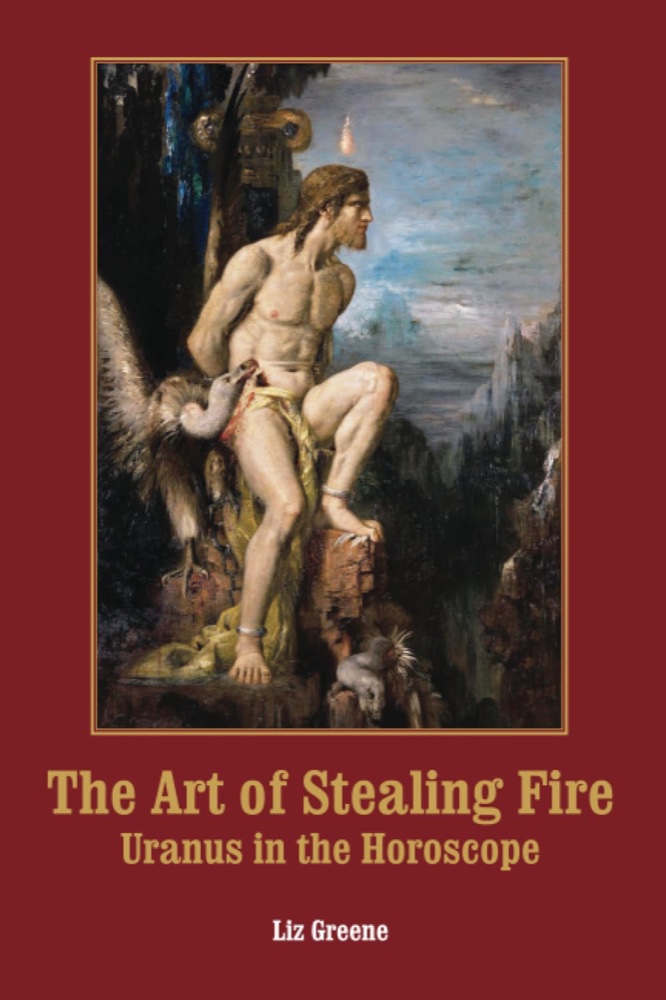
The Art of Stealing Fire
Liz Greene
Greene on Uranus: a person needs a self before they can hold its fire.
What the Book Argues
Liz Greene opens The Art of Stealing Fire: Uranus in the Horoscope by separating Uranus from "individuality." Astrology books often say a strong Uranus makes a person an individualist, and she doesn't accept it. She grants first that the Uranian person may be ahead of their time, opposing old structures and throwing out worldviews that have outlived their use. Then comes the turn:
The Uranian person may be highly unconventional because of this; but unconventional does not mean individual.
A strong Uranus sometimes makes a person less like themselves, because they have been carried off by a set of ideas far bigger than any one individual, and are hardly there at all.
The book was published in London in 1996 as Volume 7 in the seminar series of the Centre for Psychological Astrology, and the whole of it is the record of two days of teaching. The first day, January 20, 1996, at Regents College in London, was on Uranus in the birth chart. Greene starts with the myths, the Titan Prometheus stealing fire from heaven for humankind and the sky god Ouranos overthrown by his son Kronos, then goes on to Uranus in each house and in aspect to the personal planets. The second day, February 17 of the same year, was on the transits of Saturn and Uranus. Greene treats the two planets as two cycles running through a whole life, from Saturn's first square to its own place around age seven all the way to the Uranus return at eighty-four.
The "stealing fire" of the title is the key to the book. When Greene comes to Prometheus she asks the question herself: what does it mean to steal fire? Understand that, she says, and you have hold of what Uranus is really about. Her answer is also the book's main thread. This fire brings foresight and it also brings a bill, and a person needs an "I" first to be able to hold it.
The Book's Contents
- Part One: Uranus in the Natal Chart
- Unconventionality and individuality
- The mythology of Uranus
- Uranian suffering and the punishment of Prometheus
- The Sun and Saturn as containers of Uranian energy
- Uranus in the houses of the horoscope
- Moon-Uranus aspects and childhood anxiety
- Aspects of Uranus to the personal planets
- An example chart
Reading Uranus Through Myth and Jung
The outer planets have no ancient astrological tradition behind them, and that is the first thing Greene points out when she begins. Uranus was discovered only in the eighteenth century, and classical astrologers never saw it. Later writers built up a list of keywords for it, the most common being "the planet of individuality," along with an enthusiasm for change, as if a life will be made new once Uranus arrives. These are the two points Greene revises. She says Uranus, as an outer planet, reflects the collective psyche that all of us live inside. It isn't concerned with personal growth, and it often collides with a person's own values and emotional needs. Her argument rests on the signs. Uranus co-rules Aquarius with Saturn, and Aquarius is opposite Leo, ruled by the Sun, so what it stands for is the very opposite of personal expression, the place where the individual sinks into the group. She also makes clear that she doesn't think Uranus is a bad planet. What she objects to is the way astrologers have romanticized change.
So how does she teach it? Not with keywords. On the overhead projector she puts up a long list of associations with Uranus, including Prometheus, the sky god Ouranos, Plato's Forms, the numbers of Pythagoras and Mary Shelley's Frankenstein. Then she says keywords don't help, and a word like "individuality" actually gets in the way. In psychological terms the planets are gods, living forces with intentions of their own. They have to be known through their myths, and students should grow their own associations.
She draws on two lines of thought. One is myth and literature. Richard Tarnas wrote a book, Prometheus the Awakener, that reads Prometheus's fire as the creative spark and sudden enlightenment. Greene adds a layer: what Prometheus stole from the gods was the potential for consciousness, the bit of awareness of the self in every person. She also quotes at length from Aeschylus's Prometheus Bound, where Prometheus says humans once looked without seeing, and that he taught them the rising and setting of the stars and invented numbers and letters for them. The other line is Jung. Greene holds a doctorate in psychology, is a qualified Jungian analyst, and also completed the diploma course of the Faculty of Astrological Studies in England. On Promethean suffering she quotes the passage on "Promethean freedom" in Jung's Alchemical Studies. On how a person comes out of that suffering she uses Jung's view as well: give your own share of creation back to the collective, to make up for what was stolen.
Psychological astrology is often taken for a school that talks only about the inner life and never about events. Greene is plain about this when she discusses transits. Although she is called a "psychological astrologer," she doesn't see physical reality as less important than the psyche, and the line between mind and matter is an artificial one to begin with. So the book talks about myth and also keeps asking what actually happened in a given year.
Uranus and the Self
Greene doesn't treat the unrest Uranus brings as a flaw of character. While discussing the houses she asked the audience how many of them had had Uranus break into their lives, and many raised their hands. Then she asked whether, afterward, they had felt that something in them had needed that explosion. Many nodded and smiled. She calls this hindsight of a special and particularly important kind. Prometheus had a brother called Epimetheus, whose name means "hindsight," understanding only after the fact.
But she doesn't romanticize Uranus either. Uranus wants perfection. It won't accept that people get tired and grow old, and it has no patience with the small, selfish ego, and yet using Uranus well takes exactly the ego it tells you to let go of. So she says again and again that holding this fire takes an actual person:
There has to be somebody home in order to contain Uranus.
That person is built from very small things, such as what you like to eat and what kind of place you want to live in, which are the business of the seven personal planets, from the Sun and Moon out to Saturn. As for how to walk the tightrope between the ideal and reality, Greene says it is hard. She says she doesn't know how to "do" it herself. You fall off one side, then off the other, and slowly learn to balance, so that you fall less often and less badly. Perhaps, she says, the ego is the tightrope.
Common Uranian Situations
People with Uranus in the 10th house find it hard to take an ordinary job with a stable company. They might last three weeks, even three years, but sooner or later either they or the people around them blow the whole thing up. She doesn't tell them to force themselves to stay, and she doesn't tell them to simply walk out. Such people are, in a sense, spokesmen for new ideals, she says. Personal wishes can be pursued elsewhere, and in the eyes of the world they need to learn to steal fire gracefully:
learn to steal fire gracefully, because if you don’t, you will be caught with it in your pocket anyway.
Another situation is being hit by a Uranus transit. Picture it, Greene says. Transiting Uranus is about to oppose your natal Uranus. You come home from a seminar and your partner is waiting for you, and says, "I have something to tell you. A few months ago I met someone." Saying it takes thirty seconds, but it took a long time to reach that point, and really taking it in may take you years. Under a Uranus transit, she says, things arrive fast and hard, while the build-up and the clearing up are slow.
Then there is the person full of ideals who can't bear the world falling short of them. Greene calls idealists incurable meddlers, and says that "this is how I am, all of you go away" is just as much a form of control. She wants people to be able to step into the world of each planet and look around, with the Uranian view as only one among them.
Chapter by Chapter
The book has no numbered chapters. It is the two days of teaching written up as they were given, with subheadings Greene added for what was being discussed, and questions from the audience and her answers in between. What follows goes through the talks in order, grouping several stretches together.
What Uranus Is Not
Greene opens with a scene from Monty Python's Life of Brian, in which a crowd chants in unison, "We are all individuals!" Her point is that rebels are often secretly governed by what they oppose, and that Uranian ideas often drop whole into a person's awareness without being tested by personal experience, so people speak for an idea before they have thought it through. Uranus doesn't understand time, slow growth or compromise. The future it sees must happen now, and whatever stands in the way has to be cleared out, or at least reformed. Greene puts it in homely terms: the basic philosophy of Uranus is that to make an omelette, you have to break eggs, and the trouble is that the eggs are the emotional and instinctual needs of individual people.
Prometheus and Ouranos
Myth is the backbone of this part. Prometheus is a Titan, a son of heaven, but his mother is the earth, so he has a body and can suffer. Greene sees him as the spirit of foresight in the world of form, and his name means "forethought." He shaped humans out of clay and taught them astrology, building and navigation, all of them ways of turning knowledge of the cosmos into human form. After the theft of fire he was chained to a mountaintop, and every day Zeus's eagle came to eat his liver. Greene says this is the price of Uranian knowledge. The bill always comes due at the end of the month, because everyone has received this fire and nobody is exempt, but the story ends with Prometheus set free at last. For the Greeks and Romans the liver belonged to Jupiter and stood for hope, so the eagle's feeding is hope being eaten away bit by bit, the discouragement that follows the eruptions and the inspiration.
Ouranos is the other side. He is the god of the starry sky and of creation, prior to all form, and Greene explains him through Greek geometry. With a compass you can draw a hexagon, and each step can only go one way, and the Uranian idea is complete and without a gap in just this way. But Ouranos loathed the ugly children he had fathered and pushed them down under the earth, and his son Kronos overthrew him with a sickle, after which heaven and earth were apart. Kronos is Saturn, so Greene says Saturn puts an end to the endless creativity of Uranus, and this father and son relationship comes back on the second day, when she discusses the cycles of the two planets.
The Dark Side, and the Sun and Saturn
A pure Uranian idea is taken for unquestionable truth. It is as absolutely right as the hexagon drawn with a compass, and it falls apart as soon as it meets the human heart. It is about whether a system works well, not about personal morality, and for personal morality one looks to the Sun, Venus, Jupiter, the Ascendant and the 9th house. She also talks about astrologers themselves. Everyone excitedly points at the chart of some major event and says how precise the placement of this eclipse is, until one day they see the same configuration in their own child's chart or their own, and then they aren't so excited. But she adds at once that no planet is destructive by nature. The collective force simply has to be handled by an individual with a heart and common sense.
This brings her to the Sun and Saturn. These two planets are the two brackets of the personality and care most about the growth of the ego, so they are the vessels that hold the outer planets, catching Uranus, grounding it and making it the person's own. She makes a point of noting that people tend to think only those with Sun-Uranus or Moon-Uranus aspects, or Uranus in an angular house, count as Uranian. In fact a person with Saturn in aspect to Uranus is closer to Uranus than one with the Moon, Mercury, Venus or Mars in aspect to it.
Uranus in the Houses
On the houses, Greene borrows from the Roman poet Manilius, who called each house a templum, a temple. A Roman temple could be a piece of open ground set apart as holy, and until a statue was placed there, the god was not present. A house is the same. Without a planet, that area of life can mostly be managed by the ego. When a planet falls there, the person meets a god in it, an archetype that seems to take over that part of life. The house Uranus falls in is where people are most likely to feel uneasy, because they often go through a sudden separation or upheaval there at an age too young to understand it. So they struggle to keep things "normal," and Uranus upsets it again and again. The Moon wants to belong and Saturn wants certainty, and these two are the main reasons people resist Uranus.
Uranus and the Personal Planets
Whichever personal planet Uranus aspects becomes its "lightning conductor." The Moon has the hardest time, because it wants security and the familiar, which is just what Uranus won't give. Mercury is the happiest. Even with a hard aspect, Mercury says, "Ah, that's what's going on! I can see!" Venus gets on with it better than people think, since Aphrodite Urania was a daughter of Ouranos, and here Venus becomes "relationship as a system." Greene says people whose personal planets aspect Uranus sense a larger cosmos from birth, so no environment ever feels normal to them. Their special gifts and their special difficulty with ordinary life both come from here, and at first it is often not something they chose.
How to Read a Transit
Greene opens the second day by clearing up what a transit is. Saying "transiting Saturn is conjunct my such-and-such" doesn't mean a rock going around the Sun makes strange things happen. Transits are cyclical movements in the psyche. To understand one transit, look back at what happened every previous time the same transit came around, all the way to the first.
One pearl at a time doesn’t tell us much.
Only when you see the whole necklace do you know what psychological pattern lies underneath. With transiting Saturn conjunct the Sun, for instance, look back to the square about seven years earlier, the opposition seven years before that, and all the way back to the first time Saturn touched this Sun. Once those pearls are strung together, what this time asks you to face becomes clear.
The Saturn Cycle
The Saturn cycle makes a person a separate being. The separateness comes from frustration and lack, building brick by brick an individual with boundaries, made of flesh and blood. This sense of separateness is like granite. It doesn't grow the way a plant does, it forms only under pressure. The milestones of the first cycle fall at a little over seven, at fourteen or fifteen, at twenty-two and at twenty-nine and a half, each one spread over about two years. The Saturn return at twenty-nine and a half measures psychological maturity, not intelligence or talent.
The Uranus Cycle and the Two Cycles Together
Uranus doesn't serve the personal ego. It serves the collective. Greene describes a scene. Saturn is busy filling the cracks in the ego's wall with mortar, and Uranus comes along and says this wall has no windows, you can't see that there's a whole cosmos outside, sorry, it has to come down. At the very least put in a couple of extra doors and some windows, and use wood instead of brick, or better still lightweight prefabricated panels that can be taken down and moved when needed. Many of the milestones everyone knows in a life are ruled by this back and forth, Saturn holding Uranus down and Uranus sweeping Saturn away, while the person has no idea what is going on. So when you look at one cycle, always keep the other in mind, because what one opens is exactly what the other closes.
How to Read This Book
The forty-odd pages before the houses are best read from start to finish. Greene's whole view of Uranus is there, and when she later discusses the houses and transits she keeps coming back to Prometheus and Ouranos. After that you can turn straight to the pair of houses where your own Uranus falls, then read the Saturn cycle and the Uranus cycle from the second day, and think back to what was happening in your life at those ages. Greene herself suggests using it this way: first trace the great cycles of Saturn and Uranus returning to their own places, and remember what your life was like then.
This is the record of a seminar. There are many questions from the audience and the talk often wanders, from the Kabbalah and occult ritual to Alice Bailey's esoteric astrology, which is hard going without that background, and Greene says herself that she is no expert on the Kabbalah. The book has many historical and current-affairs examples set in 1990s Britain. They feel distant today and can be skipped. Her orbs are wide, up to 10 degrees for the major aspects. She says the closer the orb, the stronger the feeling, but anything within 10 degrees is at work. The book covers only Uranus, plus its cycle with Saturn, and isn't enough on its own to read a whole chart.
Greene says that tracing every year Saturn and Uranus came back to their own places is something she can't do for every client, but anyone can do it for their own chart. Your Uranus in Depth starts from exactly this. It works out precisely, from your birth time, each station of the Uranus and Saturn cycles across your life: which ones you have passed, which one you are in now, and which are still ahead. Then it reads them one at a time through what Greene says about the cycles. Around this timeline the report also reads your Uranus itself: which house it falls in and why that part of your life never stays conventional for long, what it costs you and where its blind spot lies, and which planets and areas of life your Uranus is tied to. Greene says Mercury is a friend of Uranus, so the report looks at where your Mercury is and which area of life it governs, and also at what your Sun and Saturn, the two boundaries, look like. It looks at which personal planets Uranus has taken as its "lightning conductors" in your chart, whether it is close to an angle, and which of your planets transiting Uranus reaches in the next few years. It covers every contact it finds, and doesn't invent any where there are none. Finally it puts all this together to see where this fire is most likely to break out in you, and what it takes to catch it.
It reads only Uranus and its cycles. Afterward you can go back to the pages where Greene discusses your pair of houses.
 Your Uranus in DepthSee report · $19
From the chart to a written reading
The reports below are written readings, sent as a PDF by email.