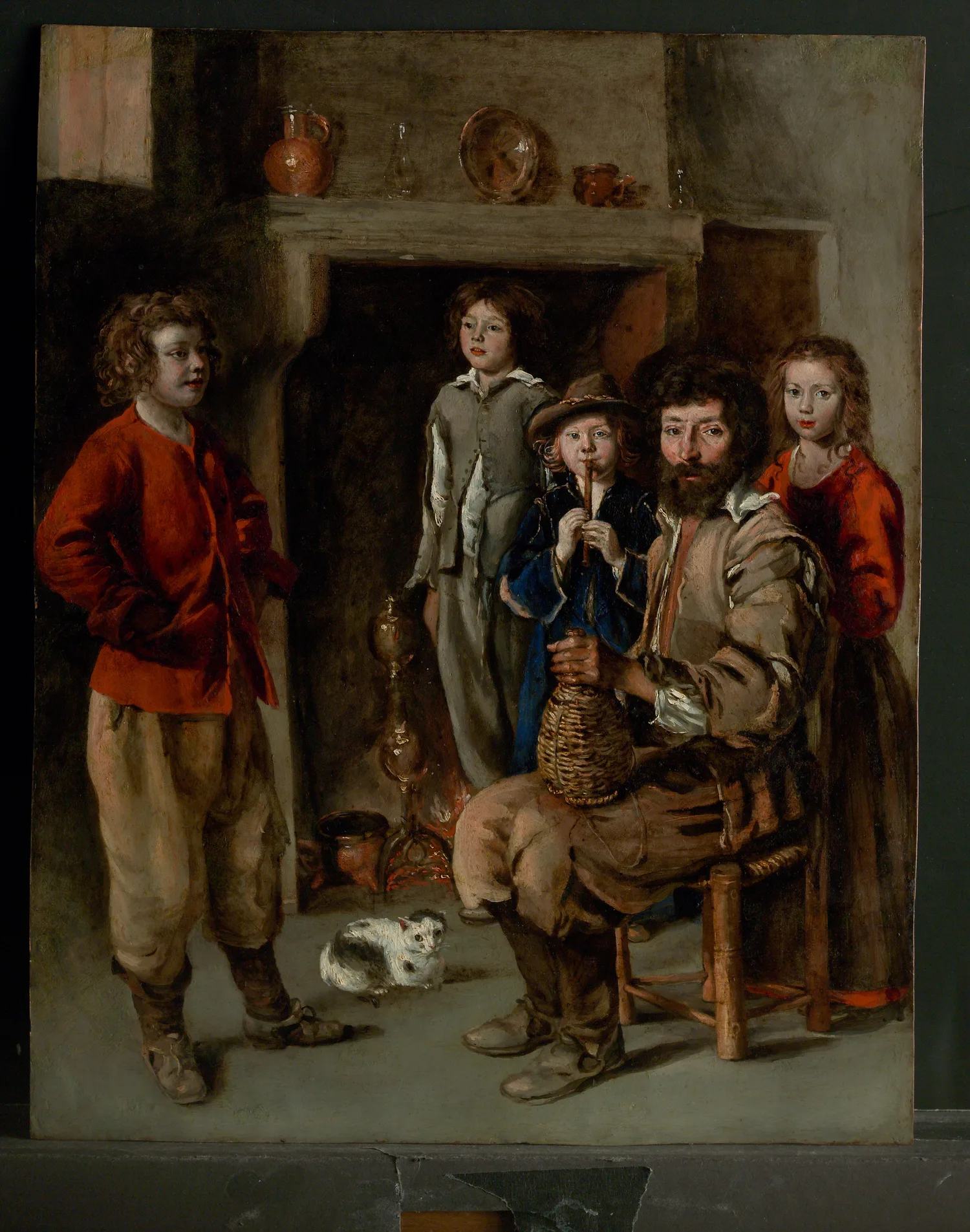
The Astrology of Family Dynamics
Erin Sullivan
One person's birth chart carries the story of a whole family
The Parents Each Child Sees
In The Astrology of Family Dynamics, Erin Sullivan devotes a passage to one observation: brothers and sisters describing the same parents can sound as if they grew up in two different households, and the father one sister remembers doesn't match the man the other one knew. Her explanation is that each child sees the parents through the lens of their own birth chart, and sees the side of them that child needs to see.
Parents have as many personae as they have children.
She has talked with many adult brothers and sisters, and each of them had seen only a piece of the parents.
The book first came out in London in 1996 under the title Dynasty, in the Contemporary Astrology series from Arkana, an imprint of Penguin. The edition in print today is the 2001 one from Weiser Books. In her introduction Sullivan says that nearly everything that can be said about families has already been said, and only inside the framework of astrology is there something new to add. She treats a family as one living whole whose members circle an invisible center, which might be a family story or a single person. So a birth chart is about more than the one person born at that moment. It carries the family's story as well, and when the planets are read as roles in a family, the part of the chart that concerns the family comes into focus.
The book has three parts. Part I gives the big picture. It starts with the individual and their generation, then moves to the family as a system, the Sun and Moon in families, mothers and fathers, the roles people take in a family, and the people we draw to us outside it. Part II covers the modes and elements of a family, the three Water houses, and how transits stir a family up. Part III borrows the book's original title, Dynasty, and tells the stories of several real families. Sullivan says she finds this part the most interesting.
The Book's Contents
- Introduction
- Part I: The Big Picture: The Organic Family
- The Individual and the Collective
- The Nuclear Family as a System
- Family Patterns and Family Trees
- The Sun and Moon in Families
- Mothers and Fathers: Freud Had It Half Right
- Family Themes: Movers and Shakers in the Family
- Families and Our Familiars
The Family as a System
Astrology already had a set of correspondences for the family: the axis of the 4th and 10th houses, the 4th house itself, the 3rd for brothers and sisters, the 9th for grandparents, the Moon for the mother and the Sun for the father. Sullivan doesn't call these wrong. Her point is that taken one at a time they say little, because natal astrology is so used to reading one person alone. She often uses the Sun as father and the Moon as mother herself, and at the level of archetype it mostly holds, but it can't be applied mechanically. Astrology is not gender-biased. The Sun is yang and the Moon is yin, and that does not make the Sun the father and the Moon the mother. That pairing is a bias laid down over a long history, until the stereotype covered over the archetype.
What she changes is the scope. She borrows general systems theory from family therapy: a family is a system, with the community and the wider family around it and its individual members inside. A family has a force that keeps it as it is, called homeostasis. In astrological terms, a Sun/Uranus homeostasis is a family where everyone is always running about, and a Moon/Neptune one is a family where dreams and dependency are the norm. Because of that force, when one person changes, the whole family has to find new places. Family therapy sorts families into two types, disengaged and enmeshed. Either extreme brings trouble, and the middle is what counts as normal. Sullivan puts this in astrological terms: the extremely disengaged family is Uranian, and the extremely enmeshed family is Neptunian.
She also has a criticism of the psychology of her day. It mostly dealt with the present situation, and rarely considered that problems in a nuclear family might have been handed down through the generations. Her generation got into the habit of tracing every flaw in themselves back to their parents, and that complaint kept a whole industry of books and workshops going. She counts herself as part of that generation. She often cites Jung, and Erich Neumann and Joseph Campbell as well. On the Sun and Moon she draws on Dane Rudhyar's lunation cycle and recommends Janet McCrickard's book, which breaks up the stereotyped symbolism of the Sun and Moon. To compare the charts of a whole family, she used the JigSaw program made by Bernadette Brady.
Where Family Trouble Comes From
Sullivan comes back again and again to one point: usually no one is to blame. When a family has a "problem person," people tend to set that person apart. She asks them to consider two things first, that no one is to blame, and what has gone wrong in the family. The one who has been hurt is often acting out the family's weakest link on everyone's behalf. When she wrote the book, she had been a mother for twenty-seven years, had been reading charts for thirty-four, and had practiced astrology and counseling for twenty-four.
So when she looks at a difficult chart, she is in no hurry to judge it harshly, because how those hard aspects turn out depends on how the child was treated when young.
Hard charts do not always a monster make!
What she means is that a child who was acknowledged, and not filled with the parents' fears, is more likely as an adult to use those hard aspects in positive ways. On family secrets, what she values is the moment when the source of something is finally said out loud. Once a family's charts have been looked at, each person feels that what they feel has a precedent and a cause, and knowing where you come from is better than believing you are on your own, with no one before you.
Replaying Family Roles Outside the Home
If, however hard you try, you always end up leading at work, or always at the bottom, always the one looking after others or always the one sorting out the mess, Sullivan says it is time to look back at the family pattern and where you stood in it.
If it is familiar, it is familial.
She says a person's place in society is usually their place in the family. On boards and committees, and in any group that works together for a long time, the family pattern gets played out by people who seem to have no connection to one another. After enough meetings it becomes clear who was the oldest or only child, who was the "golden child," and who was the one who fell through the cracks. So it is no surprise to run into "your mother" or "your sister" on a team.
But she also keeps people from taking this too far. If you are having a fight with your lover, you are having a fight with your lover, and not with your father. Full stop. Psychology can help you understand why you fight, and whether the fighting makes the relationship better or slowly wears it down, but you can't put it all down to your father. The same goes for looking at your relatives' charts. First take back your own projections, because you may be the very transit the other person is going through. So when you see your family in a situation you keep running into outside it, you can follow it back to where it came from, but the fight to be had and the relationship to work on are still the ones in front of you.
Chapter by Chapter
Chapter 1: The Individual and the Collective
Sullivan begins with the largest family. A birth chart is the transit chart of the moment of birth, so every person is a walking transit who carries the marks of the time they were born into and lands in a very large family from the start. She divides the generations by the sextile between Pluto and Neptune, and each generation has its own way of seeing its parents and making a family. She counts herself in the Pluto in Leo generation, which held on to the ideal family of a Norman Rockwell picture, a mom and dad with a son and a daughter, and was still blaming its parents in its fifties. In the 1980s she studied classics. Her professor of Greek mythology, also Pluto in Leo, was teaching Oedipus to students of the Pluto in Virgo generation, and when he asked whether they had felt that kind of triangle with their parents, the whole class looked blank. After the two of them had laughed about it, she saw that one generation should not press its model onto its children.
Chapter 2: The Nuclear Family as a System
The framework of the whole book is in this chapter. A family both makes the individual and swallows the individual up, and Sullivan describes the good side and the side that goes wrong for both the Uranian and the Neptunian family. In the Uranian family, few themes repeat across the family's charts, the strongest bonds are chosen ones, the family usually revolves around the father, and children are encouraged to become independent early. Taken to an extreme, a child comes to understand love as distance. The Neptunian family is the opposite. Themes repeat down the generations, people understand each other without speaking, the family usually revolves around the mother, and at the extreme there is no privacy at all. Her example is the mother who says, "I am cold, so you must put on a sweater."
Chapter 3: Family Patterns and Family Trees
Sullivan says a book on family charts can't be written as a manual, only as themes, and this chapter gives four steps for finding them. First look for faint themes that run through several generations, then for shared signs and shared aspects, then count the elements and modes, and last see whether the themes all crowd onto one person's chart, which makes that person the pivot of the family.
Chapter 4: The Sun and Moon in Families
The chapter's first sentence is that astrology is not gender-biased. The Sun has no character of its own. It is a lens, the vehicle of the self, and the bond between the Suns in a family is about whether each person lets the others shine. She writes six solar family themes and seven lunar ones. In a Sun/Saturn family, for example, the sense of responsibility runs heavy, many members mature late, and anyone who wants to rise above the family finds a harsh critic inside asking who they think they are. The Moon is the memory of carrying and raising children, handed down the line, so it mostly travels through the mother's side.
Chapter 5: Mothers and Fathers: Freud Had It Half Right
Freud said parents leave their children with problems. Sullivan says he had it half right, because the arrival of a child also throws the parents off balance for a while. They become anxious and overcautious, having lost their past in exchange for an uncertain future. The transits at the moment of a child's birth stay printed on the parents for good. The child's chart is the parents' transit at that moment, only this transit never passes. She also puts in a word for the absent father: a person has to step out of mood and into the place of an onlooker to grow the kind of consciousness the Sun stands for.
Chapter 6: Family Themes: Movers and Shakers in the Family
This chapter covers family secrets and the roles people play in a family. Secrets are toxic. Children in fact know everything, and keeping things from them in the name of protection only works the secret deeper into them. Then come the roles. The black sheep is the family's unspoken theme concentrated in one person. Sullivan calls this person a "circuit breaker," whose arrival keeps the family from closing in on itself and slowly going stale. The mediator looks fragile but actually holds the power to regulate the whole family, and once the mediator is taken out, someone has to start speaking up for themselves. There are also the scapegoat and the catalyst, and the catalyst usually carries signatures of the Pluto and Scorpio kind.
Chapter 7: Families and Our Familiars
This chapter is about the people we draw to us outside the family. Sullivan puts it in a single line: "We go for what we know."
Chapters 8 and 9: The Modal Family and the Elemental Family
These two chapters look at the whole family through the modes and the elements. A family dominated by one mode is rigid in its structure, and it naturally brings in the opposite through marriage or children. The chapter on the elements goes through fire, earth, air and water in turn, covering each family's ways, who its black sheep is and what its secrets usually are. The earth family is practical and dislikes big scenes. Its worst sin is irresponsibility, and what it has to learn is that simply being is enough.
Chapter 10: The Water Houses
The three Water houses are three layers of ancestry. The 12th is the original matrix, the "quantum family" all of us share. The 4th is the gene pool of the family of origin, and the 8th is where we take up what our forebears left. The section on the 8th house opens with George Bernard Shaw: "If you can't get rid of the family skeleton, you might as well make it dance." Sullivan explains where the word "symbol" comes from. It was once a bone or a stick broken in two, with each of two people keeping one half, so that they could recognize each other when the halves fitted together. What our forebears left comes down to us through symbols of this kind, so heirlooms are sacramental objects rather than sentimental keepsakes.
Chapter 11: Families in Flux: Transits
Every personal transit is a transit to the family system. When one person is deeply moved by an experience, it echoes through the family, whether that person still lives at home or has moved to the other side of the world. Still, she says, the transits that most call attention to the family are those of Saturn through Pluto crossing the IC or the Midheaven, moving through the 12th, 4th and 8th houses, or reaching the Sun and Moon.
Chapters 12 to 14: Real Lives, Real People
Sullivan calls Part III the most important part of the book, because it is about people rather than theory, and she asks readers to read it like a novel. She followed each story with the people in it for about a year, and she would rather call them "their stories" than case histories. One conclusion she draws from these stories is that in the chart, adoptive parents are indistinguishable from natural parents.
Chapters 15 and 16: Rejection Between Mother and Daughter, the Circuit Breaker
People usually talk only about parents rejecting children. Sullivan had long suspected that a child might also reject a parent, and chapter 15 tests the idea against the charts of two generations. Here she also states the limits of astrology plainly: it does not always tell us why, but only how and when. Chapter 16 is about how everyone, on the way to growing up, has to go back home at some crucial point and come to know themselves again.
Chapters 17 and 18: The Procession of the Ancestors, The Last in the Line
Sullivan says some people have to clear their family of a trait that has grown overripe and begun to spoil. A family holds on to an old shape for too long mostly out of unconscious habit, and seldom out of ill will. She also admits plainly that there is no way to prove how long a family can keep the same astrological theme. When a family line is coming to an end, there is always one person standing at the end of it.
It has to end somewhere with someone.
That person has to spend a life working the past into the present. Sullivan says that every time she found the courage to tell someone that they might be the one who carries this family and turns it around, the person was relieved, and they had usually known for a long time. The appendix at the back of the book has a worked comparison of the charts of one large family, and short family sketches for each of the twelve signs when that sign is over-developed.
How to Read This Book
Sullivan herself valued Part III most. If family astrology is new to you, start with Chapters 2 and 6 to get the family system, homeostasis and the family roles clear, then go straight to the families in Part III. Wherever you get stuck, turn back to Chapters 3 and 4 and the chapter on the Water houses. The generational material in Chapter 1 can wait until last, since the years given for each generation are rough and overlap.
The book was written in 1996 and borrows the family therapy framework of that time. Its real stories include many heavy experiences and deep family secrets, so it isn't light reading, and where some passages turn very mystical you can keep to the layer about family patterns. The book uses midpoints, harmonics and pre-natal eclipses, and asks you to compare the charts of several generations of one family. In her own bibliography she marks the JigSaw program she recommends as suitable only for people expert in both computers and astrology. She also said family charts can't be written up as a manual, so anyone hoping for a table to look things up in will be disappointed. The book gives themes and ways of reading, and you have to match them to your family yourself.
Your Family Inheritance in Depth reads only your own chart. Sullivan says a birth chart is the transit chart of the moment of birth, so the report begins with how Sullivan sees a family and which generation you were born into. Then it looks at the Sun and Moon for the father and mother your chart carries. Sullivan says this is only the usual way of reading them and shouldn't be applied rigidly. The report takes up whichever of her solar and lunar family themes your chart has. Every report covers the 4th house, and the 8th and 12th houses are read through whatever planets you have there. For the family roles she names, the report only lists which of their signatures your chart has and leaves you to compare them with your family, without deciding which role is yours. Next it looks at where the eclipses in the months before your birth fell, whether transiting Saturn, Uranus, Neptune and Pluto reach your Sun, Moon or angles over the next five years, and when your Saturn return falls, with the dates calculated precisely for your chart. Last it looks for any planet that turns up in several places in your chart and, if there is one, reads those places together, then shows you how to collect your family's charts and compare them yourself by her four steps.
Sullivan says parents have as many personae as they have children, and the parents this report talks about are only the version of them your chart carries.
 Your Family Inheritance in DepthSee report · $29
From the chart to a written reading
The reports below are written readings, sent as a PDF by email.