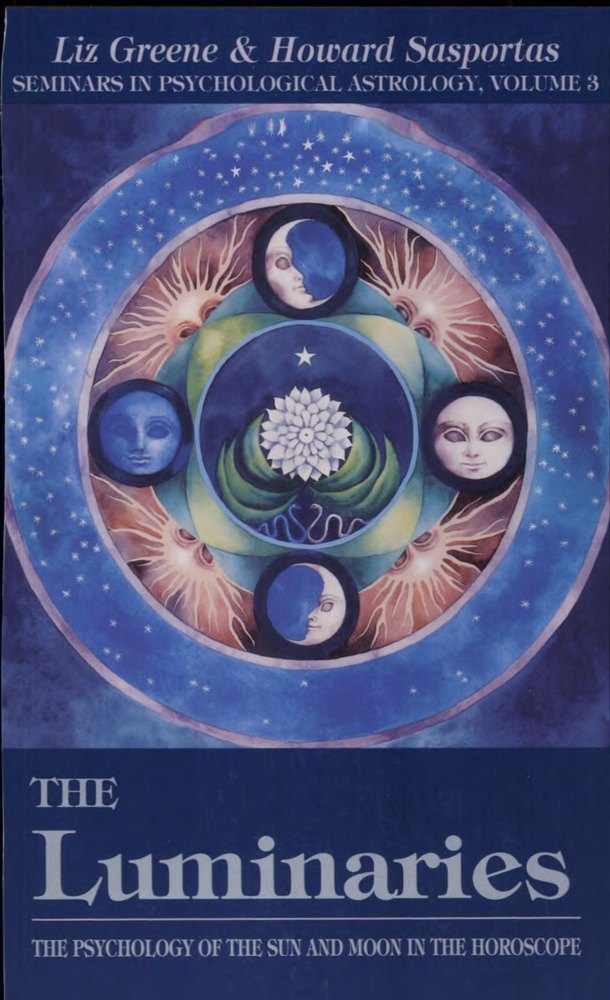
The LuminariesThe Psychology of the Sun and Moon in the Horoscope
Liz Greene & Howard Sasportas
Greene and Sasportas on the Sun and Moon: the Moon gives us safety, the Sun leads us toward becoming ourselves
Wanting to Grow, Wanting to Stay
Some people move to a different desk and feel ill at ease all day, unable to settle until the cup, the pens and the cushion are arranged the way they were before. Others have a steady job and a harmonious family, yet cannot shake the feeling that this is not the life they wanted. The Luminaries: The Psychology of the Sun and Moon in the Horoscope, written by Liz Greene and Howard Sasportas, is about where these two feelings come from. The first is the Moon looking for safety; the second is the Sun calling a person to become themselves.

Published in 1992, the book is the third volume in the pair's Seminars in Psychological Astrology series. It comes from a week-long seminar called The Inner Planets that they gave in Zürich in June 1990. The first half, on the Sun and Moon, became this book; the second half, on Mercury, Venus and Mars, appeared as a separate volume. So the whole book is a set of classroom talks, given to an audience of astrology students who asked a great many questions. It has three parts and six lectures. The Moon and the Sun each take up one part, with Greene and Sasportas lecturing once each; in the third part the two first read several example charts together, and then Greene speaks alone on the lunation cycle.
The authors see the Sun and Moon as two very basic psychological processes in everyone, pulling in opposite directions. The Moon draws a person back toward the familiar and toward merging, and also teaches us how to care for others and how to belong. The Sun pushes outward, asking us to separate from the mother and become an independent “I”, and so it brings loneliness as well as meaning. Finding a balance between the two, the authors say, is the work of a lifetime. The introduction begins with what a human being is like at birth:
Human beings are born unfinished.
A baby crocodile has teeth as soon as it hatches and can run and swim, while a human infant depends on others' care for many years. That is why our first attachment is to the mother, and why we spend the rest of our lives learning to separate from that attachment without throwing it away. Ancient astrology called the Sun and Moon the “Luminaries”, or the “Lights”, and the authors say these two lights are exemplary “instructors” within us, reflecting what a person may one day become.
When Sasportas lectures on the Moon, he uses himself as an example. His Moon is in Taurus, and when he first read Stephen Arroyo's remark that a Taurus Moon needs to have control over its surroundings to feel safe, he was a little surprised, since he had never connected Taurus with control. On reflection he admitted it was true: he is most at ease when things are orderly and he has a say in how they are arranged. If he suddenly heard that tomorrow's lecture hall was being changed, he would probably lie awake tonight wondering whether the new room would be big enough and have what he needed. Greene says in the first lecture that the sign and house of the Moon describe quite precisely what makes a person feel safe. The person at the start who cannot settle at a new desk is most likely, too, someone whose Moon is looking for safety.
From Fixed Character to Lifelong Process
In the introduction Greene and Sasportas start with the old way of reading. Earlier astrology treated a planet's placement as something fixed at birth, with the Sun and Moon representing a person's basic, unchangeable character. They change this premise, saying that any astrological factor is also a process. A placement is like an arrow pointing somewhere, and a lifetime of experience and choice gradually fills in the black-and-white outline of the archetype with colour. So the Sun and Moon speak not only of what you are now, but of what you might become.
Sasportas applies this premise to the Sun sign. In his view most newspaper horoscope columns start from a mistaken premise, assuming people automatically resemble their Sun sign, so that every Aries is impulsive and self-centred and every Gemini fickle. As he would put it, one should say: “Your Sun is in Aries, and one of your main purposes in life is to develop courage and the ability to assert yourself.” That way the reader has a goal to pursue. He also took a fresh look at the Moon. When reading someone's love life, people are used to looking first at Venus and the seventh house, but after many years of practice he found that the Moon's position tells you no less than Venus about what you will meet in love and what love will draw out of you, for men and women alike.
Greene objects to the way traditional astrology presents the Moon and Cancer as fresh bread, lovely babies and family bliss. She looks to myth for the Moon's other faces. Artemis is its wild side, Hera speaks of roots and belonging, and the story of Circe is about how instinct can take a person over. So in her account the Moon cares for people, and when its needs are pushed down, it also turns into unconscious compulsion, which always has consequences.
This way of reading the Sun and Moon has its roots. In 1983 the two authors founded the Centre for Psychological Astrology in London together, teaching astrology alongside depth psychology and humanistic psychology, and Greene herself is both an astrologer and a Jungian analyst. In discussing the mother, the book uses Winnicott's idea of the “good enough mother”; the lecture on the hero borrows Joseph Campbell's hero's journey and also cites Erich Neumann. When Sasportas discusses the father, he cites the father hunger described by James Herzog. They make no secret of what they borrow. Speaking of what the Moon needs at a gathering, Sasportas says plainly that these ideas are not his own but Arroyo's. When Greene comes to the lunar phase at birth, she says Dane Rudhyar has already covered it so well that she has nothing to add, and tells everyone to read his book.
No Moon Describes a Bad Mother
Before Greene discusses the mother and the Moon, she makes one thing clear at the outset:
No lunar configuration describes a “bad” mother.
She goes on to explain that some energies are hard for any mother to express. The mother may not have managed them well, and then the child has to do a little more of the work. Her example is a child with the Moon in Gemini. Such a child needs someone to listen and to share his curiosity, but the mother may be weighed down by duty and by fear of what others think, her own lightness long since packed away; in the chart this might show as Saturn in Virgo afflicting the Moon. The child takes this conflict in, and as an adult uses his own Saturn to press down his own Moon. Greene says Moon–Saturn is a problem you share with your mother, and blaming her does little good. What you can do is acknowledge what you lacked emotionally and supply it yourself, because there is no one else now who can do it for you.
She looks at partners the same way. A woman in the audience said her Moon was in a water sign and she had been married for twenty years to a man with the Moon in Gemini; she always wanted to come closer, and he always slipped away. Greene did not tell her how to draw her husband closer, nor what was wrong with him. She said what a water Moon needs most is to take its own feelings seriously and know they matter, even if the partner is cool and unresponsive. Perhaps you have always needed your husband to validate your needs because you do not yet value them much yourself. So the response the Moon wants has first to come from oneself; then how much or how little the partner gives no longer decides everything.
Knowing What You Lack When You Feel Unsafe
Greene discusses the Moon's needs element by element, and when you feel anxious, comparing yourself against them will usually show you which one you are missing. An earth Moon values physical stability, regular habits and a familiar home, and moving house or leaving familiar places can be very painful. An air Moon needs some room of its own within a relationship, as well as conversation and beauty; when feelings come too close, it retreats into pure reason and keeps emotion at a distance. For a water Moon, what matters most is an emotional response from others; when there is none, it is like falling into a void. A fire Moon needs to feel special and needs life to have meaning and a touch of drama. What it can least bear is the ordinary, so after months of nothing but going to work and coming home, a fire Moon easily loses its spark.
On the Sun's side, what you take away is a direction. Sasportas says the house the Sun falls in is where you must invest yourself personally and make something of it. He had a female client with the Sun conjunct Mars in Aries in the fifth house. When they first met she was so meek that he was a little surprised. A few years later she had her first child, and when she next walked into his study her face was full of strength and confidence; the affairs of the fifth house had let her find her own power and sense of authority. So when life seems to have no direction, you can first look at which house your Sun is in, and then ask yourself whether you have been taking part, in person, in that house's affairs.
Chapter by Chapter
Chapter 1: Mothers and Matriarchy: The Mythology and Psychology of the Moon
The first lecture is Greene on the Moon. She begins by asking everyone to set aside what they have learned of astrology and look at the actual Moon in the sky, saying that every student of astrology should own a telescope. The Moon's shape changes night by night, yet its cycle never varies, so to the ancients it was both unreliable and utterly dependable, and the early moon goddesses all carry this contradiction. She uses a diagram of lunar myths to guide the audience's imagination: the new Moon is Hekate, the crescent Artemis, the full Moon Demeter. She cautions that the diagram is only meant to prompt the imagination, and that many mythic figures are left out of it.
The core of this lecture is that the Moon governs safety and survival. When people feel unsafe, they turn to the Moon. If the Moon's needs go unrecognized, it malfunctions and turns into unconscious compulsive behaviour. Speaking of Hera, she carries this point into the family. Many people would rather stay in an unhappy marriage and cling to a home that hurts them than go out on their own, because the Moon cannot bear isolation; it would rather hold on to the familiar family demon than pursue an unfamiliar independent angel. So when someone keeps putting off leaving a place that makes him miserable, it is often the Moon seeking peace in its own way. Greene describes this as putting roots and tradition ahead of one's individual life.
Chapter 2: First Love: The Moon as a Significator of Relationship
The second lecture is Sasportas's turn. He treats the Moon as a planet for reading relationships, starting from the idea that the mother is everyone's first great love affair, for men and women alike. In the first months after birth the child is one with the mother. From about six months an “I” begins to separate out, and the child feels for the first time that the mother is another person. Fear comes with this, and so the child tries to please the mother, as one would court a beloved. He notes that six months of age is exactly when transiting Sun first opposes the natal Sun. Whether this first love goes smoothly comes back again and again in later love affairs.
Sasportas also offers a way to look at timing. Besides the aspects to the natal Moon, he says, you should look at the progressions and transits to the Moon between six months and three years of age, since separating from the mother takes about three years. The secondary progressed Moon moves about a degree a month, so you can check which planet it touched when you were six months old. His example: with Saturn at 1 degree Leo and the Moon at 29 degrees Leo, there is no natal conjunction, but at around two and a half, transiting Saturn will pass over this Moon. At that age the child is still very impressionable, and Saturn will colour how he later feels about being close to someone.
Chapter 3: The Hero with a Thousand Faces: The Sun and the Development of Consciousness
The second part is on the Sun, and again Greene speaks first. She discusses the Sun through Joseph Campbell's hero's journey, setting the direction from the start:
The hero myth is a solar myth, for the hero is always on the way to becoming something.
The Moon pulls back, the Sun moves forward. A hero is not born a hero; the position has to be earned, so the Sun in a person is never finished. Greene makes a point of saying that the hero and the masculine here refer to an active energy found in women and men alike. The hero first receives a call. It may be a sudden inner intuition that life has a deeper meaning, often appearing around the Saturn return near thirty or the Uranus opposition in midlife, or it may be an outer upheaval that throws life into disarray. After the call come helpers, and the helpers Greene looks for in the chart are harmonious aspects and dignified planets. A natal Venus conjunct Jupiter, for instance, gives a person optimism and generosity when the Sun meets a hard transit.
The hardest thing is crossing the threshold. Greene says the deepest meaning of the threshold is loneliness. To become an independent self, a person has no home to retreat to and must risk the possibility that no one will love him, so the Sun often emerges fully only in midlife, when a person is strong enough to face this test. She also reads the Ascendant separately from the Sun. The Ascendant is like a guide who walks alongside, asking a person first to learn certain skills that help him become what the Sun represents, and once the Sun is found within, there is a feeling of coming home.
Chapter 4: Sun, Father, and the Emergence of the Ego: The Father's Role in Individual Development
Sasportas continues with the Sun, saying at once that he cannot stress the Sun enough; in his view it is the heart of the chart. He has noticed that psychological astrologers in recent years, having learned so much psychology, go straight into infantile complexes with their clients and forget basics such as the sign the Sun is in, and he admits he has made this mistake himself. So when a chart will not open up, he suggests starting from the Sun's sign, house and aspects.
The focus of this lecture is the father. Sasportas says one of the father's main roles is to be an attractive outsider who helps the child out of the symbiosis with the mother; what matters is that the father is “another person”. What the child meets on the way to the father is shown by the planets aspecting the Sun. With the Sun trine Jupiter, the child feels that leaving the mother is not so frightening and that the outside world is rather interesting, and the ego grows with adventure and vitality. With Saturn afflicting the Sun, it is like running into a brick wall: the father may be cold, distant, often absent, or very strict, the child feels it is better to go back to the mother, and the ego grows more slowly. Sasportas says people with Saturn here get there in the end, only it takes longer and costs more effort.
He gives no hard rule on whether the fourth or the tenth house is the father. He generally gives the tenth to the parent who influenced the person most and puts the less familiar, more mysterious parent in the fourth; sometimes he reads each house once for each parent, or even reverses them. He knows some will call this fence-sitting; he calls it flexibility, because the fourth and tenth are a pair of opposite houses, and each end naturally turns toward the other. In the case of Paul, he gives the tenth house to Paul's mother, who taught him at home and influenced his choice of career, and the fourth to his father, with the Moon in Pisces on the fourth-house cusp. Paul says his father was the youngest of eight children and was looked after all his life; one of the few things father and son did together was fishing, and Paul even had to tie his father's hooks for him.
Chapter 5: The Sun and Moon in the Horoscope: A Discussion Using Example Horoscopes
The third part is called The Coniunctio, the alchemical union of Sun and Moon. This chapter is a dialogue between the two, reading together the charts of three generations: Paul, Paul's father Bill and Paul's son Max. Most striking is how the same degrees recur generation after generation. Bill's Sun is at 7 degrees Leo, and his grandson Max's Mars is also at 7 degrees Leo, only two degrees from Paul's Pluto. Even the age at which each had his first child is nearly the same: Bill at 35 years and 11 months, Paul at 36. In this chapter both authors urge the audience to cast a chart for each parent, a solar chart if the birth time is unknown, and then look at the composite charts between the parents and between oneself and each parent. Sasportas says this will show you what kind of person your father is inside, making it easier to accept and understand him.
Here Greene discusses the parents' Saturn. A parent's Saturn conjunct or afflicting a child's Sun almost always means the parent envies the child, because Saturn chokes the vitality of the sign it occupies, and envy mostly comes from what one finds hardest to live out oneself. She does not stop at blaming parents, but goes on to the other side:
Nothing makes us aware of what we are as strongly as someone telling us we are not supposed to be it.
What she means is that the solar hero becomes a hero precisely when blocked. If what you wanted to do as a child was always belittled at home, this does not erase the hurt of those years, but it shows that the opposition also helped you see clearly what you really wanted.
Chapter 6: The Rhythm of Life: A Discussion of the Lunation Cycle
The last lecture is Greene on the lunation cycle, the recurring cycle between Sun and Moon. She first defines the relationship between the two lights. The Moon is like an antenna that goes out, absorbs a bit of life and brings it back to the Sun, and the Sun gradually turns these experiences into “my” views and “my” identity. The lunar phase at birth can override the signs: a new Moon in Pisces can at times be as headlong as a Moon in Aries, and people born at the full Moon are highly sensitive to others whatever sign the Moon is in, much like a Moon in Libra.
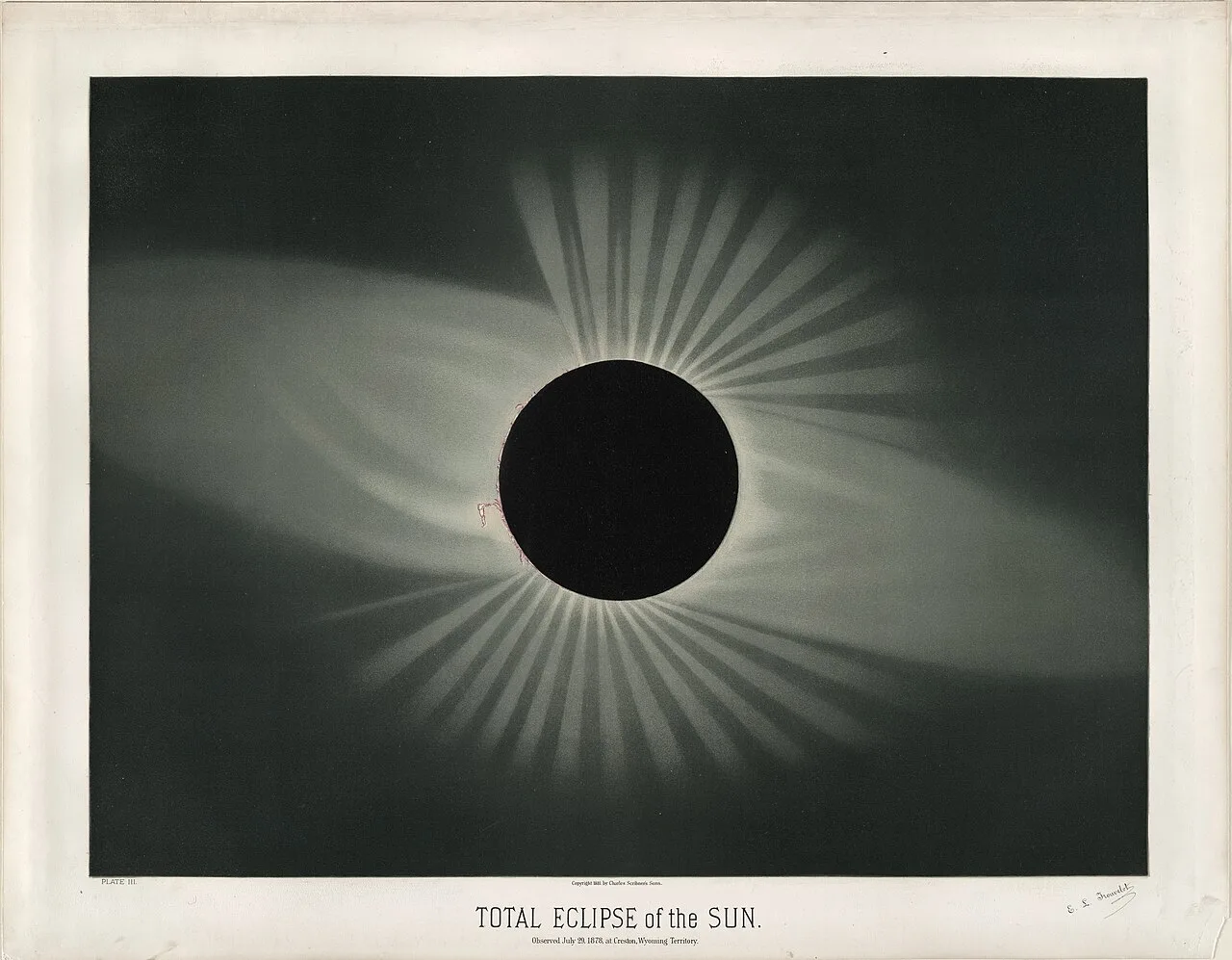
She puts most of her effort into the secondary progressed Moon. It takes about twenty-eight years to complete a circle, and the progressed new and full Moons it forms with the Sun are the timekeepers of a life. She demonstrates with a film producer named Nigel. He was born at a total solar eclipse, with the Sun and Moon in Leo in the first house, conjunct the North Node. At twenty-eight or twenty-nine his progressed lunar return and his Saturn return arrived together; a film he produced won an award and did well at the box office, and with the money he started his own production company, liking to cast unknown actors and make them stars. Later, when the transiting nodal axis moved onto his Ascendant–Descendant axis, serious trouble arose between him and his partners, and he lost the company and most of his money; for the next fourteen years no one knew where he had gone. When his progressed Moon reached the seventh-house cusp, entering Aquarius and opposing his natal Sun and Moon, he came back. It turned out he had spent those years raising sheep in Scotland and dealing in property, and his finances were stable again. The first film from his new company was a big hit, to the surprise and envy of his peers. Greene calls him a walking progressed lunar cycle.
She takes the same attitude to eclipses and the lunar nodes. Eclipses are not malefic in themselves; they suddenly bring out what has already ripened. The nodal axis, in her view, is where what is inside becomes manifest outside, and it is no more malefic. When Nigel had his first success, the transiting nodal axis was passing over his first-house planets, and Greene says such success can hardly be called malefic.
How to Read This Book
If you want first to understand your own emotions and sense of security, start with the first part: Greene's Moon leans toward myth and psychology, Sasportas's toward relationships and the timing of childhood. If you are around thirty or in midlife and feel it is time to live differently, you might begin with Greene's chapter on the hero and then read Sasportas on the Sun and the father. The lecture on the lunation cycle is the most technical and requires reading progressed charts, so it is best left for last.
The book has its difficult side. Being a set of seminar transcripts, it is full of questions and interjections from the audience, and a topic is often dropped halfway for another. It draws heavily on Greek myth, Jung and psychoanalytic language, which readers new to these will find roundabout. Some of the psychological research it cites dates back as far as the 1940s, and the contrast drawn in the discussion of the father between the “1950s-style father” and the “new father” carries the background of its era. The book speaks of the Sun and Moon as masculine and feminine, and Greene herself cautions that she is wary of sweeping generalisations about “men living the Sun and women living the Moon”. The case histories include a good deal of family conflict, and it is easy to read every lunar aspect as the mother's fault; at such moments you can return to Greene's line that no lunar configuration describes a bad mother. Also, this book covers only the two lights, the Sun and the Moon; the rest of the chart has to be read elsewhere.
Your Sun and Moon in Depth applies this book's way of reading to your own chart. Sasportas says it takes about three years for a person to separate from the mother, and that what the heavens do to the Moon during those years shapes how a person later feels about closeness. The report looks at how the heavens touched your Sun and Moon in the first three years after your birth, with the dates calculated precisely by software, and then explains how this earliest experience connects with your Moon and with the bond between you and your mother. Greene's hero's journey is also brought to bear on your chart. Your Sun sign and the house your Sun is in show what kind of person you are to become and where you must invest yourself; the harmonious aspects and well-placed planets in your chart are your helpers along the way; and the progressed Moon and the nodes show where the calls of the coming years will lead. Like the book, this report reads only the two lights, the Sun and the Moon; the other planets and houses of the chart are outside its scope.
Greene urges her audience to spend some time looking back over the turning points of their lives in the light of the Sun–Moon cycle. Events are often unexpected anyway, she says, and as for the point of doing this:
it is in order to understand your own rhythms better, so that the continuity of life begins to make more sense.
Once you know what your Moon wants and where your Sun is heading, the next time you want to leave and cannot bear to go, you will be able to tell what each side is saying.
 Your Sun and Moon in DepthSee report · $19