Cosmos and PsycheIntimations of a New World View
Richard Tarnas
A historian of ideas sets the planetary cycles beside the human psyche and human history.
The Mind Believes One Thing, the Heart Another
Many people believe, with their heads, that the planets are nothing but rock and gas circling the Sun, with no bearing on human joy or sorrow; and yet somewhere they half suspect that in the years when a life changes course, something in the sky seems to be moving too. Richard Tarnas sees this tug in two directions as the shared condition of modern people. The objective world outside, he says, went to the Enlightenment, and the subjective world within went to Romanticism, so the modern heart is loyal to Romanticism while the modern mind is loyal to the Enlightenment. Both live in the same person, and they do not fit together.

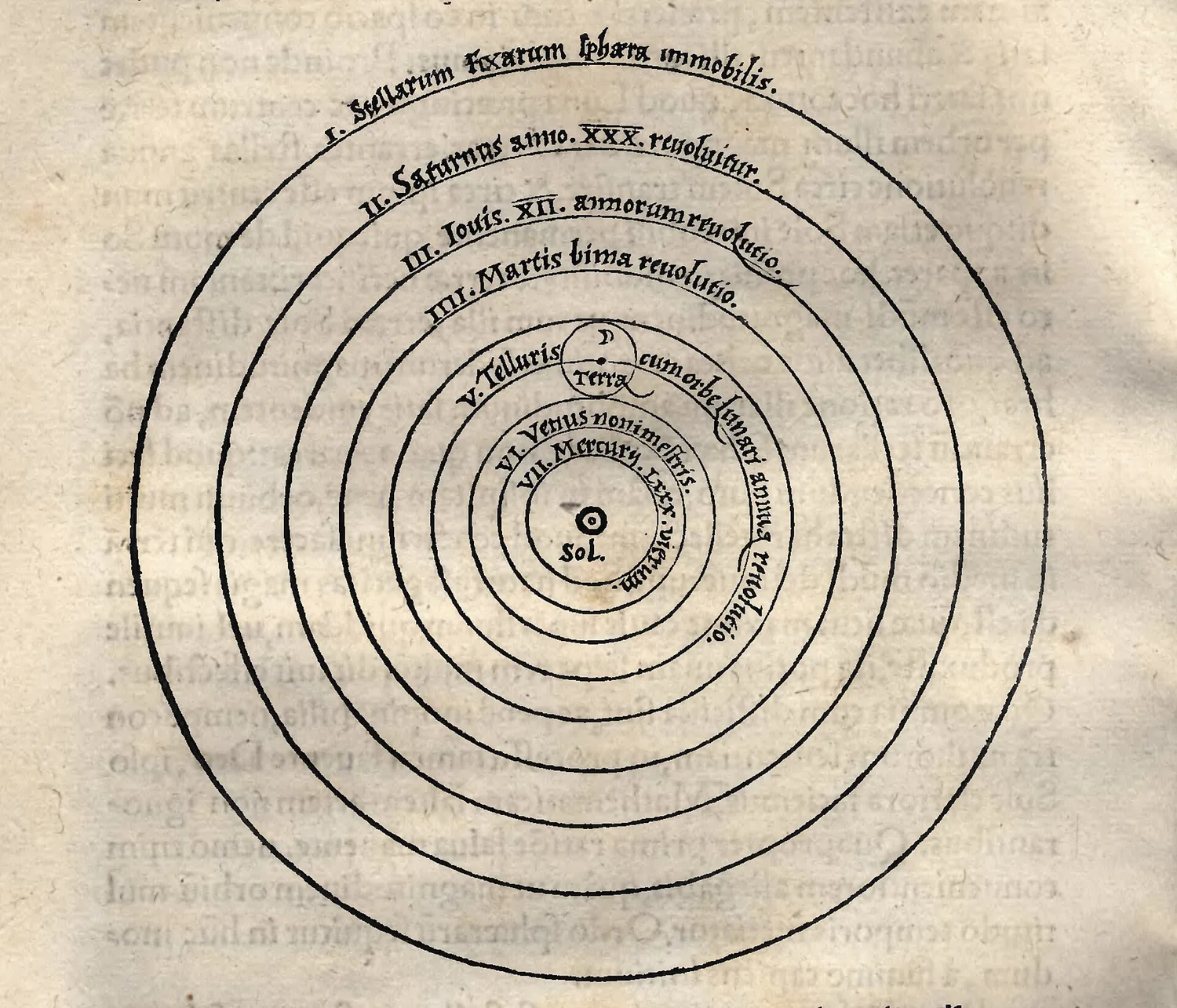
Cosmos and Psyche: Intimations of a New World View, published in 2006, sets out to ask whether that rift can be mended. Tarnas is a historian of ideas. In 1991 he published The Passion of the Western Mind, which runs from ancient Greece to the postmodern age and traces how the Western world view became what it is today. In the preface to this book he says the earlier one was laying the ground for it. This one goes on to ask: after Copernicus, humanity won the freedom to govern itself, but the universe became empty and indifferent. Is there any other way out of that condition? The evidence he brings forward is astrology.
Tarnas himself began as a sceptic. Like most people with a modern education, he started out with an unexamined distrust of astrology. In the mid-1970s he began to study it systematically. He first learned to cast birth charts, then began paying attention to people in psychotherapy, and found that some had psychological breakthroughs during one kind of transit while others sank into long difficulties during another, and that the character of these states matched the planetary meanings in the standard astrology books with great precision. He went on to study his own chart and those of forty or fifty people he knew; the more accurate the data and the better he knew the person, the clearer the correspondence. He carried on this research with colleagues and students for thirty years.
The book has eight parts. The first two describe how modern people became estranged from the cosmos. The third covers the archetypes of the ten planets, the aspects, and the cycles that Saturn and Uranus trace through a single life. Parts four to seven each set the cycle of one pair of outer planets beside the cultural history of the West, and the eighth looks ahead to coming planetary alignments. What first made Tarnas take the subject seriously was the transit of Uranus. Uranus takes about eighty-four years to circle the Sun, and when it reaches the point opposite its place at birth, it is exactly halfway round. Galileo published Sidereus Nuncius in 1610, Descartes the Discourse on Method in 1637, and Newton the Principia in 1687. All three were under this transit at the time, and each finished his book within a degree or two of its exact point. In a whole lifetime, the time a person spends with the transit that exact adds up to only about twelve months.
Jung's Evenings with Horoscopes
In 1911 Jung wrote to Freud that most of his evenings were taken up with astrology, and that he was calculating horoscopes to find clues to psychological truth, adding that “some remarkable things” had turned up. He later said that astrology represents the sum of all the psychological knowledge of antiquity. It is this line, running from Jung, that Tarnas takes up.
Western astrology has its source in Mesopotamia. The earliest known birth chart dates from around 400 BC, and the discipline took shape only in Hellenistic Alexandria. The broad direction that followed, Tarnas says, ran from a fairly flexible reading of omens in the sky toward elaborate rules for calculating specific outcomes, and the relation between heaven and humanity came to be imagined as an ever more mechanical chain of cause and effect. After the Enlightenment astrology all but vanished from the view of scholars. It revived only in the twentieth century, this time with more weight on the inner life and self-understanding, and Jung and Dane Rudhyar were the key figures. In the same period the Gauquelins, a French husband and wife, spent forty years on statistics and found that outstanding athletes were often born with Mars near the eastern horizon or the midheaven, a result that others later replicated. Tarnas nonetheless believes statistics do little to help us understand astrology.
The first thing Tarnas changes is the idea of cause. He holds that the planets do not cause particular events, any more than the hands of a clock cause the time; the planetary positions only mark which archetypes are at work in a given moment. Astrology of this kind makes archetypal predictions. The same planetary position can correspond to events that share an archetype yet look quite different from one another, for good or ill, and how it finally shows itself depends mainly on circumstances and on how the person responds. He also pares things back. Tradition holds a good many vague and outdated formulas, which he suspects are makeshift rules handed down from generation to generation. The core that holds up under testing is the archetypes the planets correspond to, together with the few major aspects between them; signs and houses play almost no part in his research. He also found, contrary to much astrological tradition, that hard aspects often correspond to the full realization of an archetype's positive side, though usually only after great effort.
The other change is to widen the view from the individual to the age. The oldest astrology was concerned with collective events in the first place, yet modern astrology looks almost only at individuals. When you examine one person's chart, Tarnas says, someone will always ask how to account for all the other people born with the same aspect; but the chronicle of an era is public, and anyone can check it. He had read the works of astrologers from Ptolemy and Kepler to Rudhyar, Hand, Greene and Arroyo, and had studied and taught this material for thirty years with the psychologist Stanislav Grof. Borrowing a phrase from James Hillman, he says the examples in the book are there to help readers train an “archetypal eye”.
Schopenhauer's Late Fame
Shelley and Schopenhauer were near contemporaries. Shelley was born with the Sun conjunct Uranus. All his life he pursued freedom and change, his life was full of sudden turns, and he wrote Prometheus Unbound. Schopenhauer was born with the Sun conjunct Saturn. He saw life as ceaseless struggle and suffering; he was solitary by nature, always afraid of accidents, and his fame came very late. He published his major work at thirty, during his first Saturn return, and the book was almost entirely ignored; the lectures he gave at the University of Berlin drew hardly anyone. Only when he brought out a collection of essays in his early sixties did his name spread across Europe. Tarnas says it is as though Schopenhauer turned the experience of the Sun–Saturn conjunction into a universal principle:
The nobler and more perfect a thing is, the later and more slowly does it come to maturity.
Tarnas does not draw this contrast in order to label anyone. He goes on to say that a person born with the Sun conjunct Uranus may be a pioneer of women's rights, or a parent who abandons the family and simply walks away; a person born with the Sun conjunct Saturn may have mature judgment and self-discipline and be able to live with solitude, or may be lonely and rigid. The chart does not foretell whether someone will be good or bad. Culture, family, circumstance, personal choice and self-awareness are all at work, and gender makes a great difference as well. So he likens the birth chart to the chord beneath a life, and the transits to its rhythm and tempo; what the chart does not write is the melody the person finally sings.
Again and again Tarnas saw in people with Sun–Saturn aspects that recognition, and the sense of having lived out who they are, tends to arrive later in life, after rejection and long stretches of solitude. If your chart has a Sun–Saturn aspect too, and after years of effort you still have not been seen, then Schopenhauer, whose book went unnoticed at thirty and who found readers only in his early sixties, is the kind of case Tarnas is describing.
Check the Weather Before You Surf
Knowing when the outer planets form aspects, Tarnas says, is like checking the weather forecast before going out to surf on a day when the wind is coming from several directions. If you have some sense of when the waves will be big and which way they will come from, you are less likely to be swallowed whole by the situation of the moment. Take the first Saturn return, between twenty-eight and thirty. These years, he says, often feel like the end of an era: youth draws to a close, a person grows serious and turns to work, long-term goals and security. Some relationships end and some lasting ones begin, and the consequences of what one has done in the past come into view. Many people feel their lives narrowing in these years. Knowing that this is a passage everyone goes through, with a shape and an end, makes it less frightening while you are in it.
He also cautions that once people know these alignments, they easily project their fears or wishes onto the future, draw firm conclusions from very little data, or try to control life rather than take part in it. So when you read transits, it is best to use them to see clearly what you are going through now, and less to guess what will happen on a given day.
Another thing to take away is an understanding of your own generation. People born after the 1960s, Tarnas says, have in a sense also “lived through” the sixties: the conflicts, the truths and the unresolved questions of that decade all live on in them. Everyone carries what all the earlier cycles left behind, just as every birth chart contains all the planets. So if you find out what aspects the outer planets were making in the years around your birth, you can tell more clearly which of your ideas and unease are shared by a whole generation, and which are your own.
Chapter by Chapter
The book does not really turn to the planets until Part Three; the first two parts are a short history of the modern mind written by a historian of ideas. Its fifty-four chapters fall into eight parts, followed by an epilogue, and are described below part by part.
Part One: The Transformation of the Cosmos
Tarnas begins in 1486. That year the twenty-three-year-old Pico wrote the Oration on the Dignity of Man, in which God, having finished the world, wishes to make one more creature but has no archetype left to use, and so tells Adam that he has been given no fixed abode and no fixed form, and is to shape himself according to his own will. Tarnas reads this passage as an announcement of the modern self: unfinished, defining itself. Then comes Copernicus. Tarnas asks the reader to imagine how shaken the first people to accept the heliocentric theory must have been to learn that the earth beneath them, the steadiest thing they knew, was in fact moving. The evidence of the time actually stood mostly on the side of the opponents; what first persuaded the early Copernicans was a spiritual and aesthetic leaning.
This part concludes with a bargain. Humanity separated itself from the world and gained autonomy, but the world was drained of meaning. Tarnas sums it up like this:
the achievement of human autonomy has been paid for by the experience of human alienation
He does not stop at regret. Modern people have long prided themselves on clearing away “anthropocentric” prejudice, and he turns the question around: could the belief that all meaning in the universe comes from human beings alone be the last and greatest anthropocentric illusion of all?
Part Two: In Search of a Deeper Order
Part Two opens with a parable. Tarnas asks you to imagine that you are the universe, and two suitors wish to know you. One treats you as a thing with no inner life and no purpose, and wants to exploit you so that he can predict and control you more surely. The other believes you have at least as much soul and depth as he does, and wants to unite with you and bring something new into being together. To which would you open your deepest secrets? The first suitor can also obtain “objective facts”, but Tarnas says that if an entire civilization recognized only this one way of knowing, the loss would be beyond measure.
Next comes Jung's synchronicity: two events with no causal link meeting to form a meaningful pattern. Jung had a woman patient who had sealed herself in tightly with a rigorous rationalism. One day, while she was telling him about a dream from the night before in which someone gave her a golden scarab, a gold-green beetle struck the windowpane outside. Jung caught it, and that moment broke through the shell of her rationalism. Tarnas holds that coincidences like this are mostly private and hard to verify, whereas astrology is a kind of synchronicity that is public, universal and open to repeated testing, which is why he based his research on astrology.
Part Three: Through the Archetypal Telescope
Part Three is the method of the whole book. Archetypes, Tarnas says, are better evoked than defined, so he describes the planets mostly through examples. Saturn, for instance, can be judgment or old age, tradition or oppression, heaviness or gravity, and he believes this many-sidedness of the archetype is exactly what leaves room for human participation. On Uranus, he starts from Herschel's discovery of the planet in 1781. The new planet was given the name of Ouranos, god of the sky, yet the meanings astrologers agree on for Uranus, change, rebellion, sudden awakening and invention, do not fit the Ouranos of myth, who was overthrown. They match at every point Prometheus, who defied the gods, stole fire for humankind and taught it the sciences. Tarnas works with very little: ten planets and five major aspects, plus three kinds of correspondence. The birth chart and personal transits are read for an individual, world transits for an era.
The chapter on personal transit cycles is the one closest to the reader. Saturn takes about twenty-nine and a half years to complete a circle and returns to its birth position between twenty-eight and thirty; this is the first Saturn return. Tarnas went through hundreds of biographies and saw that for many people the course of the next thirty years was set in these years: Beethoven wrote his first symphony, Galileo became professor of mathematics at Padua, Marie Curie discovered radium, Kafka wrote The Metamorphosis. The second Saturn return, as sixty approaches, often feels like a task completed, with some weight lifted from the shoulders. He says both Saturn returns are like a narrowing birth canal that delivers a person into the next stage of life.
Part Four: Epochs of Revolution
Uranus and Pluto form a conjunction and an opposition about once a century each, each one lasting roughly twelve years. Uranus, Tarnas says, is Promethean, bringing liberation, innovation and sudden change; Pluto is Dionysian, welling up from the depths, intense and charged with enormous power. In the decades when the two meet, upheaval appears in science and art as well. In 1543, for instance, Copernicus's De Revolutionibus and Vesalius's De Humani Corporis Fabrica were published in the same year, opening new chapters in astronomy and in anatomy. For nearly fifty years after that the heliocentric theory made almost no progress, until the next conjunction, from 1592 to 1602, when Kepler, Galileo, Tycho, Gilbert and Bacon all came forward at once.
In the same decade Shakespeare wrote a play roughly every six months. He was born in April 1564, during the previous square between the two planets, and Galileo had been born two months earlier under the same aspect. Tarnas calls this kind of echo the archetypal clockwork: people born under one aspect often do their own work under a later one.
Part Five: Cycles of Crisis and Contraction
Saturn and Pluto come into conjunction about every thirty-one to thirty-seven years, corresponding to especially heavy and contracting periods in history. Because this part looks only at the hard aspects between the two, Tarnas admits that the evidence leans dark. One of the most remarkable chains of synchronicity he ever encountered is here too. When Melville was born in 1819, Saturn was conjunct Pluto, and Uranus and Pluto were also in square. On the eleventh day after his birth the whaleship Essex left Nantucket; it was later rammed and sunk in the Pacific by a whale about eighty feet long. In his early twenties Melville went to sea on a whaler, and in those waters he borrowed from the son of Owen Chase, the first mate, the account his father had written. One full cycle later, in 1850 and 1851, Saturn was again conjunct Pluto and Uranus was conjunct Pluto as well, the three planets together for the only time in two hundred years, and it was then that Melville wrote Moby Dick. In August 1851, as he was nearly finished, the whaleship Ann Alexander was rammed and sunk in the same waters by a sperm whale. To this day these are the only two such events that are reliably recorded. Tarnas quotes a line from Moby Dick:
Some certain significance lurks in all things
This part also covers personal Saturn–Pluto transits. Most people are not born with a hard aspect between Saturn and Pluto, yet everyone meets, at some point in life, transiting Pluto aspecting natal Saturn or transiting Saturn aspecting natal Pluto. Shakespeare's great tragedies were written between 1599 and 1607, while transiting Pluto was in hard aspect to his natal Saturn; once that transit had passed, he turned to romances such as The Winter's Tale and The Tempest.
Part Six: Cycles of Creativity and Expansion
Jupiter and Uranus come into conjunction about every fourteen years, each time for around fourteen months. When Jupiter meets another planet, Tarnas says, it is as if it crowns it, and the breakthroughs of Uranus are magnified and raised up at these times. He first noticed this cycle because several famous simultaneous discoveries in the history of science fell during the conjunction. Darwin, for example, had written down the theory of evolution in his notebooks in 1838 and kept it unpublished for twenty years. In June 1858 he received a letter from Wallace, far away in the Malay Archipelago, setting out almost the same theory, and on 1 July the two men's papers were read at the Linnean Society in London, just as Jupiter was conjunct Uranus.
The last chapter of this part is about beginnings that nobody saw at the time. A few months later the president of the Linnean Society, looking back on the year, said it had produced no discovery that would transform a branch of science at a stroke. Six years after publication, Freud's The Interpretation of Dreams had sold only 351 copies. In 1976 two young men in a California garage built a personal computer, and almost nobody knew. Tarnas writes:
The moment of cultural awakening, no matter how epochal, often occurs very quietly.
Most of these beginnings happen in a notebook, on a mountain path, beside a pond, inside one person's mind, and at the time even the people doing the work may not understand what it is.
Part Seven: Awakenings of Spirit and Soul
The Uranus–Neptune cycle runs about one hundred and seventy-two years, the longest of the four cycles the book examines closely. In Tarnas's account, Neptune is transcendence, imagination and the dissolving of boundaries, and also illusion and self-deception. So in the decades when these two planets are in aspect there are relatively few concrete outward changes; what changes is the underlying way a culture sees the world, with new spiritual movements, new philosophies and cosmologies, and a widespread bewilderment too. Among his examples is a series of astronomers' births: Copernicus was born at the conjunction of 1473, Galileo and Kepler at the opposition, in 1564 and 1572, and Newton at the next conjunction, in 1642. From Copernicus to Newton, the cycle made exactly one full circle.
The last chapter of this part deals with the most recent conjunction, from 1985 to 2001, or to 2004 if counted broadly. Tarnas sees the personal computer and the internet as the form this pair of archetypes took: information flowing at great speed, people connected without limit, boundaries of every kind suddenly loosening, and at the same time a side that draws people into absorption and trance. If you were born in these years, this chapter describes the sky at your birth.
Part Eight: Towards a New Heaven and a New Earth
In the last part Tarnas first sets out the book's limitations, then looks back at his own earlier conjectures. In the late 1970s he had guessed at the mood of several coming aspects, and many of those guesses held, but he had not foreseen the internet of the 1990s at all. So he prefers to treat archetypal astrology as a telescope for seeing the present and the past clearly, and to be far more cautious about the future. In the epilogue he speaks of cosmos and psyche together:
The relation of psyche and cosmos is a mysterious marriage, one that is still unfolding
Human beings, he says, are neither isolated subjects in a meaningless universe nor blank pages that can only act out a script; they are participants embedded in the cosmos, and to a crucial degree, what the cosmos is depends on us.
How to Read This Book
The book's discussion of astrological method is concentrated in a few chapters of Part Three; most of the rest is history and biography. If you want to grasp the method first, start with Chapters 11 to 14, which cover the archetypes, the ten planets, the three kinds of correspondence and the cycles of personal transits, then read Chapter 15, the contrast between Shelley and Schopenhauer. In Parts Four to Seven, you can first pick the pair of outer planets that were in aspect at your birth, and then read the others as your interest leads. The first two parts, on how modern people became estranged from the cosmos, are easier to understand once you have read this evidence, and going back to them then makes it clearer why Tarnas wrote the book.
The book also has its difficult and dated parts. Nearly all its examples come from the West; this, Tarnas says, is the history he knows and feels able to judge. Names and dates follow one another page after page, which can be tiring, and Parts Four and Five spend long stretches on major events in Western society that are fairly far from astrology itself; these you can skim. The emphasis is on world transits, only four outer-planet cycles are examined, and only conjunctions, oppositions and squares; trines and sextiles are not discussed. The large body of evidence from birth charts and personal transits, he says, was left out of the book. Signs and houses are hardly used at all. The outlook in Part Eight was written around 2004, and most of the aspects it discusses have already passed; read it as one scholar's conjectures at the time.
Tarnas holds that to judge this view seriously, you must in the end be able to read your own birth chart and transits, and test them against your own experience over the years. Your Generational Imprint and Turning Points in Depth takes over from here: the book tests against Galileo, Schopenhauer and Melville, and the report tests against your own chart. The part of the report closest to Chapter 14 of the book concerns the two clocks of Saturn and Uranus: which stretch you have reached now and in which year the next threshold falls, with the dates calculated precisely by software. The era of your birth is another focus: which outer-planet aspects were in the sky in the years around your birth, and how the undertone of that era has stayed with you. Then come the aspects your Sun, Moon, Mercury, Venus and Mars make to Saturn and the three outer planets; whichever ones you have are the ones it reads, and through them the imprint of the era settles on you in particular.
On which points in your chart Saturn and the outer planets will touch in the coming years, and which major aspects are still to come in the sky, the report keeps to Tarnas's sense of proportion: it describes the archetypal atmosphere of those years and the themes you may face, and does not pronounce on what will happen on a given day. It reads Saturn and the three outer planets, and the aspects they make to the planets in your chart; houses are only marked as placements, and the affairs of each house are not discussed, which is also consistent with Tarnas's choice to weight planets and aspects. A full portrait of the character of the whole chart lies outside its scope. Go back to Chapter 14 after reading the report and those pages on the Saturn and Uranus cycles will mean more to you, because you will already know where these two clocks have reached in your own life.
 Your Generational Imprint and Turning Points in DepthSee report · $19