The Inner PlanetsBuilding Blocks of Personal Reality
Liz Greene & Howard Sasportas
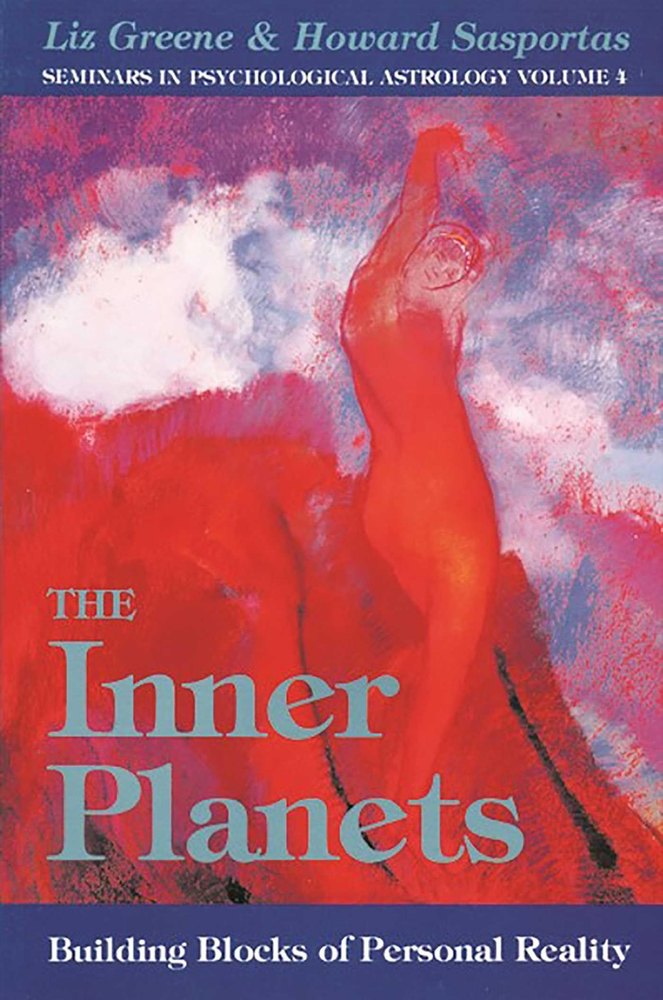
Seminar talks from the Centre for Psychological Astrology in London on the three most everyday planets
First, Knowing What You Like
Many people grow up unable to say what colours they like to wear, what music makes them happy, or which friends they are truly at ease with. Liz Greene and Howard Sasportas write about such people in the introduction to The Inner Planets: Building Blocks of Personal Reality, and the reason, they say, is usually quite ordinary: as children, no one thought these things mattered enough to help them work them out, much less affirmed the choices they made.

Published in 1993, the book is a transcript of seminars the two gave at the Centre for Psychological Astrology in London, and the fourth volume in the Seminars in Psychological Astrology series. The seminars were held around 1990, and the transcripts keep the audience's questions and the two teachers' offhand jokes. The book has five parts. Mercury, Venus and Mars each take one part, each beginning with the myth and then turning to how to read the planet in a chart; the fourth part is a joint discussion of example charts, and the last is an open question-and-answer session. Sasportas died in May 1992, and the book, published after his death, is dedicated to him.
The two argue that the inner planets serve the Sun and Moon. The Sun and Moon speak of a person's essential nature; Mercury, Venus and Mars are the means by which that nature is discovered and expressed. Venus lets a person know what makes them happy, Mercury puts it into words for others, and Mars lets them hold their ground when opposed. Compared with the great themes of Saturn and Pluto, these matters seem trivial, yet the two believe a person's sense of self is built up bit by bit from exactly these small self-affirmations, because someone who cannot say what he thinks will also find it hard to truly hear others.
The introduction gives the example of a woman with Venus in Cancer square Neptune. When young she had one or two disappointing love affairs, and then her marriage and family life were stable for many years. Later, when transiting Uranus came to oppose her natal Venus, her husband betrayed her, her daughter got into trouble, and her mother died. She could, the two say, dig into her own complexes, which is genuinely useful in a crisis, but there is something else just as important. Venus in Cancer is a part of her that cannot be dismantled or negotiated away: she needs emotional closeness, romance and a little fantasy, and these are the conditions of her happiness. The less she acknowledges this, the more she will shortchange herself to please her husband and daughter, and the resentment that builds year after year ends up pushing her family away. The two even suggest that her betrayal of her own Venus may have been a large part of why she was betrayed, and that Uranus simply exposed a situation that should have changed long before but that no one was willing to face. So they write:
Sometimes “inner work” requires an act of loyalty rather than an effort at transformation.
For this woman, being loyal to herself means first owning her Venus in Cancer. The two go on to say that a person with Venus in Cancer who, because partner and friends dislike too much closeness, tries hard to pretend her Venus is in Aquarius may simply have chosen the wrong people. It is more useful to say plainly what kind of person you are and what you value, so that the other person can respond just as directly; only then can there be real adjustment and respect between two people.
Three Undervalued Planets
Among students and practitioners of astrology there has long been a view that Mercury, Venus and Mars carry little weight. They are often dismissed in a sentence or two, Mars as “the aggressive urge” and Venus as “the urge for relationship”, and when it comes to inner growth they seem no match for Saturn and Pluto. At the very start of the introduction the two call this a very curious view of what is important. Their reasoning is that collective, deeper forces, if they are to be handled selectively, must always pass through the lens of “ordinary old you and me”, and whether a person's sense of self can take root depends on whether he knows what, on an ordinary Saturday afternoon, will make him comfortable, happy and at peace with himself.
With each planet the changes land on something specific. Textbooks usually define Venus as the drive toward love and relationship, and Greene says she has never been satisfied with this definition. In her view relationship is the means by which Venus gradually forms individual values, and the choices a person makes in love are really declarations of what he values most. Sasportas likewise says that for many years he mainly taught Venus as the principle of union and relationship, and this time he begins with Venus as a person's value system. Mars was a malefic in medieval astrology, and that reputation has followed it all the way into today's spiritually inclined astrology. Greene's answer is a practical one:
without Mars we are impotent, and then someone else's Mars will beat us to pulp.
Sasportas opens his lecture on Mars by saying he wants to help everyone make friends with the planet, to offset the bad name astrology books have given it. He revises one point about Mercury too. Some books interpret Mercury retrograde at birth as difficulty in communication, and in the charts he has worked with he has not found this to be consistently so. His view is that a retrograde Mercury makes a person look inward more, checking things over before speaking, and chewing over information repeatedly before feeling sure of it.
These changes have their sources. The Centre for Psychological Astrology that the two ran together in London taught astrology alongside depth psychology and humanistic psychology. Greene is a Jungian analyst, and she says in the question session that she brought her analytic training into astrological consultation. Sasportas studied astrology with Isabel Hickey in Boston in the late 1960s and early 1970s, and he borrows Dane Rudhyar's idea of a planet's house as “celestial instructions” on the area in which a person's life unfolds most naturally. So the book is full of Jung's shadow, the stages by which an infant gradually separates from the mother, and Winnicott's “good enough mother”. The previous volume in the series, The Luminaries, dealt with the Sun and Moon; The Inner Planets goes on to the three planets that serve them.
Even Your Shampoo Counts
Discussing Taurus and the second house, Greene says the self-worth Venus gives begins with loving one's own body and shows up in the most ordinary things: what you eat, what kind of bed you sleep in, which shampoo you use, whether you are willing to furnish your home to your own taste. All these, she says, really ask the same thing: does a person feel he deserves to give himself pleasure at the most ordinary level? People whose Venus is obstructed in the chart often feel ugly, worthless and unlovable, and try hard to make up for it with other things, such as overdeveloping the intellect, pursuing success at any cost, or being the nice person everyone likes. Greene's judgment is that the sense of worth Venus gives cannot be replaced by the strengths of other planets, because the Sun can give life meaning, but what use is meaning if a person cannot feel pleasure and fulfilment?
Her discussion of Mars also comes home to the family. Greene says that the parent who crushes a child's Mars early on is more often the one who makes the child feel guilty, not necessarily the fierce one. Such a parent says: “If you go on like this you will hurt me so much. And I have already been so badly hurt by your father/mother. I hoped that you would champion me, and take my side. Now even you are behaving like that terrible brute/bitch, injuring me when I am already so unhappy.” At this point she saw people in the audience laughing and asked whether they recognized the speech. Greene believes it is healthier for a child to have an open row with a parent than to be taught that anger is in itself dirty and immoral, because the guilt the latter leaves behind slowly eats away at a person. A blocked Mars ends up as helplessness and a sense of victimhood, with great anger pressed down underneath, which the person often does not know is there.
Sasportas's tone is homelier. When he was discussing Venus in the fourth house and someone in the audience said they wanted a beautiful home, he said: go and make that home, and you will like yourself more; it can be as simple as that. He says again and again that what a person is condemning and denying cannot be transformed, so the first step is to acknowledge the less respectable parts of oneself. Greene puts it more plainly in the question session: one of the most useful things an astrologer has is the chart's objective confirmation that it is all right to be oneself, and that one need not become someone else to please others, because the chart itself carries no moral judgment.
Three Hours in the Fitting Room
Greene says the most everyday level of Venus is walking into a shop and knowing for yourself which garment or piece of furniture is right for you, however friends or sales staff try to steer you elsewhere. If this judgment was crushed in childhood, it takes time to practise. Her advice is to be prepared to spend three hours trying things on, again and again, until you begin to get used to the feeling of being attractive in your own eyes.
People with Mercury–Saturn aspects often doubt that their minds are good enough, learn slowly, and dare not feel they know something until they have a diploma to prove it. Sasportas reminds them that Saturn is the celestial schoolteacher, the thorn that drives a person to greater achievement, so slowness does not mean poor learning. A member of the audience with Mercury square Saturn said that learning came very slowly, but that once something was learned, it was known thoroughly.
The remedy for Mars lies in the body. Sasportas gives an example: a person with Mars square Pluto buys a new shirt, finds the colour slightly wrong and takes it back to the shop, saying calmly the words he has rehearsed; when the assistant refuses to exchange it, the anger can leap from reasonable annoyance to uncontrollable rage. His approach is first to acknowledge that anger, jealousy and greed are things everyone has, so there is no need to feel monstrous because of them, and not to explode directly but to release it through the muscles: run a few times around the block, go for a swim, clean the house, dig in the garden, or write a letter you never send. Once the anger has subsided, ask why this person or this matter made you so angry, and which childhood experience it is connected to. Anger, Sasportas says, can also lead a person deeper into himself.
Chapter by Chapter
Introduction
The introduction is signed by both authors, London, April 1992. They compare reading a chart to television: you can tune it to different channels. Channel One is the cosmic channel, belonging to the outer planets and also to Jupiter and Saturn; here a person sees myth, meaning and a larger whole. Channel Two is the channel of immediate reality, belonging to the Sun, the Moon and the three inner planets that serve them; here a person becomes aware of being different from others, with a different body, emotional needs, values and abilities. There may well be more pain on Channel Two, the two say; life's unfairness is most evident here, and it is often precisely while trying to live out the inner planets that people feel this unfairness most deeply.
They also say that the inner planets are the most easily crushed by family and society. The essential nature represented by the Sun is hard to suppress, and the outer planets cannot be held back when triggered by transit, but an envious mother can easily crush her daughter's newly emerging Venus, a domineering father can easily crush his son's Mars as it takes shape, and an education that does not value effort and excellence can make the most agile Mercury clumsy and tongue-tied. The introduction ends with building a house: a house is built from the foundations up, and the inner planets are the building blocks of a person's everyday reality.
Part One: Mercury — Tricksters, Thieves, and Magicians: The Many Faces of Mercury in Mythology
Both lectures on Mercury are given by Sasportas. The myth lecture begins with Hermes' first day of life. Newly born, he could not stay in his cradle; he stole the cattle of his brother Apollo, drove them backward so the hoofprints pointed the wrong way, picked out two to roast, divided them into twelve portions and offered them to the Olympian gods, counting his own portion among them. Sasportas pauses on this episode: Mercury can identify with any other planet in the chart, today following Saturn into discipline and thrift, tomorrow following Jupiter into something completely new, or a credit-card spending spree. This is a gift, and can also be trouble, because Mercurial people often leave those around them unsure what to expect. So, he says, Hermes needs a parent who can tell him “You're going too far this time, cool it”, and Mercury works best when it has a code of its own to keep.
Part One: Mercury — Interpreting Mercury: Mercury in the Horoscope
The second lecture returns to the chart. A formula Sasportas has always found useful is that planets are like verbs and signs like adverbs: Mercury governs thinking and speaking, and its sign shows how a person thinks and speaks. On the signs, he describes a class he taught in London, about fifty people divided into twelve groups by Mercury sign, each listing the characteristics of its sign. The Mercury in Aries group finished in ten minutes; the Mercury in Gemini group's list was four times as long as anyone else's; the Mercury in Virgo group argued over details until one woman was in tears. After thirty minutes every other group had handed in its list, while the Mercury in Taurus group's sheet had only a few ideas written down and crossed out; they said they did not want to write anything down that they were not sure was fact. Sasportas's explanation is that people with Mercury in Taurus must feel that something is true in every cell of their bodies before they will say it.
Part Two: Venus — The Great Harlot: The Mythology and Psychology of Venus
The Venus part has three lectures, Greene giving the first and last and Sasportas the one in between. Greene begins by separating Venus from the Moon. The Moon wants to belong to someone, to a home; Venus belongs only to herself, and in no picture does Aphrodite hold a baby. The Moon empathizes, and sometimes trades empathy for a debt, the kind Greene calls the “let-me-iron-your-shirts-make-you-tea-and-comfort-you-and-then-you-will-owe-me” syndrome. Venus seeks relationship in order to see herself reflected in the other's eyes, and so to discover what she values. Greene illustrates this with the Judgement of Paris: Hera promised him wealth and power, Athena strategy and glory in war, Aphrodite promised nothing, and still the golden apple went to her. Greene says:
This tale is not really about love; it is about choice, and the declaration of individual values.
So when discussing Venus, she asks everyone to put one question to themselves: what do I value most? No one can love everyone or value everything, and in seeking partners and friends, people are really seeking those with whom they can share the few things they treasure most.
Part Two: Venus — The Law of Desire: An In-Depth Look at Venus
Sasportas's lecture takes its name from an idea: whatever a person truly values, he will attract. The trouble is that other planets in the chart get in the way. His example is Venus in Libra in the seventh house, longing for a loving relationship, while square Saturn in Cancer in the fourth. On the Saturn side, the person may have been pushed away as a child by a beloved parent, so one part wants love and another part fears it. If instead Venus opposes Uranus in the first house, what stands in the way becomes the fear of losing freedom. From here he moves to the dilemma of closeness and freedom, which he calls the most basic and most common challenge in partnership, one that begins when the infant wants to be close to the mother and also to leave her and look at the world outside. His remedy is simple: first recognize this as a conflict within yourself, then accept that the wish for closeness and the wish for freedom are both legitimate, and finally remember that your partner is not your mother.
Part Two: Venus — The Psychology of Erotic Love: A Discussion of Venus and Sexuality
In the second half of her lecture Greene goes one by one through the aspects between Venus and the other planets. Hard aspects between Venus and Uranus have always had a reputation for being unable to commit, and Greene says that in her experience this does not hold. Such people, she says, need a friend before they need a spouse; what they cannot bear is too much everyday routine, so they need the courage to leave breathing space within marriage, lest the relationship one day go off like a time bomb. On Venus–Mars combinations, she says signs are like clothing: they show only the manner in which a planet expresses itself and do not change its nature. Venus and Mars in Taurus or Libra, however gentle and agreeable they look, are still an iron fist in a velvet glove.
Part Three: Mars — The Warrior and the Womaniser: The Mythology and Psychology of Mars
Greene opens the Mars part. Her definition of Mars is simple: it is the Sun's fighting principle. Sooner or later a person meets challenges to his individuality and values, and from the moment of breaking free of the womb must fight for who he is. Many people find Mars hard to own, because once words are spoken and a position taken, there is no taking them back. She illustrates with love: at the beginning Neptune and Venus preside, two hearts beating as one, and the first quarrel is the first crack in the wall of paradise; even if the two make up quickly, they cannot go back to how things were before.
She also describes a workshop she saw many years ago. The astrologer Alexis Edwards set out a large table of sweets and cakes in the middle of the room and told everyone to help themselves. A person with Mars in Libra asked his neighbour to fetch him one, saying he was too tired to push through the crowd. A person with Mars in Aries was at the table before the instructions were finished, with two biscuits in his pocket. A person with Mars in Cancer strolled slowly around the table as if it made no difference which one he took, and in a moment when the crowd thinned, snatched the one he wanted with lightning speed. Greene says that any situation in which you have to go after something is worth watching to see how you go about it.
Part Three: Mars — The Henchman of the Sun: Mars in the Horoscope
Sasportas follows with Mars in the chart. He believes people are born with a capacity for striving, and, borrowing Clara Thompson's words, says it turns ugly only when it is suppressed. Healthy striving can fend off aggression, push a person to learn new skills, and help one break free of domination or overprotection to grow into the person one is meant to be. He tells the story of the snake and the guru. A snake heard a spiritual teacher teach the principle of doing no harm and resolved never to hurt anyone again; two months later, bullied half to death, it went to the teacher to ask for its money back. The teacher replied, “I didn't tell you not to hiss!” On oppositions to Mars, he says such people often come into conflict with others and need not be too upset about it, because it is precisely in contests that a person comes to know more clearly who he is and where he stands:
Lions are meant to roar, not buzz.
At the end of her own Mars lecture Greene also says that she and Sasportas, in this seminar, are in a sense on the side of the inner planets. Mars, like the others, needs inner support, so that a person can hold on to what he values in the face of opposition and go after what he wants.
Part Four: Chart Interpretation — Venus and Mars in Chart Interpretation: A Discussion with Examples; Part Five: Conclusion — Group Discussion: Questions and Answers
In Part Four the two appear together, using real example charts to discuss how Venus and Mars pull on each other between two people's charts. Part Five is an open question session, its topics far more scattered, ranging from the eastern and western hemispheres and house systems to the Ascendant and the practice of consultation. Asked whether people with all their planets in the eastern hemisphere are self-centred, Greene says one should be careful with that word. Sasportas quotes a saying that the east allows you a choice of menu, while the west gives a set menu, and Greene adds that if you don't like the coq au vin, you can still send it back to the kitchen and have it made the way you like. Neither of them wants to fix the rules rigidly.
Asked about the elements, Greene says each element has its own defence when threatened. Fire inflates itself; earth starts nailing everything down, making lists and buying insurance; water wants to merge with others; air retreats into the head, keeping people at a distance with excessive rationality. She then adds that a defence can also become a gift, because it grows out of a very deep need.
How to Read This Book
The book's whole argument is in the jointly signed introduction, only a few pages long. Read it first, then pick the planet you most want to understand. If you want to know how you think and speak, read Sasportas's two lectures on Mercury, which are conversational and full of examples. If you want to work out what you value and what you want in relationships, read Greene on the Venus myth and Sasportas's “The Law of Desire”. Those who often feel they failed to stand up for themselves, or that once they start they cannot stop, can turn straight to the two lectures on Mars.
The book is a seminar transcript, and its strengths and difficulties both come from that. The strength is a lively voice, and the audience's questions are often the very ones a reader would ask. The difficulty is the digressions: a topic can wander a long way, and the book cites many psychologists and mythic figures, which readers unfamiliar with psychoanalysis will find heavy going. The talks were given in London around 1990, and the examples are mostly British television programmes, queuing etiquette and celebrities of the day; across more than thirty years, some have become unfamiliar. The Venus lectures spend a good deal of space on the very private side of intimate relationships, in psychoanalytic language that not everyone will find comfortable.
In discussing Venus, Greene asks people what they value most, and Sasportas asks them to recognize the tug between wanting closeness and wanting freedom. Your Mercury, Venus and Mars in Depth puts these two questions to your own chart, looking at the sign and house of your Venus, what you value and what you like, and then setting Venus beside the Moon to see what this tug looks like in you. Mercury and Mars are each read in the two authors' way as well. The Mercury section looks at how far it is from the Sun, and if your Mercury was retrograde at birth, or will turn direction by progression in some years' time, it discusses the period around that year. The Mars section looks at how you go after things. If any outer planet forms a conjunction, square or opposition to these three planets over the next five years, the periods are listed, with the dates calculated precisely by software.
It reads only Mercury, Venus and Mars, the building blocks the introduction speaks of; the Sun, the Moon and the rest of the chart have to be read separately. When you have finished, you might think back to Greene's table of sweets. In your place, would you ask your neighbour to fetch one for you, or would you already be standing at the table before the instructions were finished?
 Your Mercury, Venus and Mars in DepthSee report · $19