Planets in Youth
Robert Hand
Read a child's chart as the chart of an adult in the making.
Why Hand Wrote the Book
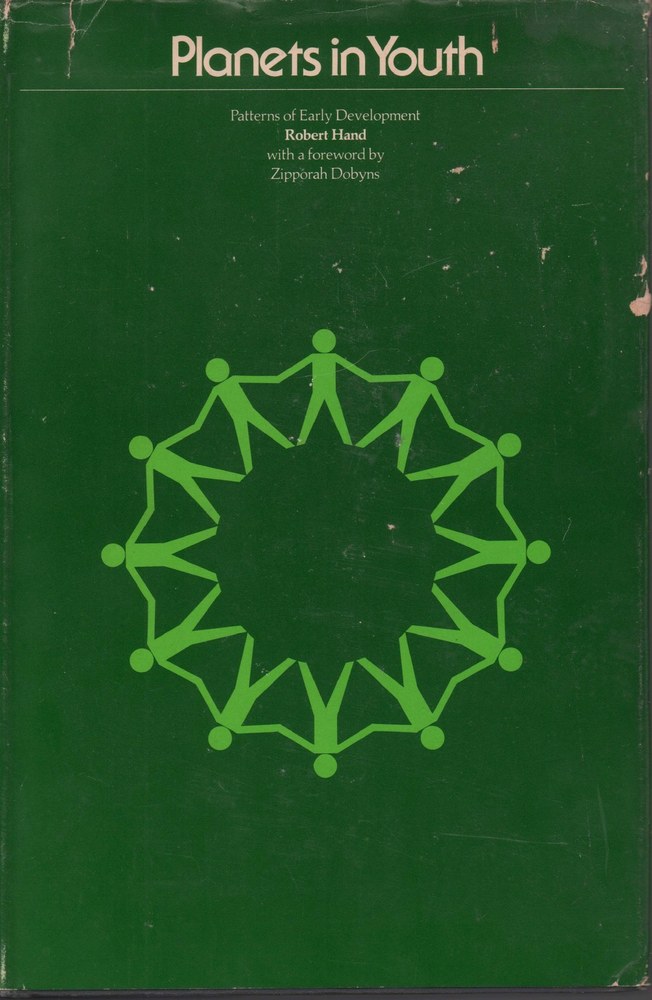
Robert Hand's Planets in Youth: Patterns of Early Development is entirely about how to read a child's birth chart. It was published in 1977 by Para Research in the United States, with a one-line dedication at the front to his daughter, Justine.
Hand explains why he wrote it. The astrology books of the time were written for adults whose characters were already set, and they dealt in events and actions. An author had to assume the person had handled what the chart shows in the ordinary way, so what got written down was the single most likely outcome. Readers often felt they had been handed a verdict from the heavens, and on difficult aspects some authors took a particularly gloomy tone. That is already a problem for adults, and it is much worse for a child, because a child's character hasn't formed yet. If the parents handle the child a different way, a difficult placement may turn in a better direction, or at least its bad side can be kept to a minimum.
So from start to finish the book is about what might happen, not what must. The first four chapters deal with method: where the parents stand in a child's chart, how certain planets work in pairs, how to score the elements and crosses, and a full reading of three children's charts. The next eleven chapters go from the Sun to Pluto and end with the rising sign. Each planet in each sign and each house, and each aspect it makes to another planet, gets an entry of about three hundred words, and every entry addresses the child as "you." The readers are mainly adults, who can use the book to understand their own children, or to look back at their own childhood.
Take the Sun conjunct Saturn. Hand writes that such a child is serious, can't enjoy the games other children love, always seems older than their age, and is very hard on themselves. The early years are the hardest, but by middle age the person grows more and more at ease, and then discipline and endurance turn into strengths: they hold on when others give way. In his words:
there is no such thing as an intrinsically bad horoscope; there are only poorly handled ones.
He goes on to say that most truly difficult placements show their bad side only when certain events or a certain relationship in childhood make them worse. Without that, the negative qualities can be kept to a minimum and may even turn into something good. The years from one to four have the greatest effect on a whole life, and the relationship with the parents matters most.
The Book's Contents
- Parent and Child
- Planetary Energies
- Elements and Crosses
- Case Studies
- Sun
- Moon
- Mercury
- Venus
Where He Parts From the Old Books
By "traditional astrology" Hand means the kind found in nineteenth-century books, which only handed down verdicts: this person will be such and such, this venture will or won't succeed. He doesn't deny that some people do this well, but he says plainly that it is not the aim of his book, and that the book is no astrological "cookbook" to be followed like a recipe either. Every delineation leaves the reader several choices. He also objects to the moralizing tone in astrology. To him the real use of astrology is to help people know themselves and accept themselves, and forcing yourself to live up to an ideal picture of who you should be can spoil even the business of being yourself. So when he comes to an unattractive placement, he tries to write about it objectively, as "something that may happen," and adds to each one how it can be corrected.
He draws on what was common knowledge in psychology. He quotes the child psychologist Haim Ginott: when a child does something wrong, the parent should make it clear that the act is wrong, not the child. He also mentions the idea from transactional analysis that everyone carries a child inside. These, he says, had long been commonplaces in psychology, yet most astrological authors ignored them.
Zipporah Dobyns, who wrote the foreword, places Hand among a new generation of astrologers who care more about where behavior comes from than about predicting exactly what a person will do. Helping someone understand why they act as they do, and pointing them toward other ways of expressing it, is in her view a different kind of success. She also says that, with her scientific training, she would have liked fewer flat statements of "you are, you do, you feel" and more room left open, but she grants that the book understands the complexity of people better than most astrology books.
He also states one of his own rules. When a sign and a planet say different things, the planet comes first, because astrologers agree almost entirely on what the planets mean and where they are, but still disagree about where the signs are. For psychological readings he himself uses the tropical zodiac.
How Children Differ From Adults
Some say children are born good, others that they are born little beasts, and Hand believes neither. What he saw as a father and a teacher is that children have exactly the same needs and drives as adults, and fight just as hard when threatened. The only difference is that a child understands less about the real world and can't always arrange it the way they want, so children often overreact to something an adult knows is no big deal. That is the real difference between children and adults:
Children are adults in the process of becoming.
A child has no job, but has school. A child has no boss, but has teachers and parents, and what the child learns in dealing with them carries straight into how the grown adult deals with bosses and every kind of authority. So what a child seems like when small doesn't matter all that much, Hand says. However accurately an astrologer describes a child's present character, it is only a curiosity of little use. What matters is seeing what kind of adult this child may grow into.
Writing about Saturn in the 4th house, he says such a child needs the parents' warmth more than most, yet often feels it never came. But then he writes:
your parents may be warm and loving people, but that for some reason you are just not tuned into receiving their affection
And if the parents really can't give that support, he says, look outside the family for a teacher or an older friend to make up for it.
Advice for Parents
A child with a lot of fire seldom cries and won't admit to weakness, and says nothing even when they badly need their mother. By the time they do say it, things may be hard to put right. Hand's advice is that you don't have to explain why on the spot every time. Wait until you have both cooled down and then talk, but do talk, because a child who feels that adults use power on a whim, without rules, will grow up to use power the same way.
A child with a lot of fixed signs resists in a particular way. They don't argue back. They just don't move, or they go away for a while, hoping you'll forget what you asked. These children have long memories, and Hand says you have to be as persistent as they are for anything to get through. Earth children often feel dull and overlooked, even when that isn't true, Capricorn and Virgo especially. They take the world very seriously and feel they have to work themselves hard to get anything done or to be noticed.
Children with the Moon in tense aspect to Saturn are often handed adult responsibilities very early and never really allowed to be children. It is the same for a child with a weak Moon and a strong Saturn, who cares a great deal about being right and takes every criticism as a crushing defeat. Hand says a child like this must know they are loved for who they are, not for being "good." Otherwise they will be truly afraid that doing something the adults dislike means losing all of their love and care.
Chapter by Chapter
Before the main text comes a foreword by Zipporah Dobyns. Of the fifteen chapters, the first four cover method and cases and the other eleven are entry-by-entry delineations. Below, one thing is picked out from each chapter.
Chapter 1: Parent and Child
This chapter says a child's chart doesn't show who the parents objectively are. It shows the child's relationship with them and the parents as the child sees them, which is why the charts of brothers and sisters can describe the same pair of parents very differently. One way people grow up, Hand says, is by discovering that the picture of the parents they carry inside is not a true likeness, and freeing themselves from it. He divides the work of parenting into two functions. One takes the child in unconditionally at the very start, so the child feels worth loving just as they are. The other leads the child out into the world and teaches discernment, rules and self-discipline. He calls the first the mother function and the second the father function, but he says either parent can take on either role, both parents carry some of each, and sometimes the roles are switched entirely. In the second half of the chapter he discusses two complexes, and describes the person with a strong father complex who looks at an untamed river and, instead of the beauty of nature, sees only a potential source of electric power.
Chapter 2: Planetary Energies
In this chapter Hand says some planets work in pairs or groups even when they make no aspect in the chart. He covers the Sun and Moon, the Moon and Saturn, Mars and Venus, Jupiter and Saturn, and the group of the Midheaven, Sun, Mars and Saturn that together make up the "ego." Under Mars and Venus he describes one kind of child. A child with a strong Mars and a weak Venus keeps provoking and testing, and looks as if they are asking for trouble, but really only wants to find out where their strength ends. Hand says trying to avoid trouble by holding such a child in check doesn't work. Give them an outlet such as sports or physical work, and accept that the child will get a few bumps and bruises now and then. The chapter also notes that in recent tests astrologers could not tell gifted children from children of below-average intelligence, so he says plainly that astrology, as it stands, cannot tell whether a child is bright.
Chapter 3: Elements and Crosses
This chapter gives a way to score the chart. The signs of the Sun, Moon, Midheaven and Ascendant each give their element two points and every other planet one, with extra points for planets near the four angles and planets in aspect to the Sun. Nine points or more in one element counts as typically strong, two or fewer as typically weak. Hand himself says this is only a rough guide for beginners, and that an experienced astrologer forms an overall impression from the whole chart. The passage on water is written for parents. Water children feel the moods of the people around them and don't need harsh scolding, and comforting them afterward matters more than the reprimand. They would rather hurt than feel nothing at all, and the impressions of childhood never fade, so give them as secure a childhood as you can.
Chapter 4: Case Studies
This chapter works through three real charts, reading each from start to finish with the methods of the earlier chapters. Hand's conclusion is that the problem lies in the meeting of child and environment, in neither one alone.
With the third chart, Hand shows how to look up the first aspects that become exact after birth, on the grounds that the earlier an influence comes, the more it matters in a child. At the end of the reading he describes two ways the child might turn out. Then he says:
These two manifestations are equally probable. Environment will make the difference.
Chapter 5: Sun, Chapter 6: Moon
From here on the book goes entry by entry, taking each planet through the twelve signs, the twelve houses and its aspects. The Sun chapter opens by saying that the Sun's difficult aspects often point to major psychological issues, but people often achieve great things in the course of dealing with those difficulties, so they should be seen as areas that need work, and the work can succeed. The Moon chapter says the Moon sign is the most important sign after the Sun and the Ascendant, and that some signs are easier for the Moon, but none is truly bad. A child with the Moon in the 4th house is deeply attached to home. When secure, this child comforts discouraged friends and looks after younger children like a little adult, and when insecure, retreats into a small private world.
Chapter 7: Mercury
Back in chapter 2 Hand pointed out that ancient astrology made Mercury the ruler of youth. Talking, going to school, getting around and learning to think matter more in childhood than at any other time of life. Many entries in this chapter tie the growth of the child's mind to whether the home gives it stimulation, and the Mercury in Gemini entry says outright, "No one wants to learn unless encouraged early in life." A child with Mercury in the 3rd house doesn't like sitting in a classroom, and even a short trip like riding the bus to school can make the whole day better.
Chapter 8: Venus
Venus rules liking people and making friends, and creativity as well. This chapter says artistic creativity is more likely to come from Venus's difficult aspects, because they carry force and have to be expressed. But Hand adds at once that any talent needs several indications in the chart, and one Venus aspect alone can't settle it.
Chapter 9: Mars
Mars is the force that says "I want to be myself." Hand says it matters that Mars develops well, because that means a person can be themselves and still get along with others. A child with a difficult Mars may be aggressive, pushing others down to seem strong while feeling weak inside, or may go the other way and shrink back from being seen. The Mars in Aries entry says the bumps and scrapes come from the child's own carelessness, and that taking the time to be careful heads off most trouble.
Chapter 10: Jupiter, Chapter 11: Saturn
Both chapters begin by explaining that the signs of Jupiter and Saturn are mostly shared by children born in the same year, and count as personal only when the planet is near the Ascendant or Midheaven or in strong aspect to the Sun, Moon or inner planets. The Saturn in Taurus entry describes a child who won't share because they fear there won't be enough to go round, so they hold on tight to their own share. Hand wants parents to let the child feel that support won't be taken away, and not to let the child feel they must struggle to get what they need. Of course the child has to make an effort, but effort driven by fear only makes things harder.
Chapters 12–14: Uranus, Neptune, Pluto
The outer planets move so slowly that, Hand says, they seem to color whole generations and are hard to recognize in one person. So these three chapters go into detail on the houses and on aspects to the Ascendant and Midheaven, cover the signs only briefly by period, and where he is unsure he says it is speculation. The house Uranus falls in is where a person most needs freedom and is most likely to meet the unexpected. If one area of life keeps being thrown into disorder, he suggests thinking about your own need for freedom there. Pluto is about how a person meets the changes that growing up demands, and how they use the power that comes into their hands. The second, he says, is not yet a big matter in childhood but grows more important with age.
Chapter 15: Rising Sign
The last chapter is on the Ascendant. Hand says it matters as much as the Sun sign and is often what others see first, and no Ascendant is better or worse than another. When the Ascendant and the Sun sign are very different in temperament, a child may feel like two people, and Hand says this is usually not dishonesty: different parts of the self really are in conflict. The chapter opens with a principle as well. A pattern that keeps recurring with other people, however unrelated to you it seems, is a part of yourself you haven't noticed. The book's last sentence goes to the child with Pisces rising, urging them not to envy more forceful people, because the world also needs the quieter people who try to make it a little better.
How to Read This Book
Start with chapter 1, then read the three cases in chapter 4 to see Hand apply the method to a real chart, and then look up the entries for your child's Sun, Moon and Ascendant. The entries address the child as "you," so parents have to translate as they read, turning "it is difficult for you to like someone only a little bit" into "my child may be like this," and then reading the advice for adults that follows.
The book was written in 1977, and some of what it says about boys and girls and about roles in the family carries the outlook of that time. The signs of the outer planets are written by period and cover only the generations of the time. Hand says Neptune in Aquarius and Pisces is beyond the scope of the book, and the Pluto signs stop at Sagittarius, with nothing for Capricorn or Aquarius, so most of today's children won't find these entries. The entries are written one at a time, and several of them can contradict one another in the same chart. Dobyns warns of this in the foreword:
Neither a book nor a computer can put the fragments together; only a human mind can integrate the ambivalences.
Dobyns goes on to say that recognizing the contradictions is the first step to resolving them, and she hopes the book helps parents take that step. Your Child's Nature and Growth in Depth goes through the same step with parents. A parent buys this report for a child and enters the child's exact date, time and place of birth when ordering. It reads the child's chart and is written for the parent. If the child has already turned eighteen, the whole report is written to them instead, as a look back at their own childhood. It begins with the book's scoring method to see how the four elements and three crosses are weighted in your child's chart, then reads the Sun, Moon and Ascendant for the adult your child is growing toward, how they settle their feelings and how they deal with the world outside.
Following chapter 1, it also reads the Midheaven and the IC for how the two parents appear in your child's mind, as the parent who leads the child out into the world and the parent who gives security and care. It speaks only of tendencies, puts no labels on the child and doesn't blame the parents. Following what Hand did in chapter 4, it looks up the first aspects to become exact after birth, each worked out precisely and dated to the month. For the other planets it reads whatever is actually in your child's chart, sets out plainly where the entries don't fit together, and ends with a few things parents can do. Every judgment in it comes from the book's entries. It covers childhood and growing up, and doesn't replace a full natal reading.
 Your Child's Nature and Growth in DepthSee report · $19
From the chart to a written reading
The reports below are written readings, sent as a PDF by email.